


Red-eyed Vireo
Vireo olivaceus
(p.248)
All new records
| 2018 |
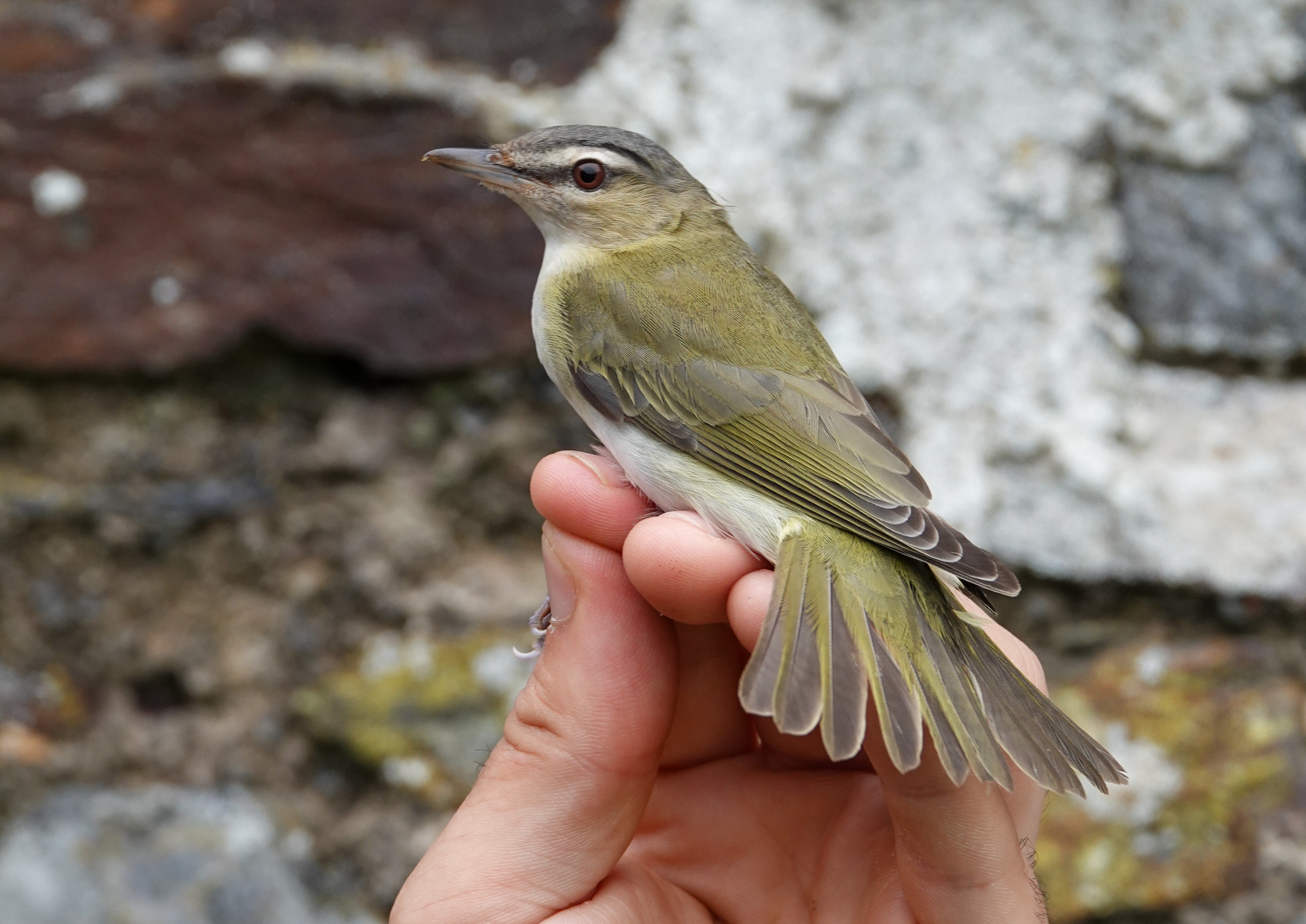
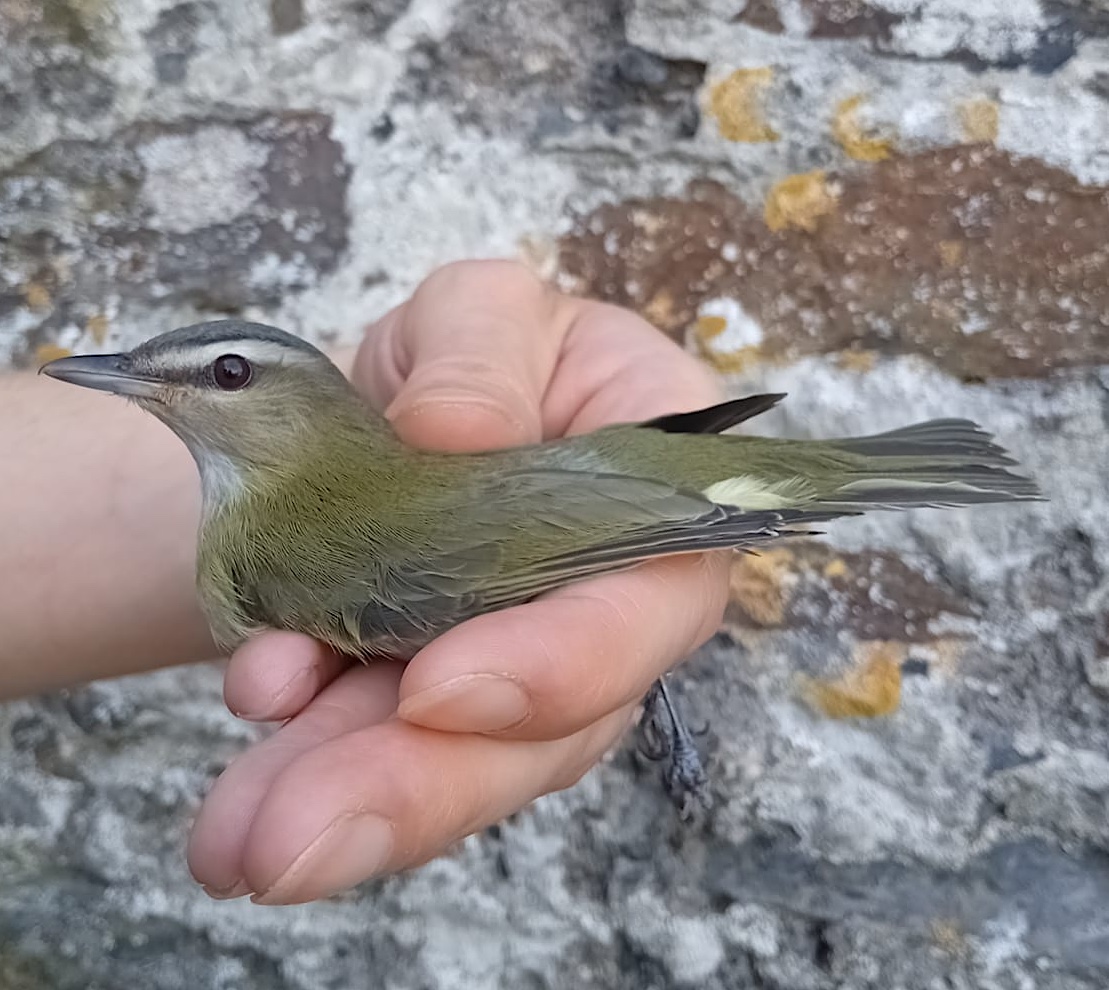
New record 19 to 22 Oct – One showed well in Millcombe on 19th (Dean Jones et al.). What is presumed to be the same bird, but conceivably a second individual given the number of Nearctic landbirds appearing in Britain and Ireland during the second half of Oct 2018, was seen briefly near Brambles on 22nd (Andy Jayne). Record accepted by BBRC. This is the 8th Lundy record; the last was in Sep 2005.
|
| 2019 |
New record 13 Oct – A first-year bird, initially seen in flight, settled on an exposed branch of an ash tree on the northern edge of Quarter Wall Copse for a couple minutes at about 13:30 hrs. This afforded excellent telescope views from a range of 20 metres before the bird dropped back and out of sight. It was relocated at about 15:00 hrs feeding in the canopy towards the south-east corner of the copse, loosely accompanied by a group of Goldcrests and Firecrests, and was last seen about 30 minutes later (Tim Davis, James Diamond, Martin Elcoate, Andy Jayne, Tim Jones). The 9th Lundy record, and the second consecutive year after one in Millcombe in Oct 2018. Record accepted by BBRC. |
| 2021 |
New record 16 Oct – One was found by Jac Turner-Moss at about 08:30 hrs just above the walled gardens of Millcombe, where he was ringing alongside Rob Duncan. Just moments later, but before other nearby birders arrived, the bird dropped out of sight. Happily, after a few slightly anxious minutes' wait, it was relocated in 'Smelly Gully' (lower Millcombe) by Tim Davis. It was then seen well by most observers, at times prominently perched in full sun, before again disappearing for a short time. It reappeared near Millcombe House before taking several long flights around the valley at around 10:15 hrs, moving between the tree nursery adjoining the ‘Secret Garden’, the tops of Turkey oaks west of Brambles, and the Battlements sycamores. Record accepted by BBRC; Lundy’s tenth Red-eyed Vireo, and the third during the last four years. |
| 2023 |
New records 20 to 26 Sep – One was trapped and ringed in Millcombe at approximately 15:20 hrs (Luke Marriner, Tony Taylor et al.). It was retrapped in Millcombe during the morning of 22nd when it was found to have put on 0.1g in weight (Luke Marriner et al.) and later photographed – complete with ring – in Smelly Gully (lower Millcombe) at about 10:45 hrs on 26 Sep (Angus Croudace). This is the 11th Lundy record, the earliest by some eight days and the seventh to be ringed on the island. 22 Sep – Approximately two hours after the bird ringed on 20 Sep was retrapped, a second, unringed, individual was seen along the path from the pines to the Ugly on the north side of Millcombe at about 11:30 hrs (Chris Baillie). The 12th Lundy record. 23 & 25 Sep – Single birds were seen in Millcombe and though observers were unable to confirm the presence or absence of a ring on either date, it is assumed – there being no evidence to the contrary – that these sightings involved either or both individuals confirmed as being present on 22nd. 9 Oct – An unringed bird, first seen in trees near the Casbah (south side of Millcombe) at about 09:45 hrs, was trapped and ringed later that morning (Luke Marriner, Joe Parker et al.). The 13th Lundy record and the eighth to be ringed. Records accepted by BBRC.
|
| 2026 |
New record – subject to acceptance by BBRC 26 Sep – One was trapped (in the Slope net, below the Ugly) and ringed in Millcombe during the afternoon (Nik Ward et al.). The 14th island record and ninth ringed.
|

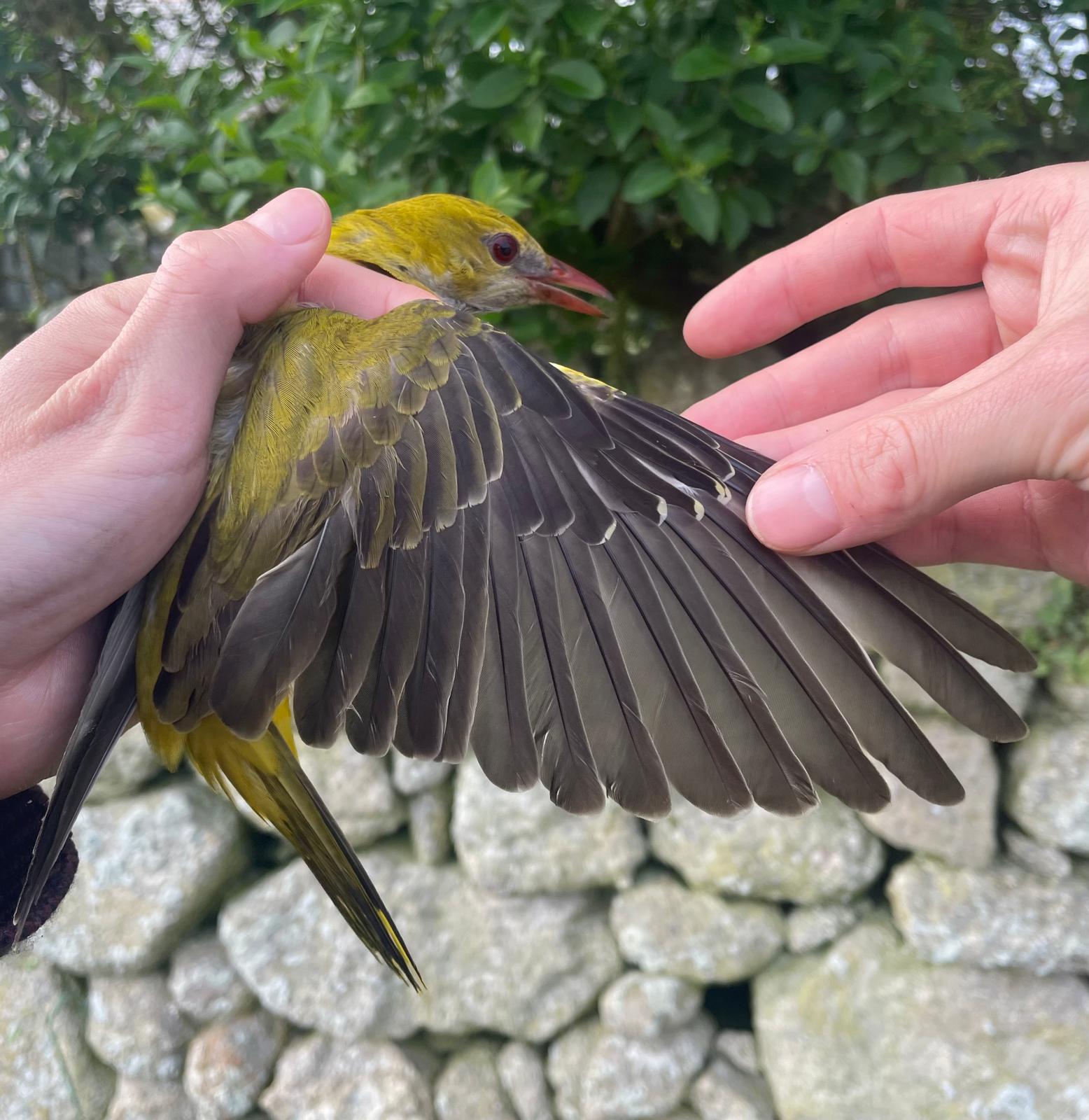
Golden Oriole
Oriolus oriolus
[Eurasian Golden Oriole] (pp.229–230)
All new records
| Earliest and latest dates in spring since 2006 (last year covered in full by The Birds of Lundy) – Earliest: 10 Apr (2011) Latest: 21 Jun (2019) | |
| 2008 |
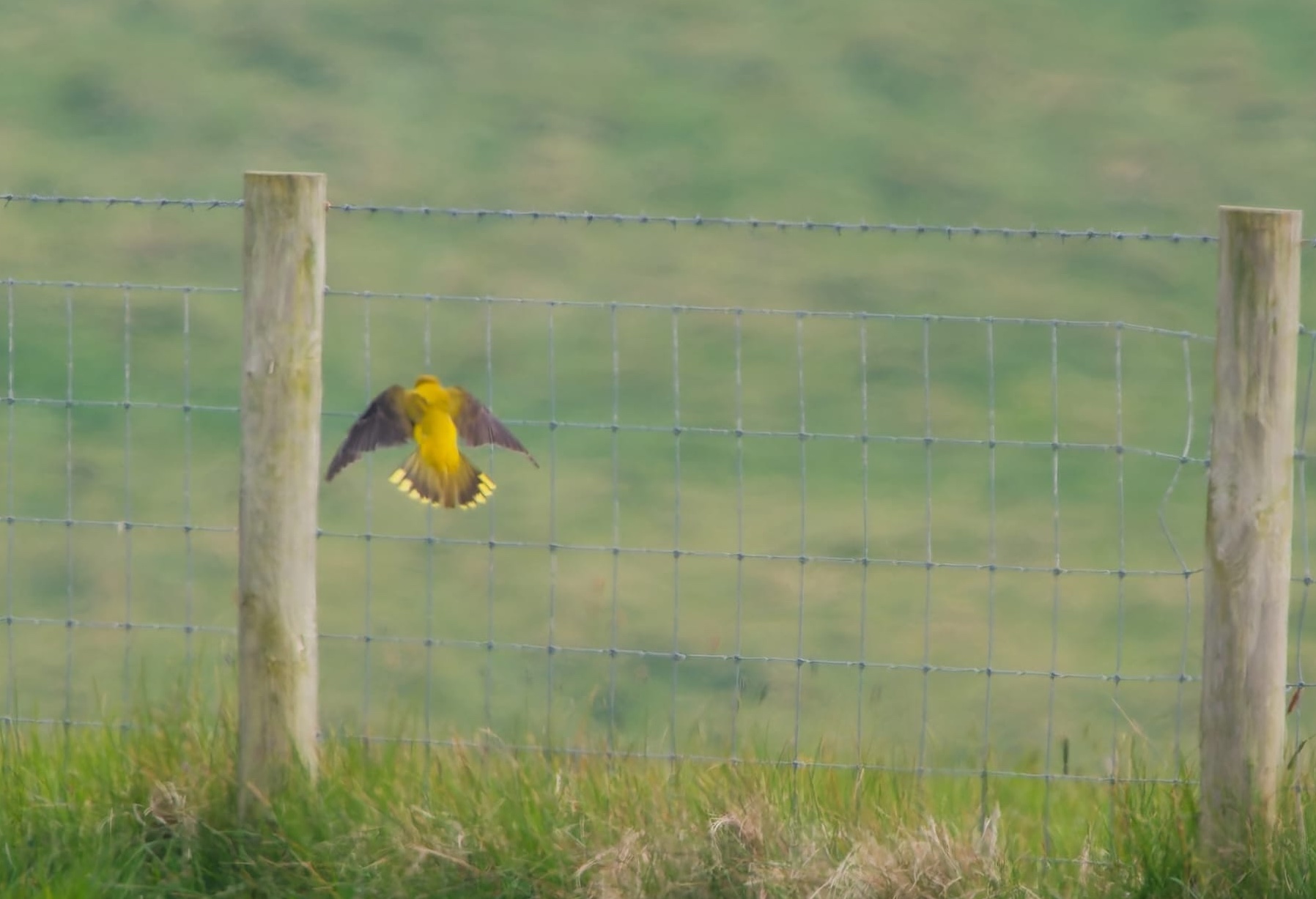
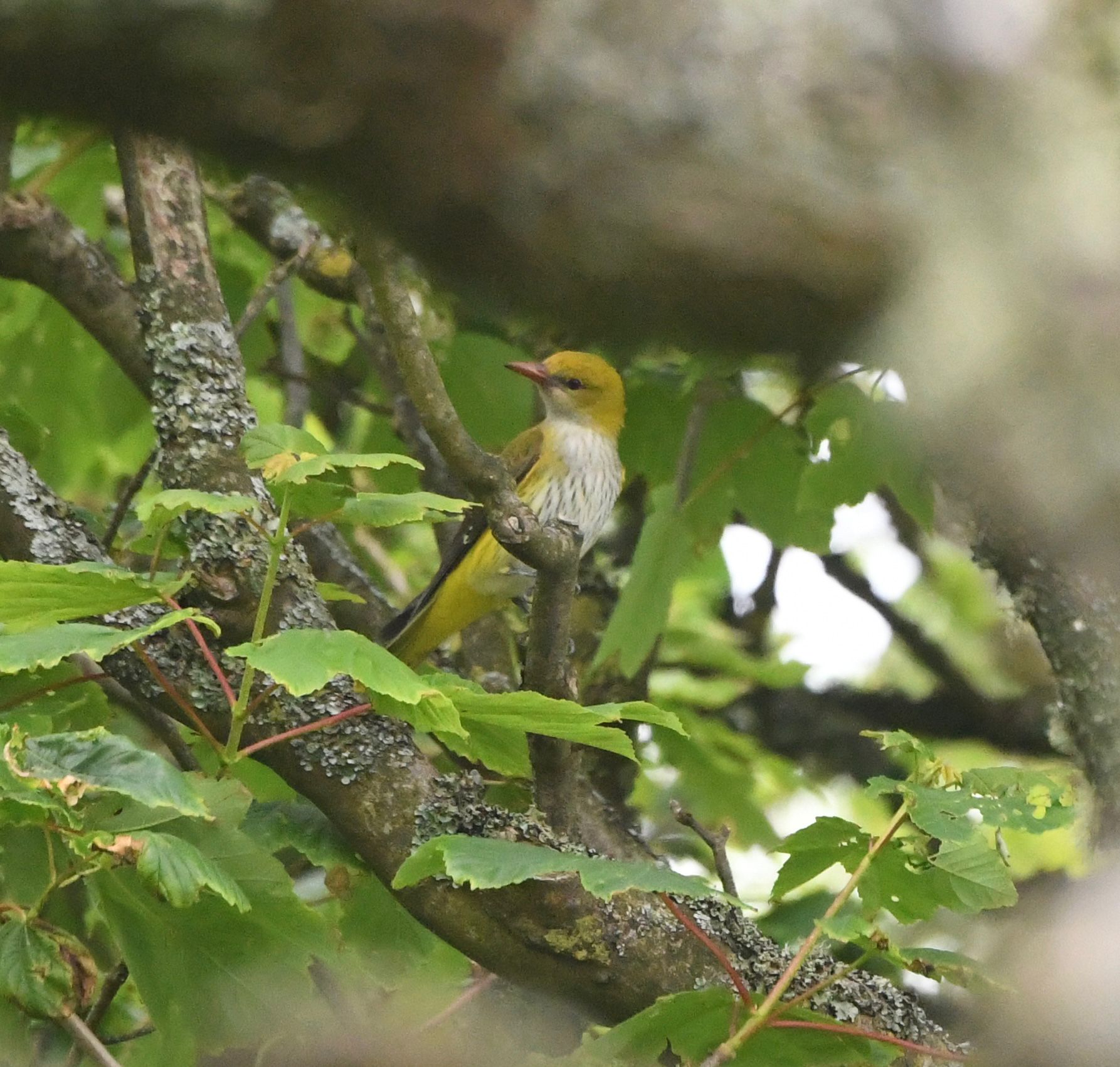
New records 28 Apr to 5 May – One in Millcombe on the evening of 28 April (S. Wheatley) and caught and ringed the following day (C. McShane et al.) was found to be an immature male in a rather emaciated state. It was retrapped on 2 May and (presumably the same bird) was still present on 5 May, when seen in the field (J. Horton & P. Simpson). Between initial capture and retrapping, the bird's weight increased from a poor 54g to a rather healthier 64g. A photograph of the bird in the hand is included in the 2008 LFS logbook. Record accepted by DBRC. 22 May – An immature male was seen in Millcombe (M. Shakespeare). Record accepted by DBRC. |
| 2011 |
New records 10 to 16 Apr – A male was in Millcombe (I. Campbell, E. Dowding et al.). 7 to 10 May – A female or immature in Millcombe (S. Barnes, E. Davis, J.W. Leonard et al.) Records accepted by DBRC. |
| 2012 |
New records 3 to 30 May – In spite of (or perhaps because of) the atrocious spring weather, 2012 was an exceptionally good year for this species on Lundy, with several different individuals – probably five or more – occurring in May. A male first seen and photographed in Millcombe on 3rd (D. Fox, L. Jones et al.) was trapped and ringed there on 4th (S. Petrek) and was still present on 5th. A female was reported about 500 m north of South West Point on 4th. Two birds, a male and a duller female/immature male, were in Millcombe on 6th (J. Leonard, D. Powell). A male was still in Millcombe on 7th & 8th (I. Searle) and what may have been the same bird was seen a few hours later on a wall by the forge; it flew off south when disturbed (I. Searle). Early on 9th, two birds (male and female/immature male) were seen and photographed outside Government House (G. Cooper). A comparison of the available images suggests that the males photographed on 3/4 and 9 May were two different individuals, with the first a much brighter, more strongly marked bird. What seem likely to have been the same two birds as seen on 9th continued to be recorded in the Millcombe area until 12 May, on which date the same or another male was “between Old Light and pond” (M. Vacker). A first-summer male was in St John’s Valley, Millcombe and St Helen’s Copse on 20th (R. Andrews & G. Saul, M. Jones et al.) and a female or immature male was in Millcombe on 29 May (R. Skeates) and in Quarter Wall Copse on 30 May (T. Davis & T. Jones). Records accepted by DBRC.
|
| 2013 |
New record 23 Apr – A male was in the St John’s Valley and Millcombe area (David Clifton, Rob Skeates et al.). Record accepted by DBRC. What were possibly the remains of a Golden Oriole were found on the Lower East Side Path, between Millcombe and St Helen’s Combe, on 8 May. |
| 2014 |
New records 24 & 25 May – One was in and around Millcombe on 24 & 25 May (Ian Hartley, Paul Holt, Richard Taylor). Record accepted by DBRC. What seems likely to have the same bird was reported on 18 & 21–23 May but no supporting information was received by either the Lundy or Devon Bird Recorders. Record accepted by DBRC. |
| 2015 |
New record 10 & 13 May – What seems likely to have been the same female or immature male was in the St Helen’s Copse area on 10th (Brian Thompson et al., Devon Birds day trip) and in Millcombe on 13th (Chris Baillie/A Rocha group). Record accepted by DBRC. |
| 2016 |
New records 12 May – One in Millcombe (Tim Smith). 12 & 15 Jun – One in Lower Millcombe (Alan & Sandra Rowland) on 12th, whilst a sound recording was made of a calling bird in Quarter Wall Copse on 15th (Malcolm Gibbs). Records accepted by DBRC. |
| 2018 |
New records – including exceptional autumn occurrence 31 May – A male in Millcombe was singing first thing and last seen flying high across the valley to the north at around 10.30 hrs (Tony Taylor et al.). 4 & 5 Sep – A female or immature was in Millcombe (Rebecca & Rich Taylor, Tony Taylor et al.). Only the second autumn record for Lundy, the first dating back as far as 11 Oct 1967! Records accepted by DBRC. |
| 2019 |
New record 21 Jun – A male in full song in upper Millcombe was periodically seen in flight, as it crossed from one side of the valley to the other (Dean Jones & Zoë Barton). Dean related the encounter in the LFS logbook: “I heard a brief call which sounded good for Golden Oriole. I made my way slowly and quietly to where the call had come from and the bird then burst into full song from the top of an old oak tree at the top of Millcombe. It sang here for about 20 minutes allowing me to get some recordings on my phone, but then stopped singing and began moving through the canopy where I was able to see the bird periodically through the foliage.” Record accepted by DBRC. |
| 2020 |
New records 8 & 9 May – A singing male in Millcombe (Dean Jones et al.) Reporting the sighting on the Lundy Birds blog, Dean wrote on 8th: "The unquestionable highlight of the day came in the form of a male Golden Oriole which was singing and calling in Millcombe just above the Casbah first thing. Although the bird was being very vocal, I didn’t manage to actually see it until later in the day due to the now lush-green canopies in Millcombe providing perfect camouflage. Luckily though, come the afternoon, Tom was driving down the Valley in his ATV, after his umpteenth lamb check of the day, and flushed the bird, allowing brief but spectacular views in flight. Thanks Tom!" On 9th Dean noted that: "Highlights included the male Golden Oriole for his second day (much showier today but I still didn’t manage a photo)." 20 May – A female or 2nd calendar-year male in Millcombe (Dean Jones): "Observations were again limited to brief fly-bys as the bird moved from both sides of the valley". 18 Jun – A sub-adult male in Millcombe (Dean Jones): "A rather miserable and wet morning’s census was brightened enormously by the occurrence of a sub-adult male Golden Oriole singing from a fog-clagged Millcombe first thing. Luckily the mist lifted just enough for a decent but brief view of the bird on top of the Secret Garden Sycamore before it shot off down the valley and out of sight." Records accepted by DBRC. |
| 2021 |
New records 11 to 15 May – An elusive sub-adult male was calling and singing in Millcombe in the early morning of 11th. As more observers arrived and were able to watch and listen in different parts of the valley, in became clear that two birds were in fact present – the relatively greenish sub-adult seen earlier and a much brighter-yellow, more adult individual. Both birds remained in the vicinity of Millcombe and St Helen’s Copse until 14th, with the brighter bird also seen on the morning of 15th (Dean Jones et al.). This is the fourth consecutive year that Golden Oriole has occurred on Lundy, with at least 16 individuals occurring in the past decade alone. Records accepted by DBRC. |
| 2022 |
New record 24 to 27 May – An elusive female-type bird was present in Millcombe (Paul Holt, Jamie Dunning, Stuart Cossey). Record accepted by DBRC. |
| 2024 |
New records 13 to 20 Apr – An adult male was first seen in Millcombe on the morning of 13th (Tony Taylor), coinciding with a notable early influx of Golden Orioles to South West England, as well as the arrival of two Night Herons on Lundy. It was seen intermittenly – at times showing extraordinarily well – over the next week, though could be typically elusive for long periods, frustrating the efforts of many searching for it. Sightings were nearly all in Millcombe, though also occasionally in St Helen's Combe. It was last seen in Millcombe on 20th. Although completely silent during almost all of its prolonged stay – perhaps surprisingly for an adult male – it was heard sub-singing very briefly once or twice. During the evening of 19th it was watched for about 15 minutes as it hunted for large caterpillars in the blackthorn scrub between the Ugly and the top of the walled gardens in Millcombe, perching shrike-like to scan for prey, then pouncing once located and taking its prize back to the cover of a nearby sycamore tree to knock off coarse hairs before consumption. This sequence was repeated at least three or four times. Subject to formal acceptance, the 12th record of the last decade, eleven of which have been in spring. It was also the second earliest Golden Oriole ever recorded on Lundy (the earliest being one on 10 Apr 2011 – see above). 11 to 19 May – Following reports of a male and a female in Millcombe on 11th, and a female-type seen on 12th, there were daily records in the Millcombe area from 14th to 19th, with up to three individuals present – a male (singing at times) and two female-type birds (multiple observers). One of the latter was trapped and ringed in Millcombe on the morning of 18th and last seen on 19th(multiple observers). Records accepted by DBRC.
|
| 2025 |
New record – subject to acceptance by DBRC 29 Apr – A female was seen in Millcombe, initially near the Casbah at 08:41 hrs (Flo Turner) and about half-an-hour later flying up the valley and landing in Millcombe Pines (Joe Parker). It was not seen again. 18 May – A female was seen in Millcombe (Kathleen Power, Ezra Sherwell). 22 to 24 May – A male was in Millcombe on 22nd (Carol & Chris Baillie), whilst two – a male and female – were in Quarter Wall Copse and later Millcombe on 23rd (Kathleen Power), and a male flew out of St Helen's Copse, pursued by a Peregrine at 12:20 hrs on 24th (Shaun Barnes & Ken Ebsworthy). |
| 2026 |
New records – subject to acceptance by DBRC An exceptional series of spring records, during a significant influx to the South West of the UK more widely, saw orioles logged on 25 dates from 3 May to 15 Jun, with two individuals present on many days, and at least nine different birds thought to have passed through the island during this period. 3 to 7 May – A calling bird was heard but not seen in Millcombe at around 11:00 hrs on 3rd, then later watched and photographed in the Tent Field area at 12:50 hrs (Tim Stripp), where it was last seen moving along the fenceline that runs across the middle of the field from South West Field towards the Church at 13:30 hrs (Emma Abel, Ross Bower et al.). Photos showed it to be a second calendar-year male. What was considered the same individual was photographed in Quarter Wall Copse at 09:19 hrs on 4 May (Neil Barnes). An adult male was seen on the Terrace at 11.01 hrs on 5 May (Greg Lee). Later on 5th, it was along the eastern end of Quarter Wall at 12:51 hrs (Kevin Hale) and in Quarter Wall Copse, viewed from Quarry Cottages, at 14:30 hrs (Tim Stripp). A 2nd-year male was in Millcombe at 17:15 hrs on 6 May (Brennig Hughes) and near the Casbah at about 09:10 hrs on 7 May (Greg Lee). A different individual, again a 2nd-year male, was around 'Pointless Wall' (between the Airfield and Quarter Wall) at 09:45 hrs on 7th (Greg Lee). 11 May – A second-year male was seen along the Upper East Side Path flew towards Millcombe (Greg Lee). 22 to 31 May – There were daily sightings throughout this period, including both a bright 2nd-year male and a presumed 2nd-year female bird. One flew south along the Terrace on 22nd (Alex); both birds were in upper Millcombe on 23rd (Paul St Pierre); the female was above the Casbah in Millcombe on 24th (Greg Lee); one was reported on 25th; both were mobile around Millcombe and St Helen's Copse on 26th with the female photographed and song heard from the male (Tracy Gould, Greg Lee); there were daily sightings in Millcombe from 27th to 31st, with song heard in Millcombe at just after 06:30 hrs on 30th and the male was trapped and ringed a couple of hours later at about 08:25 hrs, when it was confirmed as a second calendar-year bird – the ninth Golden Oriole to be ringed on the island (Greg Lee, Thomas Weston et al.). It was noted that this individual was building some fat, though muscle remained quite low. The female was seen near Rocket Pole Pond on 28th but not subsequently. 4 to 15 Jun – Two males – one an adult, the other a 2nd-year bird – were reported in Millcombe on 4 Jun, with further sightings there on 5th & 6th. Song was heard in Millcombe on 8th – complete with accompanying mimicry from the resident territorial Song Thrush! (Chris Baillie) and there was a final sighting of both birds on 10th, with further records of single birds on 12th, 14th & 15th (the latter reported singing, so presumably a lingering male from earlier in the month).
|


Great Grey Shrike
Lanius excubitor
(p.232)
All new records
| 2015 |
16 & 17 Oct – One, first seen in flight over St John’s Valley (James Diamond, Tim Jones et al.) and hovering at height near the Church in the early morning of 16th, flew north-west over the village but could not be found again that day in spite of intensive searching. It was relocated in Millcombe, on the south-facing slopes of The Ugly, on the morning of 17th (Ivan Lakin, Kevin Rylands et al.) and showed well in the same area for the rest of the day, perching prominently on blackthorn to watch intently for passing bumble-bees, which it seized in flight. This bird was part of a significant and unusually early influx of Great Grey Shrikes to Britain, primarily along the east coast, with at least ten in Norfolk alone on 16th. This constitutes only the second occurrence for Lundy, the first dating back some 41 years when a first-year female was trapped and ringed on the Terrace on 22 Oct 1974. Record accepted by Devon Bird Recorder. |
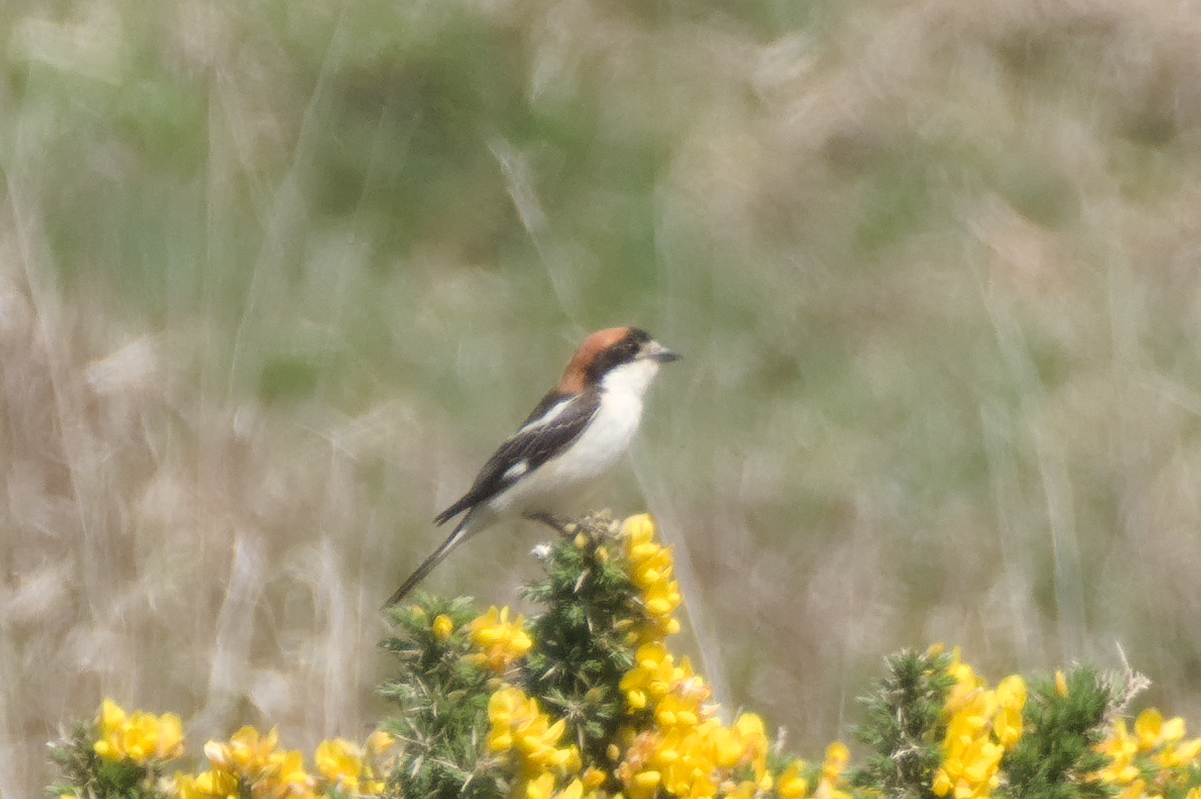
Woodchat Shrike
Lanius senator
(pp.232–233)
All new records
| 2009 |
New record 27 Jun – One was seen at Quarter Wall and on the wall between the Brick Field and main track on 27 Jun (K. Sawyer, C. Wood et al.). Record accepted by DBRC. |
| 2010 |
New record 17 May – One in upper Millcombe (D. Illing, Enslin family). Record accepted by DBRC. |
| 2012 |
New record 19 May – A male photographed as it perched on Threequarter Wall (R. Morris). Record accepted by DBRC. Photo © Rick Morris.
|
| 2014 |
New records 12 May – A male at the North End on 12 May was found by David Collins, who noted: “The bird was first seen in the vicinity of the ‘rail tracks’ which lead from the North Light to the top of the cove where the landing place is on the east shore. It then flew up towards the plateau and was seen perched on the little bridge just before you descend to the lighthouse. It was then observed feeding from rocks along the cliff-top on the east side before we lost it. It caught and ate a large beetle.” 27 to 31 May – A male on 27 May, first seen near the Old Light and making its way south along the walls, was later perched on a fence to the west of the Church. On 28th it was seen in St John’s Valley, close to the Church again, and on the fence-line between the top of Millcombe and St Helen’s Field (where it was watched taking beetles and caterpillars). It was in the same area on 30th, while by 31st it had moved to the western end of Quarter Wall (P. Holt, Richard Taylor, Tony Taylor et al.) Records accepted by DBRC. It is possible that all of these records refer to a single long-staying bird, but it seems more probable that two individuals were involved given the lengthy gap between sightings of what is a pretty conspicuous species. |
| 2018 |
New record 24 to 28 May – One was at Quarter Wall, initially just east of the main track on 24th (Ken & Joan Saul), but had moved to the western end of the wall by 27th (Rebecca & Rich Taylor, Tony Taylor et al.) and was still present there on 28th (Martin Thorne). Record accepted by DBRC. |
| 2023 |
New record 6 Sep – A juvenile/first-winter bird was found along the Upper East Side Path between Millcombe and the fenceline dividing Barton Field and St Helen's Field (Angus Croudace et al.). Record accepted by DBRC.
|
| 2024 |
New records 18 Apr – One was first seen perched on barbed wire along the top of the fenceline between the start of the Upper East Side Path in upper Millcombe and St Helen's/Barton Fields at about 09:00 hrs (Julia Schröder et al.). It remained in this general area for much of the day, for a time moving a little further south, being seen close to Government House. It was feeding well, frequently dropping onto the ground to catch beetles, and was last reported at about 16:45 hrs, back by the fenceline between St Helen's and Barton Fields. It was not seen on 19th (or subsequently). 14 May – One was seen briefly, just west of the main track gate in Quarter Wall (Chris Baillie). It moved off east but couldn't be relocated. Records accepted by DBRC. Only the third & fourth occurrences during the last decade.
|
| 2025 |
New record – subject to acceptance by DBRC 30 Apr – A male was found perched on gorse between Quarter Wall Pond and the Old Hospital at 13:20 hrs (Ezra Sherwell). It remained in the same area, moving a bit closer to Quarry Cottages ('Belle Vue'), until at least 17:00 hrs (Mark & Sandie West) but could not be found the next day.
|

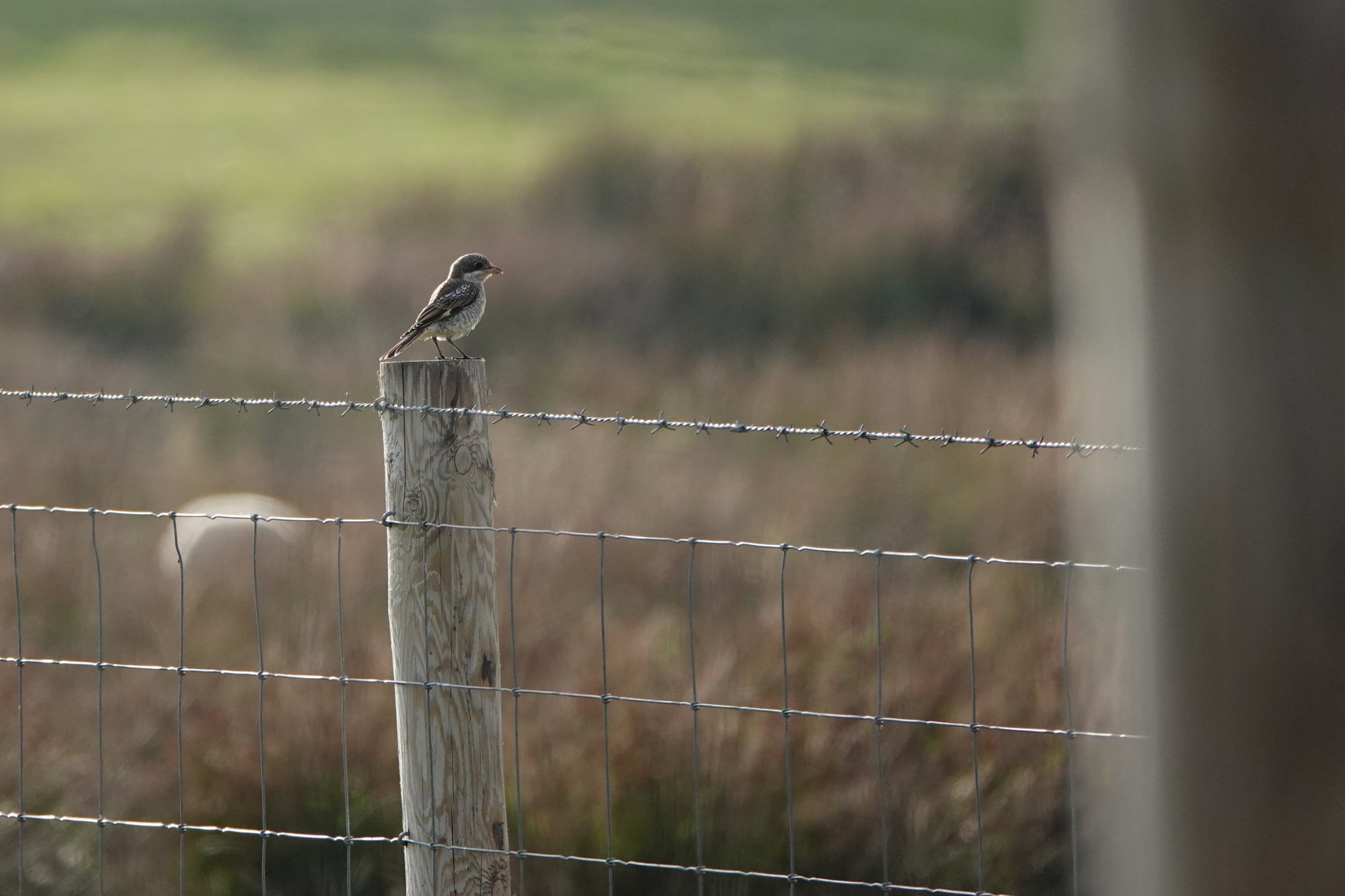

Red-backed Shrike
Lanius collurio
(pp.230–231)
Update
| 2005 |
Additional record 11 & 12 Jun – A female was in Millcombe (A. Matthews, Peter Reay, Mark Worden). This record was not included in the 2005 LFS Annual Report, instead being listed in an appendix of records rejected pending receipt of a description or other supporting information. Its subsequent acceptance and publication in the 2005 Devon Bird Report (presumably on the basis of notes submitted directly to Devon Birds) was overlooked when compiling The Birds of Lundy. |
All new records
| 2010 |
New record 18 May – A male was seen and photographed on the Millcombe side of The Ugly, and later in the area cleared of rhododendron between The Ugly and St Helen’s Combe (S. Barnes, R. Fowling). Record accepted by DBRC. |
| 2012 |
New records 2 Jun – A male just west of the main track at Quarter Wall (T. Davis & T. Jones et al.). 7 Oct – A first-winter bird was close to the main track near Gannets’ Combe (A. Williams, I. Lakin). Records accepted by the Devon Bird Recorder. |
| 2016 |
New record 31 Aug – A first-year bird was in Millcombe (Dave Jones, Rebecca & Richard Taylor). Record accepted by Devon Bird Recorder.
|
| 2018 |
New record 26 & 27 Sep – A juvenile was in upper Millcombe during the late afternoon and early evening of 26th. It was seen briefly near Millcombe House on the morning of 27th, but not subsequently (Tim Davis & Tim Jones et al.). Record accepted by Devon Bird Recorder. |
| 2019 |
New record 6 Jun – A female was near St Helen’s Copse (Chris & Carol Baillie). Record accepted by Devon Bird Recorder. |
| 2020 |
New record 12 Sep – A juvenile was in the vicinity of Quarry Cottages, the Terrace and the track to Quarry Beach during the early afternoon (Tim Davis & Tim Jones et al.). Record accepted by Devon Bird Recorder. |
| 2024 |
New record – subject to acceptance by Devon Bird Recorder 9 Sep – A juvenile/first-winter bird was well-watched and photographed in upper Millcombe during the late morning and early afternoon (Angus Croudace, Thomas Weston et al.) |

Chough
Pyrrhocorax pyrrhocorax
[Red-billed Chough] (pp.234–235)
All new records
| 2012 |
New record 29 Oct to end of year – What was thought to be a calling Chough was heard from the direction of South West Point during an early morning migration watch from Castle Hill on 29 Oct (Tim Jones), but without visual confirmation. Tony Taylor later reported glimpsing for a second or two what he thought was a Chough in the same area. An adult was seen and photographed at Shutter Point on 30 Oct (Paul Barrett). What is presumed to be the same bird was seen near the Rocket Pole on 15 & 16 Nov and also near Benson’s Cave on 15th (James Leonard, Ed & Ellie Bassett et al.). It was again at Shutter Point on 18 Nov (Andrew Taylor) and on the southern edge of Castle Hill on 21 Nov (Kay Easton). There were no further reports until 9 Dec, when it was foraging and in flight just east of the Devil’s Limekiln (David Oddy). On 18 Dec it was seen from the (upstairs) living room of Square Cottage (Keith Lugg). Finally, it was photographed sitting on the Church on 27 Dec, when it was also seen in flight being mobbed by a Raven (A. McGibbon). This is the first record since one off the East Side on 28 Dec 2000, though there was an unconfirmed report of one near the Devil’s Slide on 1 Sep 2010. Record accepted by DBRC.
Photo: Chough near Shutter Point, 30 Oct 2012 © Paul Barrett. |
| 2013 |
New records 1 Jan to 30 Mar – The bird that arrived in Oct 2012 continued to be seen regularly up to and including the last record on 30 Mar, when it was feeding in St Helen’s Field. All logbook entries for Jan–Mar involved sightings in the south of the island, from Old Light, to St Helen’s Field, Millcombe/St John’s Valley, Tent Field and South End. St Helen’s Field and the paths between the Tavern and Millcombe appeared to be especially favoured feeding areas from mid-Feb onwards. 18 & 19 May – There were further sightings (presumed to relate to other individuals, since the overwintering bird was not seen in April, in spite of thorough searching) reported in mid-May: one feeding in field just north of High Street gate and seen and heard in flight near Jenny’s Cove on 18 May (N. & D. Downie, J. & S. Buchanan) and one seen and heard calling over Millcombe on 19 May (Viv Phillips, Kim Atkinson & Jan Ozyer). All the above records accepted by DBRC. In addition there was an unsubstantiated report of two on 8 May. Photo © Mike Jones, March 2013.
|
|
2023 |
New record 15 Oct – One was seen on the island’s north-west coast by a visiting climber (U. Bauer) familiar with Choughs. Though not reported until a couple of days later, a very good description was provided. There was no sign later in the week when the area was searched by birders. Record accepted by DBRC. |
| 2025 |
New record – subject to acceptance by DBRC 19 Sep – One at North End, reported by the Feral Stock Management Team. |
| 2021 |
Report assessed as not proven 23 Oct – A report of two over the Landing Bay was assessed by DBRC as 'not proven'. |


Magpie
Pica pica
[Eurasian Magpie] (pp.233–234)
All new records
| 2020 |
New record 5 Sep – One was seen briefly in the Tent Field, between the Black Shed and the helipad, during the early afternoon (Shaun Robson). This is the first record of an extremely rare bird for Lundy since May 1996! |
Jackdaw
Coloeus monedula
[Western Jackdaw] (p.235)
All new records
| 2007 |
New record 18 Oct – A notable influx of 31 birds (the fourth-highest total ever recorded) occurred, together with 18 Rooks. The mixed flock arrived during the morning from the north and circled high over the South End. Most birds landed in the Tillage Field, but all had left by early afternoon. |
| 2008 |
New record 23 Apr – One feeding in the Tillage Field. |
| 2009 |
New records 14 & 15 Mar – Four flying north landed amongst sheep in the Brick Field on 14th, remaining to 15th. 16 Apr – Five in Middle Park. 6 to 8 May – Four on 6th, unspecified number on 7th and six on 8th (locations not recorded). |
| 2010 |
New records 13 to 20 May – Daily sightings of a single bird, with two on 15th, then one on 26 & 28 May and on nine dates from 5 to 25 Jun (possibly just one long-staying individual?). 13 to ?? Jul – Two on 13th and a single bird on three dates at the end of the month. 4 Sep – One around the Village. |
| 2011 |
New records 28 & 29 Apr – Four on 28th were seen leaving the island with three Carrion Crows, flying high to the south-east towards Hartland Point at 18.05 hrs on 29th. 27 & 30 May – One sitting on eastern end of Halfway Wall on 27th and on Tillage Field wall on 30th. |
| 2012 |
New record 26 Apr – Two in the south of the island (Jeremy Barker). |
| 2013 |
New record 23 May – One (Neil Trout). |
| 2014 |
New records 27 Apr – One on roof of Black Shed and later feeding in Tillage Field and St Helen’s Field (Richard Campey). 8 Jul – Two were around the Landing Bay on what is an unusual date for this species on Lundy (Cambridge Conservation Volunteers).
Photo: Jackdaw in Tillage Field, 27 Apr 2014 © Richard Campey |
| 2015 |
New records 10 May – One (P. Treen). 27 May – One at Brazen Ward and in the Brick/Tillage Fields (Philip & Helen Lymbery). 6 Jun – One in the Tillage Field and later over the Airfield (Richard Campey). |
| 2016 |
New record 31 Jul – One near Jenny's Cove. |
| 2017 |
New records 24 to 27 Mar – Two on 24th & 25th, three on 26th and four on 27th (Tim Davis & Tim Jones et al.). All four birds were seen flying north above the Terrace on the latter date, apparently leaving the island. 29 Apr to 1 May – One on 29th & 30th, followed by two in the Lighthouse Field on 1st (Neil Trout). |
| 2018 |
New records 22 Feb – One in Barton Field (Dean Jones). 16 Mar – One with roosting flock of Carrion Crows (Dean Jones). 25 & 26 Mar – One Tent Field on 25th and St Helen's Field on 26th (Tony Taylor) |
| 2019 |
New records 2 to 7 Feb – One first seen in the upper Lighthouse Field on 2 Feb (Tim Davis & Tim Jones) was present until 7th, 22 Oct – Three on the main track at Quarter Wall on took off and flew north (Sam Bosanquet). |
| 2020 |
New records – unprecedented spring influx 26 Feb to 25 May – One calling from Millcombe Wood on 26 Feb, with two present on 27th; one in High Street Field on 13 & 14 Mar; one over Millcombe on 24 Mar; three on 26th; two foraging in Lower Aerogenerator Field (Lighthouse Field) on 28 & 29 Mar; 14 parachuting into Tent Field on 30 Mar; seven in High St Field on 31st; 11 on 1 Apr; an exceptional mass arrival of 59 on 2 Apr; 11 on 3rd & 4th; one over the Village on 11th; two calling loudly over the Village on 12th; 11 in Lower Aerogenerator Field on 25th, in Helicopter (Tent) Field on 26th, and on the roof of Old House South on 27th; six over Jenny's Cove on 1 May; and – finally – two calling from the roof of the Barn on 25 May (Dean Jones et al.). This is by far the most significant and sustained influx to the island of recent years. It is thought that prolonged spells of settled weather, particularly in Apr, may have been a contributory factor. The flock of 59 birds on 2 Apr exceeded the previous record spring count of 53, set way back in the early years of LFS, on 25 Apr 1948! However, the all-time record still stands at a collossal 250 on 20 Oct 1983. |
| 2021 |
New records 1 Mar to 17 Apr – Single birds were logged on 13 dates from 1 Mar to 1 Apr, followed by two on 2 & 3 Apr and further singles 14,15 & 17 Apr (Dean Jones et al.). All sightings were in the south of the island, mainly High Street Field and Ackland’s Moor but also in Brick Field and the Campsite. 9 Oct – Four were over the South End and Village on 9 Oct (Paul Holt). 17 Dec – One was reported along the Goat Path, above the Beach Road (Kevin Waterfall). |
| 2022 |
New record 22 Oct to 31 Dec – A single bird first seen in Brick Field on 22 Oct (Paul Holt) remained until the end of the year and into 2023 feeding in the Village and the East Side fields. |
| 2023 |
New records 1 Jan to 2 Apr – The long-staying bird from autumn 2022 remained on the island throughout the winter and early spring. It was joined by two fresh arrivals on 27 Mar, with all three seen together in flight over the East Side and later in Brick Field. These three continued to be seen daily, up to and including 1 Apr, but only one, thought to be the original singleton, remained the next day. 13 May – One heard calling over Millcombe. |
| 2024 |
New records 25 Mar – One in Brick Field. 11 Apr to 1 May – One was outside around the village on 11 & 12 Apr; two were in upper Lighthouse Field on 13th; one was perched by the Upper East Path at Brick Field on 14th, with two arriving high over Benjamin's Chair and flying N, plus one around the Lambing Shed on the same date; two over Millcombe on 16th; two calling over the Ugly, one in upper Lighthouse Field, and two in High Street Field, then flying towards the village on 17th, two in upper Lighthouse Field on 18th; and three in flight together on 20th, which appeared to arrive very high from the N. They came down lower over the village, did a circuit of the Church then returned NE gaining height until almost lost to view, apparently trying to leave the island to the E. Singles were logged on 23rd & 26th, then three again on 28th. Finally, one was logged on 1 May. |
| 2025 |
New records 8 Jun – One was calling near the Church. |
| 2026 |
New records 3 to 6 Mar – One feeding alongside six Carrion Crows in High Street Field on 3rd (Thomas Weston) and by the water tanks, with a Hooded Crow, on 4th (Eleanor Harris), was followed by a total of three Jackdaws logged during morning census that day (Thomas Weston), and a further single bird on 6th. 13 to 17 Mar – One first seen in Tillage Field at 17:20 hrs on 13th, seems likely to have been the same individual present at Old Light on 14th, in Barton Field on 16th and (finally) over the Village at 08:47 hrs on 17th (Eleanor Harris & Thomas Weston). 2 to 20 Apr – Two flew north over the Old Light Shearwater Colony at 11:00 hrs on 2nd (Flo Turner); one flew past the Black Shed on 6th, one was by the Church and around the Village on 7th (Thomas Weston); one was recorded on census on 13th (Simon Parker); and one was flying north over the Lambing Shed (Thomas Weston) and later with Carrion Crows in Tillage Field on 20th (Tony Taylor). Given the intensive coverage of the island during April, these sightings are thought likely to represent multiple indviduals passing through the island rather than one or two long-staying birds. 20 May – One, Millcombe (Eleanor Harris). 3 Jun – One was around South West Field and Airfield (Jessie Dermody). |

Rook
Corvus frugilegus
(pp.236–237)
All new records
| 2007 |
New record 18 Oct – A notable influx of 18 occurred, together with 31 Jackdaws. The mixed flock arrived during the morning from the north and circled high over the South End. Most birds landed in the Tillage Field, but all had left by early afternoon. |
| 2009 |
New records 5 & 6 Feb – One in Lighthouse Field. 13 & 15 Mar – One in Brick Field 14 Sep – Two (circumstances unknown). |
| 2010 |
New records 22 Mar – One seen from Brazen Ward. 10 May – One around Brick Field and Airfield. 30 May – Ten (no location given). 16 Jul – One. |
| 2013 |
New record 19 Apr – Four flew north past lower Millcombe, calling as they went, before turning west, rising over the fields and out of sight (Tony Taylor). |
| 2015 |
New records 16 Apr – One calling as it circled high over the Village (Tim Jones). 10 May – One at Quarter Wall. 30 May – One (location not given, B. Boyland/BirdTrack). |
| 2016 |
New records 1 to 10 Jun – One, first seen in the Tillage Field on 1st was recorded on six further dates up to 10th (Paul Holt, Richard & Rebecca Taylor & Tony Taylor). 13 Sep to 11 Oct – A single bird was seen on eight dates from 13 to 25 Sep (Andy Turner et al.), followed by the same or another on 11 Oct. |
| 2017 |
New record May to Aug – One on 29 & 30 May (Chris Townend) and, what was considered to be the same long-staying individual, on a further 19 dates up to and including 26 Aug (Dean Jones, Richard & Rebecca Taylor, Tony Taylor et al.). Most sightings were from the vicinity of the Tillage Field and pig-sty. |
| 2019 |
New record 4 to 8 Apr – One first reported on 4th (Jo King) was outside Paradise Row on 6th and feeding with Carrion Crows in Tent Field on 8th (Dean Jones). |
| 2020 |
New record 20 Apr – One in upper Aerogenerator Field/Lighthouse Field (Dean Jones). |
| 2021 |
New records 30 Mar – Two, foraging with Carrion Crows in South West Field (Dean Jones). 26 Apr – One in Tillage Field, also alongside Carrion Crows (Dean Jones). |
| 2022 |
New record 14 Mar – One being mobbed by Crows over the Village in the morning and then heard by Brick Field in the afternoon. |
| 2023 |
New record 2 Apr – One flew over the Village during the early evening. |
| 2024 |
New records 1 Apr – One came in off the sea at the South End and circled the Church twice, calling, around 08:15 before heading north up the island (Thomas Weston). It was not seen again. Amazingly this seems likely to have been the same individual watched by Tim Jones as it flew out to sea and towards Lundy from Bull Point, on the North Devon mainland around 07:30 hrs, meaning it took about 45mins for the bird to make the crossing. The date was also remarkably similar to the only record of 2023! 18 Apr – One calling over Castle Hill was presumably the same individual seen feeding shortly afterwards in upper Lighthouse Field (Tim Jones, Thomas Weston). 21 Apr – One flew south over Quarter Wall (Thomas Weston). 23 Apr – Two were seen over Jenny's Cove apparently attempting to leave the island to the north-west (Thomas Weston). |
| 2025 |
New records 12 Mar to 20 Apr – Records of single birds on five dates, with two in flight over Ackland's Moor on 5 Apr. One flew SE out to sea from Castle Hill on 20 Apr (Paul Holt). 9 & 10 Jun – A juvenile was in Brick Field (Flo Turner). |
| 2026 |
New records 9 to 18 Mar – One flew in off the sea at the Castle and continued north over the Village at 12:20 hrs on 9th, with further single birds (potentially one and the same individual) logged over the Village at 11:30 hrs on 14th and at Old Light at 09:00 hrs on 18th. 6 Apr – Two flew over Millcombe at about 10:00 hrs (Greg Lee). 27 Apr – One flew high over upper Millcombe calling at 08:47 hrs (multiple observers). |
Raven
Corvus corax
[Northern Raven] (pp.238–240)
Selected new records
| 2009 |
Maximum counts 13 Sep – A count of 14 was one of the higher totals of recent years (which also include 14 in Oct 2005, and 19 in Oct 2002). |
| 2010 |
Maximum counts 11 Oct – A count of 20 was the highest since 19 in 2002. |
| 2011 |
Maximum counts 29 Apr & 14 Oct – Counts of 16 on both dates were the highest of the year. |
| 2012 |
Maximum counts 11 Apr – A count of 16 was the highest of the year. |
| 2013 |
Maximum counts 28 Aug – A count of 17 was the highest of the year. |
| 2014 |
Maximum counts Jun – A count of 14 was the highest of the year. |
| 2015 |
Maximum counts Mar & Oct – Counts of 13 were the highest of the year. |
| 2016 |
Maximum counts 6 Oct – A count of 17 was the highest of the year. |
| 2017 |
Maximum counts 16 Sep – A count of 20 was the highest since 2010 and involved “a mobile gang of presumed adolescents flying over the village area in at least two separate groups calling very loudly” (Dean Jones). |
| 2018 |
Commencement of breeding 1 Feb – A pair were carrying sticks to a nest site at Halfway Wall Bay. Maximum counts 29 Aug – A count of 20 equalled the highest total recorded since publication of The Birds of Lundy. |
| 2019 |
Commencement of breeding 1 & 3 Feb – A pair were carrying sticks to a nest site at Halfway Wall Bay on 1st – precisely the same date as in 2018! They were seen carrying nest-lining material on 3rd. Maximum counts 3 Feb – A count of 13 was the highest of the year. |
| 2020 |
Commencement of breeding 26 Jan – One was carrying nesting material along the East Side. There were four successful nests: at Benjamin’s Chair, the cliffs just west of Old Light, Halfway Wall Bay, and Long Roost. The first fledglings were seen at the South End on 12 May. Maximum counts 8 Mar – A count of 20 was the highest of the year. |
| 2021 |
Commencement of breeding Early Feb – A territorial pair at the South End were gathering nesting material in the first week of Feb. However, chicks only fledged from this nest on 22 May – an unusually late date for a traditionally early nester. It seems likely that a replacement clutch may have been laid following failure at an earlier stage in the season. Maximum counts Peak autumn totals were 14 on 17 Sep and 15 on 13 & 14 Oct, followed by 23 on 11 Nov – by far the highest count of the year. |
| 2022 |
Late fledging The first fledglings were not seen until the late date of 24 May. Maximum counts The highest count of the year was 21 on both 17 Sep and 16 Oct. |
| 2023 |
Summary of all records Breeding: Adults were gathering nest material on 16 Feb. Fledged young were seen at Benjamin's Chair, Middle Park and Long Roost. Highest monthly counts: Jan 12; Feb 14; Mar 17; Apr 18; May 22; Jun 24; Jul 12; Aug 13; Sep 15; Oct 19; Nov 12; Dec 6. The peak count of the year was 24 on 25 Jun (with 23 logged on 9 Jun and 22 on 21 May). |
| 2024 |
Summary of all records Highest monthly counts: Jan 9; Feb 16; Mar 13; Apr 18; May 29; Jun 14; Jul 12; Aug 17; Sep 20; Oct 16; Nov 12; Dec 10. The high count of 29 on 19 May comprised 21 adults and 8 juveniles (i.e. young of the year). A fully-grown bird was caught (by hand!) in the Village and ringed on 9 Oct (Tom Williams) – the first Raven to be ringed on Lundy since 1983! |
| 2025 |
Summary of all records Breeding: Fledged young were seen in early May at Benjamin's Chair and at Long Roost. Autumn influx: A count of 26 on 10 Nov, including 19 along the East Side, pointed towards an influx of dispersing birds from the mainland, where nomadic flocks of up to 50 or more birds can be seen following the coastline in both spring and autumn, for example at Bull Point, west of Ilfracombe. Highest monthly counts: Jan 9; Feb 11; Mar 9; Apr 13; May 14; Jun 8; Jul 9; Aug 12; Sep 23; Oct 12; Nov 26; Dec 5 – but coverage minimal after mid-Nov. |
| 2026 |
Summary of all records Spring – A high count of 17 on 6 Mar could potentially have involved an influx of immature/non-breeding birds from the mainland, being considerably higher than any other count during the first three months of the year (the next highest counts was 10 on 17 Mar). Breeding: Between mid-Apr and early May, recently fledged young, still being fed by adults, were seen at Benjamin's Chair, Old Light, and St John's Stone (West Side near Threequarter Wall). Highest monthly counts: Jan 9; Feb 8; Mar 17; Apr 18; May 16; Jun 12; Jul 13; Aug 12; Sep 15; |
Carrion Crow
Corvus corone
(p.237)
Selected new records
| 2007 |
Maximum counts 30 Apr – The highest spring count: 55. 12 Nov – The highest autumn count: 47. |
| 2008 |
Maximum counts 28 Feb – The highest late-winter/early-spring count: 57. 19 Oct – The highest autumn count: 54. The population remains at a high level in comparison with preceding decades; from 1960 to 2006 counts of 50 or more had been made on only a handful of occasions. |
| 2009 |
Maximum counts 16 Apr – The highest spring count: 52. 25 Aug – The highest autumn count: 60. |
| 2010 |
Maximum counts 8 May – The highest spring count: 47. 28 Oct – The highest autumn count: 44. |
| 2011 |
Maximum counts 29 Apr – The highest spring count: 63. 7–9 Nov – The highest autumn count: 40. |
| 2012 |
Maximum counts 31 May – The highest spring count: 52. 23 Oct – The highest autumn count: 64. |
| 2013 |
Maximum counts 22 May – The highest spring count: 48. 24 Nov – The highest autumn count: 59. |
| 2014 |
Maximum counts 24 Apr – The highest spring count: 50. 31 Dec – The highest autumn/winter count: 70. This matches the previous all-time record high count, when an estimate of the island's population gave a "likely total in excess of 70 individuals" in spring 2007. |
| 2015 |
Maximum counts May – The highest spring count: 49. 10 Oct – The highest autumn count: 75. This sets a new record high count for the island. |
| 2016 |
Maximum counts 3 Apr – The highest spring count: 60. 20 Oct – The highest autumn count: 68. |
| 2017 |
Maximum counts 22 Mar – The highest spring count: 49. 9 Oct – The highest autumn count: only 48, suggesting indifferent to poor breeding productivity. |
| 2018 |
Maximum counts 24 Mar – The highest spring count: 41. 12 Sep – The highest autumn count: 53. |
| 2019 |
Maximum counts 3 Feb – The highest pre-breeding/spring count: 42. 27 Sep – The highest autumn count: 64, suggesting good breeding productivity. |
| 2020 |
Maximum counts 19 Jan – The highest pre-breeding/spring count: 57. 7 Sep – The highest autumn count: 43. |
| 2021 |
Maximum counts 3 Jan – The highest pre-breeding/spring count: 43. Aug to Dec – Maximum post-breeding counts were between 22 and 29 from early Aug to late Dec, when 44 were logged on 28 Dec (Matt Stritch), perhaps suggesting an influx from the mainland. |
| 2022 |
Maximum counts 11 Apr – The highest pre-breeding/spring count: 47. 25 Oct – The highest autumn count: 31. |
| 2023 |
Summary 5 Feb – The highest pre-breeding/spring count: 47. 28 Aug & 4 Oct – The highest autumn count: 45. Highest monthly counts: Jan 30; Feb 47; Mar 40; Apr 43; May 33; Jun 38; Jul 25; Aug 45; Sep 39; Oct 45; Nov 37; Dec 18. |
| 2024 |
Summary 1 May – The highest pre-breeding/spring count: 51. 2 Oct – The highest autumn count: 62. Highest monthly counts: Jan 19; Feb 22; Mar 38; Apr 43; May 51; Jun 23; Jul 26; Aug 22; Sep 49; Oct 62; Nov 52; Dec 26. |
| 2025 |
Summary 11 Mar – The highest pre-breeding/spring count: 47. 16 Sep – 55 were logged during morning census. There were four other counts of ≥45 during Sep, indicating high breeding-season productivity. Highest monthly counts: Jan 14; Feb 29; Mar 47; Apr 27; May 35; Jun 21; Jul 22; Aug 37; Sep 55; Oct 37; Nov 17; Dec 13 |
| 2026 |
Summary Autumn influx – There appears to have been something of an influx in mid-Sep – albeit a temporary one – when the daily counts logged from 15th to 17th were 70, 58 and 62, respectively. Peak counts during the rest of month were mostly in the upper 30s or low to mid 40s, the only exception being 48 on 10th. Highest monthly counts: Jan 25; Feb 26; Mar 37; Apr 38; May 37; Jun 29; Jul 26; Aug 32; Sep 70; |
Hooded Crow
Corvus corone cornix
(p.238)
All new records
Note that from 2002 to 2025, Hooded Crow was treated as a distinct species, Corvus cornix, on the British List. From the beginning of 2026, it reverts to being treated as a subspecies of Carrion Crow, i.e. Corvus corone cornix. All occurrences on the island will continue to be documented, supported by photos wherever possible.
| 2010 |
New records 25 Mar – One with Carrion Crows in the Brick Field (Kevin Welsh). 29 & 30 May – One (Philip Lymbery & H. Engelen). 29 Jun – One between Pondsbury and Halfway Wall (H. McLiffe). |
| 2012 |
New record 17–28 May – One photographed on the West Side, just north of the Devil’s Slide on 17 May (Mike Jones) remained until 28th and was seen by many observers at a variety of locations (though all south of Quarter Wall). Record accepted by DBRC. |
| 2014 |
New record 14 to 16 Jun – One was in and around the Brick Field (Adam Bainbridge, Shaun Barnes, Kevin Welsh et al.). Record accepted by DBRC.
|
| 2018 |
Possible hybrid individual 20 to 28 Mar – One, initially seen on Ackland's Moor on 20th (Rob Waterfield), was at Quarter Wall on 21st (Dean Jones). Presumably the same individual was in Tillage Field on 28th (Grant & Shelley Sherman). Dean Jones noted "Obvious contrast in colouration of head and wings to the rest of the bird's body but body colouration much darker than typical Hooded Crow." As a consequence, DBRC considered that this individual may have been a hybrid Carrion x Hooded Crow, rather than a pure Hooded Crow. |
| 2019 |
New record 5 May – One was in flight with six Carrion Crows heading north past the Church in the early morning. Record accepted by DBRC. |
| 2020 |
New records 13 & 14 Mar – Two were with Carrion Crows and Jackdaws in High Street Field and on Ackland's Moor on 13th, one remaining on 14th when it was seen in Brick Field (Dean Jones). 1 & 15 May – Singles in Tent Field (Dean Jones). With no sightings between 2 and14 May, it seems probable that either two different birds were involved on 1st & 15th, or the same individual visited the island twice but disappeared to the mainland in the intervening period. Records accepted by DBRC. |
| 2022 |
New record 2 & 12 May – There were sightings of single birds in Lighthouse Field on 2 May (Rachel Bedwin, Laura Piratique) and in Lighthouse/Aerogerator Fields on 12 May (Richard Campey, Tim Davis, Tim Jones). Record accepted by DBRC as referring to one individual, though the possibility that two different birds were involved can’t be excluded. |
| 2023 |
New records 10 to 14 Mar – One first seen and photographed near Tibbetts on 10th and again in Middle Park before flying north over Three-quarter Wall on 12th (Ester Spears), was last seen flying over the Church on 14th (Andy Jayne). 30 Apr & 1 May – One flew over Quarter Wall and landed near Pondsbury on 30th, and was present in Brick Field the following day (Stuart Cossey et al.). 12 to 24 May – Two were seen in Lighthouse Field and by the Water Tanks on 12 & 13 May. One remained in Brick Field on 14th and continued to be seen daily up to and including 24th, associating with Carrion Crows, and spending its time mainly in Tillage Field or around the Water Tanks, but venturing as far as Quarter Wall on 19th (Stuart Cossey et al.) Records accepted by DBRC. |
| 2024 |
New records – subject to acceptance by DBRC 18 Apr – One flew in from the north past the Tavern and over the Black Shed at 07:20 hrs (Tim Jones). It continued SSW in the direction of Tent Field but was not seen again. Record shots taken. Subject to formal acceptance, the seventh Lundy record during the last decade and the 12th since publication of The Birds of Lundy. 26 May to 22 Jun – A presumed hybrid Hooded Crow x Carrion Crow was seen regularly in the vicinity of the Water Tanks, Airfield and Brick Field (Thomas Weston et al.) |
| 2025 |
New records – subject to acceptance by DBRC 16 to 23 Apr – One first seen at Halfway Wall by Lundy Ranger, Matt 'Roger' White, was logged daily on the farm in-fields, up to and including 23 Apr (multiple observers). 30 Apr to 12 May – One in Brick Field and then regularly in the Ackland's Moor and Airfield area (Jimmy Hair et al.) was joined by a second individual on 7th (Tim Jones), which showed plumage features consistent with a Hooded Crow x Carrion Crow hybrid (e.g. rather dusky grey nape, mantle and underparts, with blotchy blackish markings on the lower belly and vent). Two birds, one a possible hybrid, were seen flying past North Light on 12th and with no further records after that, it looks as if this was the long-staying Hooded Crow leaving the island, potentially with the hybrid logged on 7th. The gap in Hooded Crow records for a week in late April is intriguing and likely to reflect genuine absence (rather than a long-staying bird being overlooked), given that the Observatory team was conducting a daily census (taking in all the key areas for feeding crows), and there was intensive additional coverage from visiting birders. Did one individual leave the island and later return, or did multiple individuals pass through? And if the second, possible hybrid, seen on 12th was the same as that logged on 7th, where did it go in the meantime? Note that with effect from the end of December 2025, Hooded Crow is no longer recognised at species level on the British List but reverts to be being a subspecies of Carrion Crow. However, visitors are encouraged to continue recording all sightings of Hooded Crow on Lundy in the Bird Observatory/LFS logbook in the Tavern, with photos wherever possible. These will be gladly received by on-island members of the Bird Observatory team. |
| 2026 |
New records – subject to acceptance by Devon Bird Recorder 4 Mar – One, together with a Jackdaw, by the flooded grassland near the water tanks (Eleanor Harris). 3 to 11 Apr – One (possibly a hybrid Carrion x Hooded Crow) was photographed in Tillage Field at 16:28 hrs on 3 Apr (Eleanor Harris & Thomas Weston). It was subsequently logged on most days up to and including 11th. |
 Hooded Crow in Brick Field on 16 Jun 2014 © Grant Sherman
Blue Tit
Cyanistes caeruleus
[Eurasian Blue Tit] (p.226)
All new records
| 2011 |
New records 28 Sep – One. 20 Oct to 9 Nov – Recorded on 13 dates during this period; mostly single birds (one ringed on 20th), but two were seen on 25 & 27 Oct (in Millcombe/St John’s Valley on latter date). |
| 2012 |
New record 31 Mar – One in Millcombe (Norma & Trevor Dobie). |
| 2015 |
New record 10 Apr – An adult female was trapped and ringed in Millcombe (Rob Duncan). |
| 2020 |
New record 5 Oct – Two were seen in the Ugly/St Helen's Copse area (Shaun Barnes). |
| 2024 |
New record 16 Sep – One reported from Millcombe. |
| 2026 |
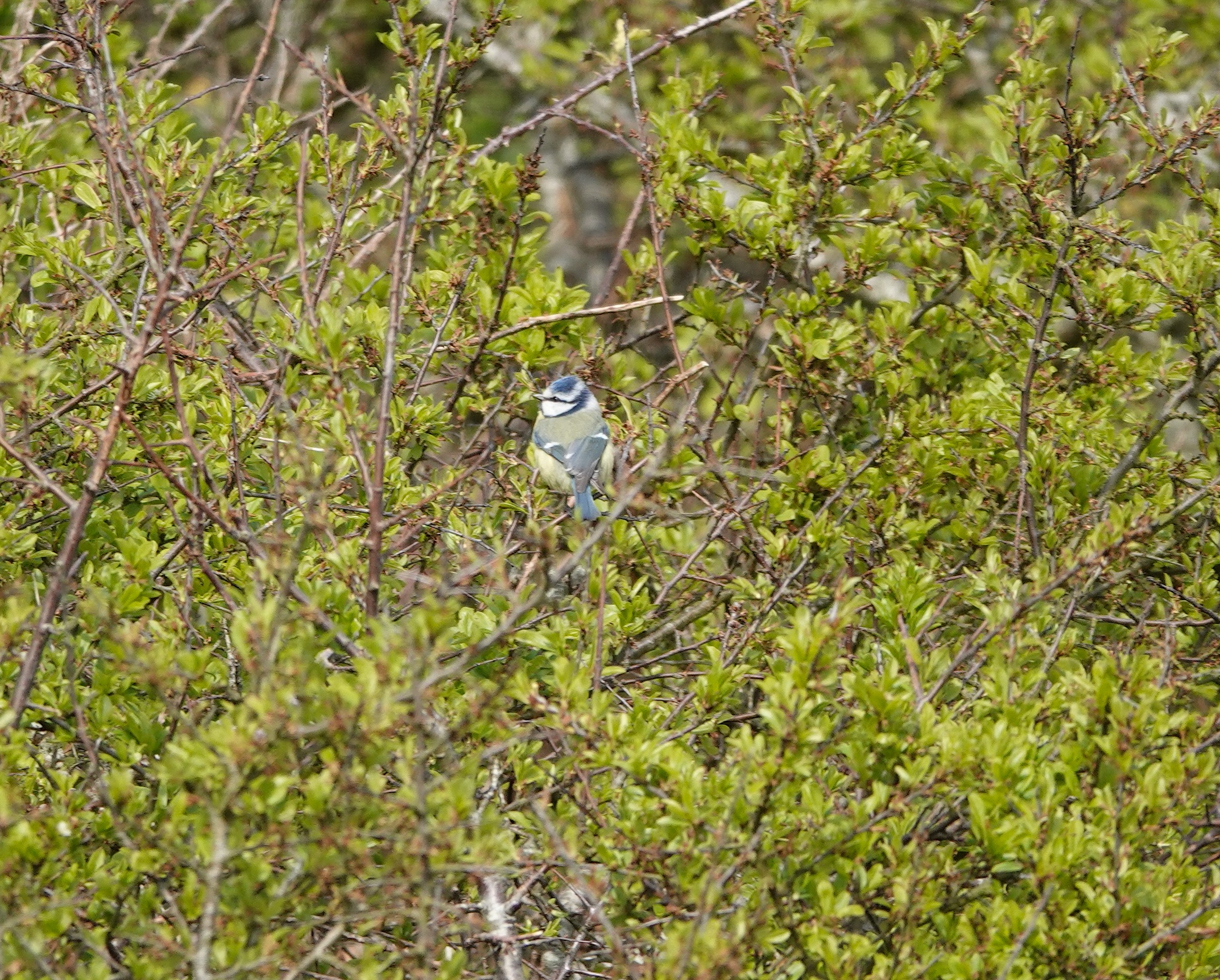
New record 21 to 23 Apr – One, initially seen at Brambles just after 09:00 hrs (Chris Dee et al.) was relocated by call in upper Millcombe, in blackthorn scrub around the start of the Upper East Side Path, and watched intermittently between 15:35 and 16:10 hrs (Tim Jones et al.). There was no sign of it during strong easterly winds on 22nd, when Millcombe was largely 'blown out', but it was seen again briefly at 08:30 during morning census, when it was in scrub just above the walled gardens near the start of the track to Millcombe House (Tim Davis & Tim Jones). Its bright plumage suggested that it was likely a male.
|
Great Tit
Parus major
(pp.226–227)
All new records
| 2007 |
New record 15 & 16 Aug – One. |
| 2011 |
New records 23 Apr – One in Millcombe. 28 Sep – One (location unknown); the same date as a Blue Tit was also reported. |
Coal Tit
Periparus ater
(pp.227–228)
All new records
| 2008 |
New records 17 to 21 Oct – One on 17 Oct was joined by a second bird on 18th & 19th, with a final sighting of a single bird on 21st. All records were from either Millcombe or Quarter Wall |
| 2010 |
New record 11 to 23 Oct – Recorded on ten dates, with two on 11th, three on 12th, two on 13th & 14th and singles on the remaining days. Four birds, all believed to have been of the continental race P a. ater were trapped and ringed during this period. |
| 2012 |
New records 31 Mar – One in Millcombe (Derren Fox). 13 to 11 Nov – A small influx in mid-Oct involved at least five different birds. One was seen at the Castle early in the morning of 13 Oct and later in Millcombe (Ivan Lakin, Kevin Rylands). Two were trapped and ringed in Millcombe on 14 Oct, with a third individual trapped there on 15th. During the morning of 16 Oct, two were seen at St Helen’s Copse, plus an unringed bird at Quarter Wall Copse. Two were in St John’s Valley that afternoon, one of which was unringed (Richard Taylor & Tony Taylor). Over the next several days, individuals were seen regularly along the East Side, from Millcombe to the Terrace Trap, including Quarter Wall Copse and Quarry Pond. All those seen well enough in the field were carrying rings. The maximum count was three on 16 & 17 Oct, with ones and twos thereafter until 28th (many observers). However, new individuals were trapped and ringed in Millcombe on 20 & 21 Oct (Tony Taylor). There were two records of single birds in Millcombe in Nov, on 8th & 11th (Andrew Cleave, James Leonard) – perhaps one of the Oct birds that had remained otherwise undetected? |
| 2014 |
New record 18 to 20 Apr – A single bird was reported daily in Millcombe (Martin Thorne); Coal Tits are particularly rare on the island in spring. |
| 2015 |
New records 4 Oct to 22 Nov – There were autumn records on the unusually high total of 23 dates between 4 Oct (three birds) and 22 Nov (two), with a maximum count of four on 14 Oct, though ringing information indicated that there were at least two long-staying individuals, rather than a continuous turnover of new arrivals. Observer coverage was very low during much of Nov (and the weather largely dreadful!), so whilst there was a long gap between sightings from 2 to 22 Nov, it is possible that birds were present throughout that period. The great majority were seen in Millcombe but one was at Quarter Wall Copse on both 15 Oct and 22 Nov. Three were ringed in early Oct (one on 3rd, two on 4th); all were identified as belonging to the British subspecies P. a. britannicus and all were first-year birds. Two of the three individuals were retrapped between 28 & 30 Oct. |
| 2016 |
New record – including presumed overwintering 22 Feb to 27 Apr – Records of a single bird in Millcombe on 19 dates are likely all to have been of the same overwintering individual: a bird trapped on 3 Apr had been ringed on 3 October 2015. It was “singing heartily” in Millcombe on 3 Mar (Neil Trout). There were no autumn records. |
| 2017 |
New record 29 Oct to 30 Dec – Sightings, probably involving just one long-staying individual, were made on 14 dates from 29 Oct (Millcombe and also feeding with Chiffchaffs and Goldcrests along a wall above Benjamin’s Chair – Andy Jayne & Dean Jones) to 30 Dec (in Quarter Wall Copse – Dean Jones & Zoë Barton). Most reports were from Millcombe, with one additional sighting in Quarter Wall Copse on 14 Nov. This bird overwintered, being seen again in late Jan and early Feb 2018. |
| 2018 |
New records – including presumed overwintering 26 Jan to 1 Feb – One in Millcombe and St Helen's Copse was presumed to be the same individual present at the end of 2017 (Tim Davis & Tim Jones et al.). 31 Mar to 3 Apr – One very active bird, calling frequently, in Millcombe on 31st, 1st & 3rd (Dean Jones, Tony Taylor, Neil Trout). This appears most likely to have been a newly arrived migrant, it seeming improbable that the bird seen in late Jan would have avoided detection for two months. |
| 2019 |
New record 1 to 5 May – A singing male of the continental race Periparus ater ater was in Millcombe, 1 to 5 May (Tim Jones et al.) Record accepted by DBRC. |
| 2020 |
New records 10 Oct to 31 Dec – A mid-Oct arrival brought daily records from 10th to 18th, including a peak of five on 15th (in Millcombe, St Helen's Combe, and in willows above Quarry Beach). There were two on 12th, 17th & 18th, and singles on the remaining dates. The first bird to arrive, on 10th, showed plumage features consistent with the Irish-breeding race of Coal Tit P. a. hibernicus, having noticeably yellowish cheeks, a similar yellow wash on the underparts, and distinctly cinnamon flanks. However, no definite conclusion about the bird's origins can be drawn on plumage alone as there are known to be intergrades between Irish and British Coal Tits in the north-east of the island of Ireland. This particular individual, which was ringed in Millcombe on 15 Oct, was seen regularly in Millcombe through the rest of Oct and Nov, then more sporadically in Dec, but was still present at the end of the year and into early 2021. |
| 2021 |
Overwintering on the island 10 Jan to 12 Mar – The bird ringed on 15 Oct 2020, showing plumage characteristics suggesting that it might belong to the Irish-breeding race P. a. hibernicus, overwintered on the island and was logged on 18 dates from 10 Jan to 12 Mar, mainly in Millcombe but also at Quarter Wall Copse on 17 Feb. |
| 2022 | Not recorded. |
| 2023 | Not recorded. |
| 2024 | Not recorded. |
| 2025 | Not recorded. |
| 2026 |
New record 26 Sep – One was heard calling from the Millcombe Pines area during the morning (Thomas Weston et al.). The first occurrence for five years. |
Woodlark
Lullula arborea
[Wood Lark] (p.155)
All new records
| 2007 |
New record 20 Oct – One was heard calling in flight over Castle Hill, during a morning of strong southward diurnal finch and thrush passage (T. Davis, J. Diamond, T. Jones, I. Lakin, K. Rylands). Record accepted by Devon Bird Recorder. This is the first record since 1998 and only the 13th occurrence since 1960. |
| 2009 |
New record 22 Oct – One was seen and heard calling in flight over Millcombe during the late morning (Richard Taylor). Record accepted by Devon Bird Recorder. |
| 2019 |
New record 2 May – One calling in flight near the Church at 12:45 hrs on 2 May (Rob Duncan & David Kightley) was seen |
| 2020 |
New records An exceptional autumn for this species, with records on three dates, thought to involve four different birds. 16 Oct – One flew south, calling as it went, over the Ugly and lower Millcombe, during the early morning (Jamie Dunning, Dean Jones et al.). What was considered to be a different individual was seen and heard on the western fringes of Middle Park, just north of Halfway Wall, at 16:30 hrs the same day (Tim Davis & Tim Jones). 22 Oct – One showed well, allowing itself to be photographed, above Benjamin’s Chair (Dean Jones). 4 Nov – One calling in flight over Millcombe on (Dean Jones). |
| 2021 |
New record 27 Feb – An early spring migrant was photographed foraging in Barton Field (Dean Jones) – only the second Feb record for Lundy, the first dating back nearly 70 years to 1952! Record accepted by Devon Bird Recorder. |
| 2023 |
New record 2 Nov – One was found crouched in heather near the Rocket Pole, sheltering from the 60 mph wind gusts during the passage of Storm Ciarán (Luke Marriner). |
Skylark
Alauda arvensis
[Sky Lark] (pp. 156–158)
Selected new records
| 2010 |
Notable autumn-passage count 4 Oct – A count of 100 was among the higher autumn passage totals since The Birds of Lundy was published in 2007, being equalled but not exceeded in Oct 2012 & Oct 2019. The highest count of recent years was 170 on 13 Oct 2022. |
| 2012 |
Arrival of birds on breeding territories 12 Feb – About ten were apparently already on breeding territories in scattered ones and twos, while a flock of 45 was present on the Airfield. Interestingly, a significant number of birds within the flock were singing for extended periods from the ground (Tony Taylor). Notable autumn-passage count 26 Oct – A count of 100 was among the higher autumn passage totals since The Birds of Lundy was published in 2007, being equalled but not exceeded in Oct 2010 & Oct 2019. The highest count of recent years was 170 on 13 Oct 2022. |
| 2013 |
Notable spring count 11 Apr – A count of 120 remains the highest number recorded in spring since The Birds of Lundy was published in 2007. |
|
Photo: Skylark in South West Field, 24 Apr 2014 © Richard Campey |
|
| 2014 |
Notable spring count 25 Apr – A count of 118 is the second-highest spring total of recent years. |
| 2015 |
Notable late-winter/early-spring count 2 to 5 Mar – A flock of 87 birds were feeding in Lighthouse Field on 2nd, with at least 90 there on 4th and 95 on 5th. |
| 2016 |
Notable late-winter count 27 Jan – A loose flock of 46 birds were feeding in the High Street field. |
| 2017 |
Arrival of birds on breeding territories Jan to Mar – After two on 25 Jan and six on 4 Feb, the first singing bird was reported on 7 Feb (Dean Jones). Counts rose to 13 on 18 Feb, 20 on 26 Feb and 46 on 22 Mar. |
| 2018 |
Winter movement 30 Jan – Whilst seawatching from North Light, one was picked up by telescope at considerable distance from the island, flying in off the sea and continuing south over North End (Tim Davis & Tim Jones). Otherwise, very few were present on the island in Jan and the first half of Feb, with only four records of one to three birds in the first half of Jan and maxima of five on 30 Jan and seven on 1 Feb in spite of thorough searching of suitable habitat across the island. |
| 2019 |
Take-up of territories; breeding census One was singing on New Year’s Day (Robert Pell) and many breeding territories were taken up during the unusually mild weather in Feb (in contrast with early 2018 – see above). Dean Jones mapped 49 song territories during the breeding season. Notable autumn-passage count 15 Oct – A count of 100 was among the higher autumn passage totals since The Birds of Lundy was published in 2007, being equalled but not exceeded in Oct 2010 & Oct 2012. The highest count of recent years was 170 on 13 Oct 2022. |
| 2022 |
Notable autumn-passage count 13 Oct – A count of 170 remains the highest number recorded during autumn passage since The Birds of Lundy was published in 2007. |
| 2023 |
Summary of all records Highest monthly counts (and number of days recorded): Jan 0 (0); Feb 6 (22); Mar 41 (24); Apr 60 (30); May 64 (31); Jun 36 (28); Jul 16 (30); Aug 18 (26); Sep 56 (27); Oct 85 (29); Nov 16 (9); Dec 0 (0). The highest count of the year was 85 on 12 Oct (the only autumn total ≥60). In spring, the maxima were 60 on 26 Apr, and 64 on 18 May. Nocturnal surveys deliver a significant ringing total Concerted use of thermal imaging equipment at night, particularly during the autumn, resulted in 66 Skylarks being ringed, 27 of these between 2 & 5 Oct alone. Looking back at previous years, the numbers ringed in both 1996 & 1997 were slightly higher, at 72 in each of the two years, although the majority of these were pulli (nestlings). This was part of a targeted research effort during the 1990s, which resulted in 405 Skylarks being ringed in just seven years, from 1994 to 2000, inclusive. This respresents nearly two-thirds of all the Skylarks ever ringed on Lundy (1947 to the end of 2022). The 2023 total is therefore not only the highest for the best part of 25 years and the third-highest ever, but also (by a considerable margin) the highest number of fully grown Skylarks ringed in a single year. Number ringed during the year: 66 |
| 2024 |
Summary of all records Highest monthly counts (and number of days recorded): Jan 1 (2); Feb 10 (16); Mar 31 (31); Apr 41 (30); May 45 (31); Jun 29 (29); Jul 24 (27); Aug 13 (23); Sep 28 (30); Oct 80 (31); Nov 51 (23); Dec 3 (3). The highest counts of the year by a significant margin, all in late autumn, were 80 on 27 Oct and 76 on 31 Oct, followed by 51 on 6 Nov. Number ringed during the year: 46 |
| 2025 |
Summary of all records Late winter and spring – There were only scattered records of one to three birds during Jan and the first three weeks of Feb, though limited coverage may have played a part in that, given that a concerted effort on 22 Feb yielded a total of 43 birds, comprising seven in South West Field, one on Acklands Moor, and 35 from the Airfield to North End. The highest spring count was 45 on 27 Apr. Breeding confirmed – Adults were seen carrying food in Middle Park on 25 Jun. Post-breeding dispersal and autumn passage – The final double-digit count of the late-summer and early-autumn period was 16 on 23 Jul, with only single figures (mostly in the range one to four birds) logged from then until well into Sep, in spite of good coverage of the island during this period. An evident influx of passage migrants in mid-Sep brought 10 on 13th, 13 on 15th and 15 on 16th, rising further the following week to 21 on 21st, 43 on 22nd and 48 on 25th. During Oct, daily totals were mostly between 5 and 25, with the notable exceptions of 84 on 9th and 60 on 22nd. Small numbers (one to seven birds) were recorded on scattered dates in Nov. Highest monthly counts (and number of days recorded): Jan 1 (1); Feb 43 (11); Mar 22 (26); Apr 45 (30); May 38 (29); Jun 27 (25); Jul 22 (17); Aug 8 (25); Sep 48 (28); Oct 84 (26); Nov 7 (7); Dec 0 (0) – but coverage minimal after mid-Nov. Number ringed during the year: 14 |
| 2026 |
Summary of all records Highest monthly counts (and number of days recorded): Jan 1 (1); Feb 6 (6); Mar 26 (28); Apr 39 (30); May 54 (31); Jun 37 (29); Jul 37 (29); Aug 14 (30); Sep 42 (30); |

Shore Lark
Eremophila alpestris
[Horned Lark] (p.158)
All new records
| 2014 |
New record 12 Jun – A male in breeding plumage was watched for about 45 minutes at North End as it perched on rocks, fed on the ground and sub-sang in the area between the top of the steps down to North Light and John O’Groats (Tim Davis & Tim Jones). Record accepted by DBRC; the fifth for Lundy, the last dating back to 22 May 1992. It is striking that four of the island's six Shore Lark records have now been in May or Jun, given that this is usually thought of as a wintering species in Britain. |
Short-toed Lark
Calandrella brachydactyla
[Greater Short-toed Lark] (p.155)
All new records
| 2008 |
New record 19 May – One along the main track at the North End, between John O’Groats and the head of Gannets’ Combe (Tim Davis, James Diamond, Tim Jones et al.). Record accepted by DBRC; the 17th occurrence on Lundy. |
| 2012 |
New records 8 May – One in the open area immediately seaward of Quarry Cottages was seen well but flew down over the sidelands and out of sight when disturbed by a Wheatear (Ian Searle). 1 Jun to 6 Jul – Two feeding together on the main track at Halfway Wall on the evening of 1 Jun (Chris & Carol Baillie) were seen the following day by many observers and both remained in the same area until 12 Jun; this is the first time that two have occurred together on the island. Thereafter, only one was seen, on 13, 14, 27 & 29 Jun and 6 Jul (many observers; photographed by Paul & Mike Hopes on 6 Jul). 12 & 13 Sep – One in the stonecrusher area of the Tent Field on 12 & 13 Sep (Richard Taylor & Tony Taylor; photographed on 12th by Michaela Cozens) seems likely to have been different from the summer individuals (and treated by DBRC as such), though indications are that the bird was in active moult, which would lend weight to the possibility that one had remained undetected on the island for two months. Records accepted by DBRC; the 18th to 20th occurrences on the island. |
| 2013 |
New record 23 Oct – One near Quarter Wall (Richard Campey). Record accepted by DBRC; the 21st for Lundy. |
| 2014 |
New record 18 May – One was seen and photographed near Quarter Wall during the Devon Birds day trip (Phil Abbott, Jon Turner et al.). Record accepted by DBRC; the 22nd for Lundy. Photo © Phil Abbott. |
| 2018 |
New record 13 May – One on track along the West Side approximately 100 m south of the Old Light at 15.20 hrs, then on the track near the stonecrusher at 17.35 hrs. On the latter occasion it flew to the corner of Lighthouse Field nearest the Cemetery. It was seen – and photographed – for a final time at 19.25 hrs (Sam Bosanquet). Record accepted by DBRC; the 23rd island record. |
| 2024 |
New record 23 Sep to 11 Oct – One found on the main track close to Pondsbury on 23 Sep (Eleanor Harris, Thomas Weston et al.), was logged on a further 16 dates, up to and including 11 Oct. It was always seen either on, or very close to, the main track between Pondsbury and Halfway Wall gate, typically feeding actively but could be elusive at times (multiple observers). Record accepted by DBRC; the 24th for Lundy but the first after a six-year gap.
|


