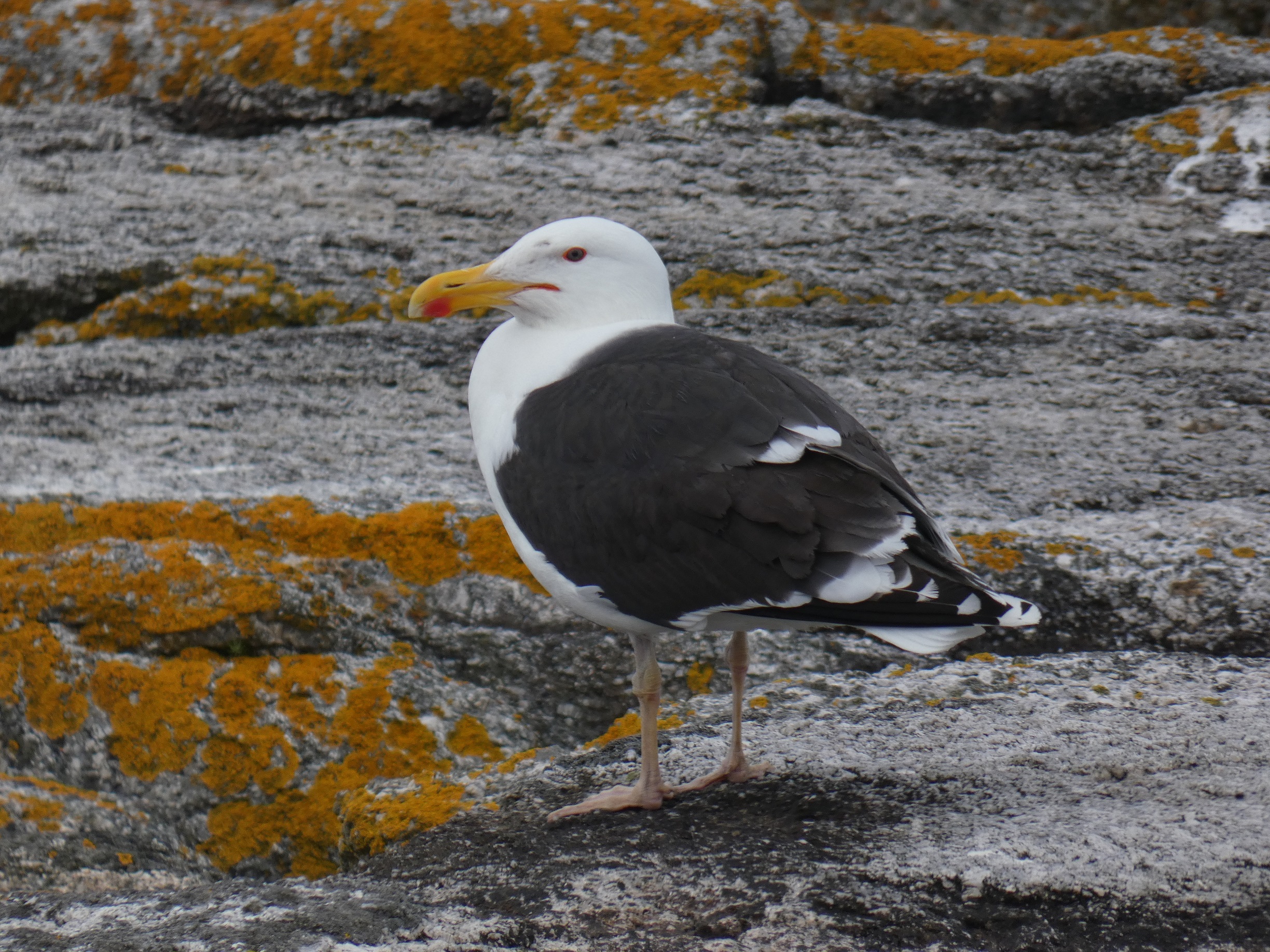
Great Black-backed Gull
Larus marinus
(pp.124–125)
Selected new records
| 2008 |
Breeding census The seabird census in late May recorded 57 pairs, virtually unchanged from the 58 pairs counted in 2004 (David Price et al./RSPB). |
| 2013 |
Breeding census The RSPB seabird census recorded a total of 50 pairs – similar to numbers in the two previous surveys: 58 and 57 pairs in 2004 and 2008 respectively (information contributed by David Price). A high total of 124 was recorded on 26 Nov (Neil Trout). |
| 2017 |
Breeding season 3 May – The highest count of the year was of 114 birds and 34 apparently occupied nests during a land-based circumnavigation of the island perimeter (Tim Davis). |
| 2018 |
Breeding census The all-island breeding survey of large gulls produced a total of 51 apparently occupied nests (David Price, Peter Slader et al.). |
| 2020 |
Breeding season 16 Jun – A land-based survey of the whole island perimeter produced a total of 62 birds. |
| 2021 |
Breeding season Nests were counted as part of the RSPB-led census of breeding seabirds, though this work was focused primarily on cliff-nesting species such as auks, Kittiwake and Fulmar, and there was no dedicated survey of large gulls in 2021 using the same methodology applied in previous years. The very low number of nests recorded – just 21 – was therefore thought to be unreliable in terms of an overall population estimate. |
| 2022 |
19 May – A walk of the whole island perimeter yielded a total of 74 individuals (Tim Davis, Tim Jones). Breeding census A complete census during May identified 43 breeding pairs, three fewer than the last fully comparable count in 2018 (Paul St Pierre, Antony Bellamy et al.) – see also remarks above for 2021. |
| 2023 |
Summary of all records The RSPB-led survey of breeding seabirds in late spring and early summer yielded a total of just 32 apparently occupied nests – a significant decline on numbers recorded in 2022 and 2018, reflecting the current parlous state of all three of Lundy's nesting large gull species. Highest monthly counts (log data): Jan 16; Feb 17; Mar 59; Apr 41; May 38; Jun 39; Jul 108; Aug 15; Sep 107; Oct 93; Nov 22; Dec 22. The high count in July reflects a dedicated effort to detect and read colour-rings (see under 'Ringing movements' below). |
| 2024 |
Summary of all records Highest monthly counts (log data): Jan 19; Feb 29; Mar 28; Apr 34; May 44; Jun 21; Jul 28; Aug 16; Sep 38; Oct 64; Nov 59; Dec 37.
|
| 2025 |
Summary of all records Highest monthly counts (log data): Jan 34; Feb 19; Mar 45; Apr 23; May 49; Jun 24; Jul 17; Aug 45; Sep 81; Oct 107; Nov 27; Dec 2 – but coverage minimal after mid-Nov. The first chick logged was at St Philip's Stone on 13 Jun. An adult was seen eating a Guillemot chick at Jenny's Cove on 11 Jun. The Jun max of 24 included 20 at Battery Point. Several high counts were made in the last week of Sep, including 62 on 23rd, 80 on 24th and 81 on 25th. The great majority of these were from the northern third of the island. Further high counts towards the end of Oct included 107 on 21st, 93 on 22nd, 100 on 23rd, and 76 on 25th. Number ringed during the year: 2 (chicks ringed at North East Point in late Jun; the first Great Black-backed Gulls to be ringed on Lundy since 2010). |
| 2026 |
Summary of all records Highest monthly counts (log data): Jan 30; Feb 23; Mar 16; Apr 36; |
|
Ringing movements Colour-ring field sightings: A concerted effort by Assistant Bird Observatory Warden Luke Marriner resulted in a superb series of colour-ring reads of gulls marked elsewhere and seen on Lundy in July 2023. These included nine Great Black-backed Gulls ringed as pulli (chicks) by Skokholm Bird Observatory, Pembrokeshire in the following years: 2015 (1) 2019 (2) 2020 (3) 2021 (2) and 2022 (1). All were sighted at Dead Cow Point, on the west coast of Lundy, between 5 & 23 Jul 2023. All except the individual ringed in 2015 would likely still have been of pre-breeding age; earliest breeding would be at four years but may not occur until the fifth or sixth year. Another individual, seen at Dead Cow Point on 17 Jul 2023, had been colour-marked as a pullus on Mullion Island, Cornwall in 2019. In addition, a Great Black-backed Gull found dead at Pondsbury on 1 Jul 2023 had been ringed on Skokholm as a pullus in 2015. |