


By Thomas Weston
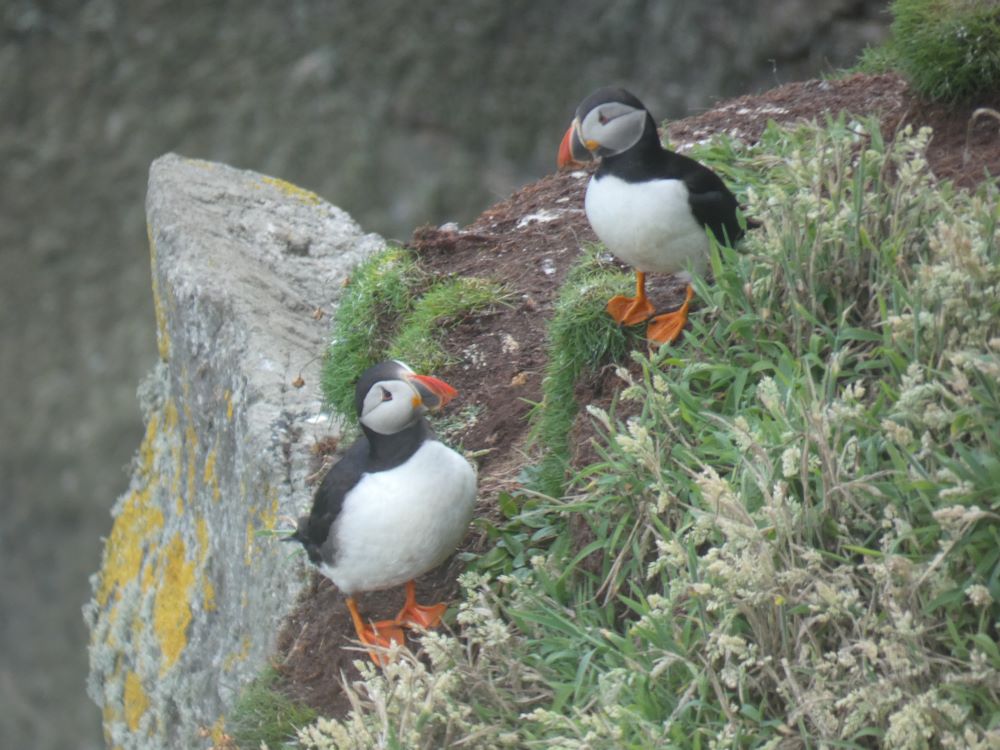 One of the main species affected by the winter storms, the Puffin. By Thomas Weston
Introduction
|
Species
|
2025
|
2026
|
% Change
|
|
Puffin
|
478
|
337
|
-29.5%
|
|
Razorbill
|
1456
|
1370
|
-6%
|
|
Guillemot
|
6854
|
6517
|
-5%
|
The results of the Jenny's Cove Coordinated count undertaken by the Lundy Bird Observatory on June 22nd 2026 showed that Puffin numbers were down 29.5% compared to the numbers in June 2025, the numbers of Razorbill were down 6% when compared to 2025, and the number of Guillemot were down 5% when compared to 2025. In comparison, the RSPB recorded 163 individuals in Jenny's Cove in May 2026 during the RSPB Large Gull Jenny's Cove specific Puffin survey, and 266 individuals across the whole island when undertaking the RSPB Large Gull survey across the whole island.
Discussion
The RSPB's May 2026 counts, and the Lundy Bird Observatory June 2026 counts show a marked decrease in the number of all auks in Jenny's Cove when compared to the standardised auk counts undertaken in June 2025 (RSPB showed a 65.9% decrease, whereas Lundy Bird Observatory showed a 29.5%). The counts demonstrated that Puffins fared the worse, Razorbills the second worst effected, and Guillemots the least. This data is fundemental to when comparing the annual changes in the auk counts of Jenny's Cove, as well as a measure of the longterm recovery of auks, including the Puffins, when compared to pre-rat eradication counts. Unfortunatley, we do not have any comparisons between any other seabird islands to compare to, however, based on the reports and strandings noted in the winter/spring newspaper reports, a decrease of all species was not surprising. Luckily, the phenology of Puffins means that wintering locations of a breeding colony can be several hundred kilometres difference. I.e birds who breed together, do not always winter together. Using this knowledge, the strandings of hundreds of thousands of auks, including Puffins across such a large area of the West Europe/Atlantic Coast, could have led to the complete demise of all of Lundy's Puffins. Unsurprisingly, it has been noted that Skokholm and other Scottish Islands have seen a decrease in the number of returning Puffins this year. This is a concern as in June 2025, an estimate of only 1500 Puffins across the whole of Lundy was recorded with 478 individuals in Jenny's Cove alone. As a result, the wrecks of winter 2025/2026, could have decimated the whole island population by a single wreck, or by multiple wrecks across the large geographic area of the storms. The frequency, and the relentlessness of the storms, during a period when Puffins returned northwards towards the United Kingdom to breed was devestating, though the fact that some individuals were wintering in different areas means that their population was affected on island, but not decimated altogether. As a result, we estimate that within a 2-3yr period, based on breeding success and good adult survival, the population could bounce back and increase once more. Productivity in summer 2026 was estimated to be 0.4 in Jenny's Cove. This productivity estimate was low, and conerning, but not 0 which is a positive. A good or high productivity is generally considered to be 0.6, so this year 20% less birds successfully fledged a chick than a 'good' year, and 60% less bird fledged a chick compared to an 'incredible' year. This productivity, alongside lower numbers of returning individuals in April demonstarted that those birds who arrived back were in poor condition. It could be that the surviving birds returned at the 'normal time', though due to the storms, began breeding later than they would normally. This was seen in the RSPB's May coordinated Jenny's Cove count whereby numbers were almost 66% down on June 2025. This could have been a result of birds sat on eggs later than the norm, and as a result, the numbers were more representable in June 2026 by the Lundy Bird Observatory team, as this was when most individuals would have hatched and were feeding chicks. A high count of 546 Puffins were recorded along the west coast between Old Light and Three Quarter Wall on the 18th July 2026. This high count was gathered when adult Puffins were almost certainly departing, and demonstrated a more representative count of west coast breeders. However, it is unsure how many were Jenny's Cove breeders, and if this count included birds from other areas of the island that were not counted as part of the Lundy Bird Observatory coordinated count. Looking forward, replicating the Jenny's Cove counts to understand how the numbers in the cove rebound and increase, will be an aim of the Bird Observatory going forward as with future climate chanage resulting in more frequent, and more extreme weather, winters similar to 2025/2026 will become 'the norm'. It is worth noting that Skomer was an exception to the rule, showing an increase to their highest ever level this year, and this was surprising given the widespread strandings and hundreds of thousands of dead birds reported elsewhere. Moreover, unlike the Treshnish Isles, Lundy has never really ringed enough Puffins to make a meaningful amount of data to determine how many of Lundy's Puffins are being found elsewhere and how many are returning to the island to breed in future years. Using the seabird register, we have productivity estimates for the colony in Jenny's Cove, however understanding our adult Puffins is an project we would love to begin. This would be especially important in years such as 2026 whereby BTO ringing recoveries gave an insight into the lives of the UK Puffins elsewhere.
Conclusion
Standardised Jenny's Cove counts of all seabird species, including our auks, is fundemental to understanding the island's seabird populations. The counts gained from the RSPB and Lundy Bird Observatory in Jenny's Cove in summer 2026 highlighted a decline in the number of Puffins, Guillemots and Razorbills this year compared to June 2025. Lundy Bird Observatory aims to continue its research of these species through productivity monitoring and daily counts, with help from the annual seabird assistant, the Bird Observatory assistant, and the work of the Conservation Team on the island.