


By Thomas Weston
Introduction
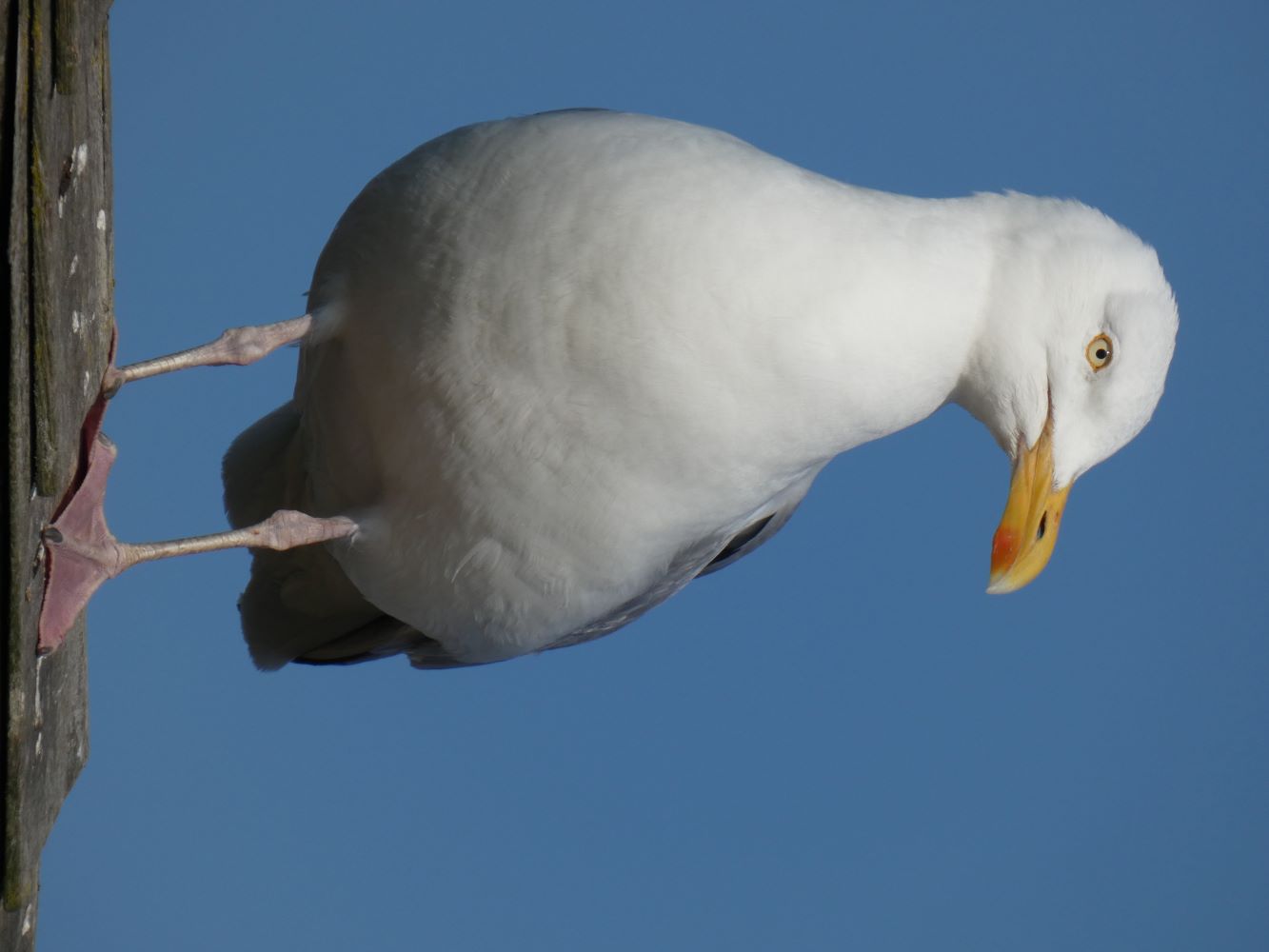 One of our breeding Large Gulls on the island, the Herring Gull by Thomas Weston
This survey was part of the three year scheduled monitoring of Large Gulls on the island since the early 2000's.
Aims
- To complete the four-year RSPB Large Gull survey to compare distribution and numbers compared to previous Large Gull survey results.
- To continue the colour ringing of Large Gulls to understand survival and return rates.
Methods
RSPB Large Gull Survey
The RSPB arrived for one week in mid-May to complete the Large Gull survey. Large Gulls in mid-May should be paired up, present in the colonies, and sat on nests. The standardised survey of Large Gulls on the island required splitting the island into sections and using the Seabird Register, the island was split into six sections. Within each section, viewpoints were labelled to allow the whole section to be surveyed from specific vantage points. Working in pairs, consisting of one Bird Observatory volunteer/staff member paired to an RSPB staff member, the nonintrusive monitoring was undertaken. The observers stood at the chosen viewpoint and recorded the species present, the number of individuals, the number of Apparently Occupied Nests, and mapped the distribution of the colony within the section. The results were compared to previous survey, to determine any recent population changes, as well as to the surveys from the early 2000’s, whereby the population was considered a baseline due to the rat eradication being completed, and population estimates were more standardised.
Colour ringing
Colonies whereby access could be achieved, licenced bird ringing staff, and volunteers accessed the Large Gull colonies in late June. The chicks were caught by hand, ringed with a British Trust for Ornithology (BTO) metal ring and fitted with a colour ring where possible. The chicks’ biometrics were taken including weight and feather stage. Chicks that were too small for colour ringing were metal ringed only, and chicks that were in poorer condition were also metal ringed only. Colonies were only accessed for an hour maximum and where possible, the number of nests were recorded per colony.
Results
RSPB Large Gull Survey
In 2026, the total island count for Lesser Black-backed Gulls pairs was 93 apparent breeding pairs: a decline of 3% since the 2023 survey, and a 79% decline from counts of over 400 in the early 2000s. There were 240 apparent breeding pairs of Herring Gulls: a decline of 2% since the 2023 survey, and a 69% decline from counts of over 700 in the early 2000s. Great Black-backed Gulls pairs fell to 28 apparent breeding pairs: a decrease of 13% since the 2023 survey, and a 20% decline from counts of over 50 in the early 2000s.
Colour ringing
In total, two colonies in the northeast of the island, one on the west, and one in the southwest of the island were all accessed. Altogether, 13 Herring Gulls and a single Great Black-Backed Gull were fitted with British Trust for Ornithology metal rings and weighed, but no colour rings were fitted this year due to size and condition of the chicks.
Discussion
The RSPB data from the Large Gull Survey 2026 demonstrates a continued decline in the three Large Gull species on the island since the Rat Eradication in the early 2000’s. This is the opposite to the other seabird species found on the island, with data from the survey showing Lesser Black-Backed Gulls had declined the greatest, followed by the Herring Gulls, and the Great Black-Backed Gulls too.
These long-lived, colonial species need to produce enough chicks to replace themselves. The chicks that fledge need to survive their first winter and return to the island to breed at the age of 3 or 4 when individuals begin to think about nesting. On island, during the nesting period, the birds are amongst the rocky cliffs, with some colonies within areas of Bracken. The different feeding strategies used by Large Gulls to gain enough food for their chicks is important to ensure successful fledging from the colony. It is known from studies across the country that the Lesser Black-Backed Gulls from coastal breeding grounds are highly pelagic, finding fish out at sea and in the Atlantic. From observational data, it is shown that the Herring Gulls are feeding in agricultural farmland on the mainland, with evidence of worms and plastic gloves found in regurgitated pellets, and a continual presence around the domestic sheep feed on island too. Unfortunately, without tracking of the Herring Gulls on the island, we can assume that some birds are also finding the preferred fish too, though from observational data it is difficult to determine. Moreover, the Great Black-Backed Gulls are scavengers, they are known to feed on the other gull chicks, as well as the chicks of a range of seabirds on the island. Observational data from the season shows they have been seen amongst feeding frenzies offshore and sometimes took seabird chicks from the cliffs. However, it seems as though the amount of available food is low. Taking feeding behaviour into account, the colony data still shows not only a reduction in numbers, but a reduction in the size of the colony too, with some colonies consisting of only a few breeding birds in a specific area. Thus, potentially because of environmental effects resulting in low productivity and a reduction in the number of breeding adults present.
During the Large Gull chick ringing period, whereby we entered the colonies for ringing and colour ringing, we found that the Large Gull chicks were too small for colour ringing. Where access could be made, there seemed to be high mortality amongst the chicks this year. There were empty nests recorded, and eggs with failed broods in them too showing that breeding success this year was poor. It is assumed, though cannot be backed up yet, but the breeding success of the Large Gulls has been low for a few years with a lack of individuals between 1-3 years of age present. We are unsure the effects of Highly Pathogenic Avian Flu (HPAI) in 2021/22, however it was noted that adults were affected than juveniles. Juveniles who were ringed last year were not seen this year on the island, and observational counts of juveniles amongst Large Gull roost flocks on the plateau showed that juveniles were not present. Therefore, a mixture of low reproduction, low replacement, but potentially good adult survival, has resulted in a gradual decrease in the population. A decrease in the number of adults from HPAI could have shown a catastrophic loss of birds within a few years, however this does not seem to be the case in the previous three years since the last survey.
Conclusion
We thank the RSPB for undertaking this survey on the island. Large Gulls continue to show a downward trend on the island, and we aim to continue monitoring of the colonies to understand the causes of decline.