


By Thomas Weston
The day was nice and calm, a slight breeze passed and I awoke to start housekeeping today. One of the first birds seen was a Sparrowhawk, casually passing by in the breeze being mobbed by some Swallows. Greg was on census and was also on housekeeping but starting at 10am, rather than 8am. There was a noticeable passage of birds; to begin the sound of Skylarks and Meadow Pipits filled the air as birds attempted to move south. Greg noted a Snipe and 2 Pied Flycatchers in Millcombe, a Firecrest above the Casbah, as well as 4 Redstarts, a Golden Plover, and a Whinchat all on the plateau.
Whilst Greg, Eleanor and I were moving between accommodation cleaning, it seemed as though there were lots of birds about. When driving between Millcombe House and Brambles, a Spotted Flycatcher, a Redstart, and 2 Pied Flycatchers were on Battlements Corner. A somewhat of an oak woodland vibe, it was nice to see them flitting between the canopy. There were a couple of flyover Ringed Plover whilst in Brambles and then the Swallows started streaming through. At first there was a big pulse, maybe 100 per minute, equating to 1500 birds in 15 minutes at least. However, when the boat arrived and some guest birders arrived, they estimated passage to be 1 per second. They watched for two and a half hours, gaining more than 7500 Swallows passing their watch point. It was obvious passage did not die down between Brambles and Old Light, with an additional 1000 birds noted by our driving team.
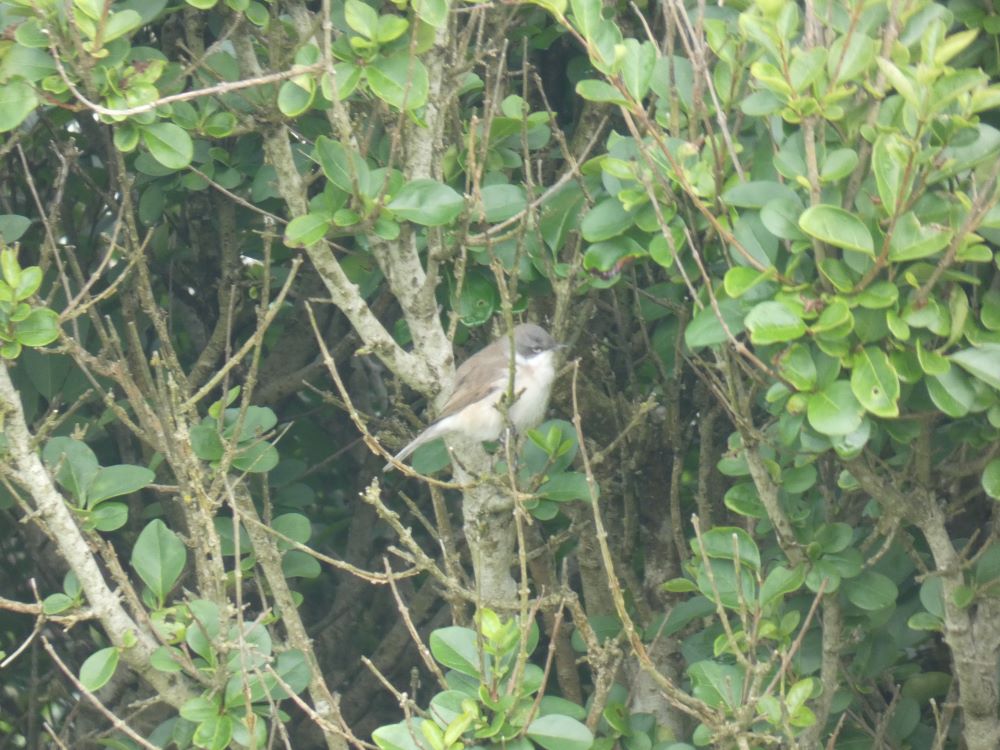 Eastern Lesser Whitethroat at Stoneycroft by Greg Lee
At Old Light, we finished cleaning and moved to Stoneycroft. It seemed the best day of the autumn so far for migration and species diversity. When peering into Stoneycroft’s garden, it was nice to see a Lesser Whitethroat. Wait, a Lesser Whitethroat?! This is not only an island scarcity, but we had to remind ourselves it was the end of September and not the end of July when most think of, or already start, migrating. The bird was preening and seemed quite tired too. It also did not fit the ‘usual’ slaty grey head and generally grey kind of bird. This one was a sandier colour, brown sand that went to the head and merged in with the grey of the forehead. It was a bird with white outer tail feathers, almost certainly an Eastern Lesser Whitethroat and highly likely ‘blythi’ if we were to determine subspecies from the field. Greg got my camera and got some pics. All of a sudden, a second Lesser Whitethroat joined the party. This one your more typical-looking bird and presumably a late nominate migrant.
After we completed housekeeping and additional tasks, plus dinner, it was already 6pm and not long before sunset nowadays. The trio of us decided to try and catch the island scarcity, for a better and more scientific understanding of the subspecies we were debating. With a bit of luck, some behaviour watching, and some great teamwork, we managed to catch and ring the bird and take some much-needed biometrics and photos too to help. All this information pointed towards it being an Eastern Lesser Whitethroat as first thought, but determining subspecies will have to be left to those with more knowledge.
Elsewhere, a Quail was seen, the first since the big summer influx.