


Bird Sightings
21/05/2026 – A Few Surprises
By Thomas Weston
The morning started with me going down to Millcombe to lead a Lundy Field Society (LFS) Ringing demonstration. It was rather breezy from the SW and there was fog on the plateau which did not fill me with much hope. However, parts of Millcombe were calm and the nets I planned to open were in the shelter. The meetup and start time were both 6am, though on walking down I could hear people chatting and having tea and coffee. It was only a couple of mins after 6am but everyone was super keen, and I was just opening nets!
I was joined by another S permit ringing trainer Rackie, as well as conservation team member Maddie (with Alex), plus 20 LFS participants. The session started well with a nice range of species. Singles of Goldfinch, Linnet and Blackcap were nice, followed by a couple of Chiffchaff, an unusually new male Dunnock in full breeding attire, as well as a pair of Chaffinches – one being new and the other a retrap. The surprises came in the form of the ‘Acros’. We ended up catching 3 Sedge Warbler and 2 Reed Warbler. Amazingly, whilst the ringing demonstration was going on we ended up seeing at least three more Sedge Warblers fly in off the sea and land in Smelly Gully, and a third unringed Reed Warbler remained singing in Millcombe Pond. Where else would you like to be when that’s the best habitat around?
The session ended around 10:00, though I was lucky enough to see some of the moths from the LFS Moth Trapping session too. A personal favourite was Chinese Character, though the Buff Tips are always fun to see.
Back to birds and there was a burst of Spotted Flycatcher migration noted on the way up to the Tavern. This was also noted by Greg who was on census this morning. At first he initially saw at least five in Millcombe, though birds migrating through led to at least seven being seen whilst walking up after the end of the session – in reality I think there were a few more! In addition to this there were at least four along the East Coast, and I subsequently found another at Old Light, so there were at least twelve on the island today.
Whilst Maddie, Emma and Greg were helping RSPB undertake some seabird surveys in Jenny’s Cove, the rest of the Conservation Team consisting of Simon, Tara, Eleanor and I met a wildlife film crew who are keen to showcase our Puffins and Manx Shearwaters. We showed them a Puffin colony on the west coast, and we saw about thirty-six individuals on the water which was nice and gave food for thought for the coming filming days. We aimed to show the team the Manx Shearwater study colony, though some logistical issues led to this being delayed until the evening. As a result, we walked back to the Village and before we had a well-earned chill, after the 5am start and busy daytime + nighttime schedule, the next surprise flew overhead calling. It was a Red-throated Pipit, a rare bird who has not been recorded on the island since 2023. The bird gave two or three calls as it flew over heading from East to West. The bird was independently heard by me and a fellow bird watcher who were both close in distance, but unaware of each other’s presence or the fact we both heard the bird. We discussed our observations of this bird and confirmed each other’s thoughts and beliefs. Amazing!
Ready for the evening ahead and a night on the cliffs with the Conservation Team and hopefully some Manx Shearwaters too! And with the wind noticeably dropping, the temperatures rose! The cold, miserable, windy and wet weather of the past few days was just a memory as the warm, high pressure rose from the south. Surely there will be some rather more special birds on the way!
20/05/2026 – No rain today!
 Small Adder's-tongue by Greg Lee
19/05/2026 – More Rain
By Greg Lee
The rain swept in overnight with the horizontal element to the downpour causing an early wrap-up to our LFS Manx Shearwater evening, the strong precipitation would last well into the morning, curtailing census in the adverse conditions.
However, with the rain subsiding late morning, members of the Conservation Team were able to join the RSPB in counting the gull colonies along the southwestern corner of the island. Despite the strong breeze, it was good work out there with the stunning scenery and landscape complemented by carpets of Thrift and the familiar scent of the emerging Bracken along with some of the Mint that grows on the slopes. We have recently acquired something to record a rare moth associated with Thrift and hopefully we can report on some success when the weather begins to calm. Some Bluebells still remain in flower, a plant I normally associate with woodlands still emerald green from freshly-emerged leaves at this time of year, but on Lundy seems quite content on growing around Ackland's Moor and elsewhere on the island. On the other hand, the purple-blue of emerging Sheep’s-bit Scabious battled to outshine the Bluebells in terms of who can claim the title of superior blue flower.
 Thrift by Greg Lee
Back on to the birds and it was a positive turn out for the gulls, with the Lesser Black-backed Gulls perhaps doing slightly better than expected, their smart yellow legs glowing as they sat amongst their colonies. A couple of Great Black-backed Gull nests were also spotted, these overlords of the cliffs often choosing isolated areas away from the other gull species, who aren’t keen on being close neighbours with their brutish cousins. Interestingly, there seemed to be a good number of Razorbills about, possibly suggesting that they are spreading around the island to new areas, with many birds whirring off the cliffs and over the waters close by. Gazing out to sea, a constant stream of Manx Shearwaters was also evident, having probably appreciated the foul conditions the previous night to return to the cliffs. A good flying demonstration by a pair of Peregrines was also appreciated. Over near Old Light, a lone Painted Lady was being thrashed about by the winds.
Later on, with the winds ramping up, a report of a possible interesting bird had us scouring the airfield, though perhaps sensibly, apart from a few Meadow Pipits, most birds were laying low. However, a consolation was a lone Ringed Plover feeding nicely on the turf near the Water Tanks, these birds being fairly scarce visitors to the island in most years.
 Ringed Plover by Greg Lee
18/05/2026 – A Wet and Wild Day on the island
By Thomas Weston
This week started at around 4:30am this morning, when some extremely heavy and persistent rain fell across the island, and it seemed to last for a good 20mins or so. Getting that extra rest we awoke and enjoyed watching the weather from the comfort of our house for a little.
Today we had a day off and some free time, so me and Eleanor were keen to join the RSPB Large Gull survey that is currently being undertaken across the island. The survey involved counting individuals within each section of the island, and making a note of any sat on something that resembles a nest – aptly known as an Apparently Occupied Nest (AON), which is a technique we use for studying and calculating the number of breeding pairs of seabird species on the island. During the nicer weather on Saturday, the team made a conscious effort to complete as much of the South and East when they arrived, before finishing the last of the East coast yesterday. Meaning only the West coast to complete today! We met up at 09:30am and joined the team, consisting of four RSPB and three Conservation Team members. We had a briefing, protocol and risk assessment read before we split into two smaller teams consisting of Eleanor, two of the RSPB colleagues, and myself, and then Emma and the other two RSPB colleagues. Our team headed to the Battery and began counting gulls within the first survey square, whilst Emma and her team headed to Aztec Bay. After completing our first site, we headed to Jenny’s Cove to complete our second square, before Emma and the team headed North into their second survey square too.
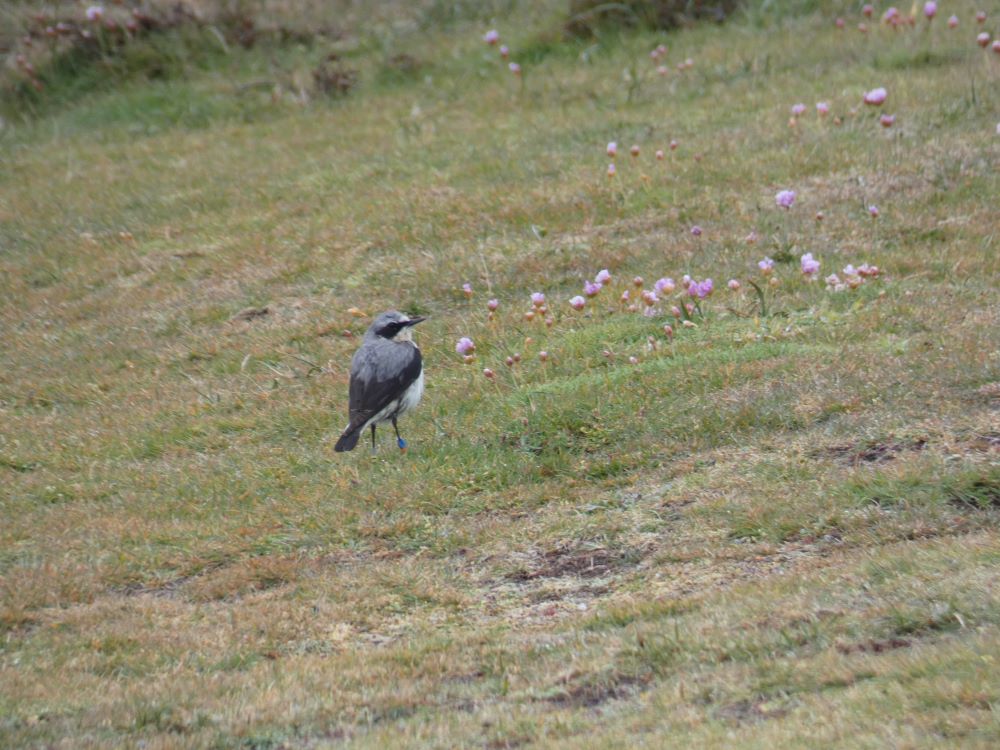 A wet Wheatear at Dead Cow Point by Thomas Weston
Some our survey highlights included a nice range of gulls, including Lesser Black Backed Gull, Herring Gull, and Great Black-Backed Gulls including some on AONs which was amazing to record and see! It was not only the gulls we saw, but good numbers of 2500+ Guillemots, 100+ Puffins, and 500+ Razorbills within our sections. A flyby Gannet, some resting Fulmars on AONs and a frenzy of nest-building Kittiwakes made up the seabird festival. Walking on back, the weather deteriorated, but we did see a colour ringed Wheatear near Dead Cow Point. This male had also been seen by a guest which was quite funny. The Wheatear colour ringing team are on the island currently, so please keep an eye out for some colour ringed bids – one of ‘our breeders’ is a Skokholm ringed bird first seen last year.
We spent the afternoon taking it easy and having a more relaxing day off before giving the Lundy Field Society ‘Discover Lundy’ group a Manx Shearwater talk and walk. The evening was successful with a 45-minute talk in the Church followed by a brief wander out to a colony. The weather was atrocious, gusting 40mph and horizontal rain was not the most fun, but we quickly found a bird and processed the retrap. We walked back with the team and finished at a rather respectable time of 11pm.