


By Greg Lee
It was a glorious sunny morning for my census today with just a light NW wind on the top of the island. After a very clear night, it perhaps wasn’t surprising that the bushes weren’t filled with newly arrived birds, but it seemed like the perfect conditions to keep an eye on what was moving overhead. Sure enough, Sand Martins, House Martins and Swallows were arriving in off the sea all through the morning along with flocks of Linnets. Birders on the mainland Devon coast have been reporting large movements of the latter over the past couple of days. With the sun gleaming off the sea from the east, looking down at the Landing Bay was a bit more of challenge but after scouring the surface, the Great Northern Diver was sitting happily, having avoided the attentions of a Grey Seal the previous morning. Millcombe is currently full of Blackthorn blossom, and this is a magnet for many of the warblers pushing through with small numbers of Willow Warblers and Chiffchaffs interspersed with the occasional Blackcap this morning. The regular Treecreeper also made itself known by calling from the Pines area. When the local Sparrowhawk buzzed through, even the vocal Song Thrush dived down into the scrub, but the birds were quickly back to normal with a couple of minutes. If you are visiting the island, the Millcombe Song Thrush is a well-known individual with a particular penchant for mimicry. Just today it imitated several waders including Curlew, Greenshank, Green and Common Sandpipers. On top of that it also seemed to be enjoying doing Crossbill and perhaps most strangely, the harsh alarm-call of a Grey Squirrel. Has this bird spent some time in woodland next to an estuary? Heading to Benjamin’s Chair, Sand Martins were whizzing past me and I was surprised to see two cliff-feeding Willow Warblers in this area. Less surprising was an impressive raft of Razorbills on the sea, I could hear the birds rather deep calls drifting up the cliffs as they sat tightly-packed on the water. Over on the airfield, the Skylarks were in full song, and the Meadow Pipits were also squeaking around in various parties. The male Kestrel was also hovering in the still winds, usually I encounter this bird sat on the Quarry cottages or nearby rocks.
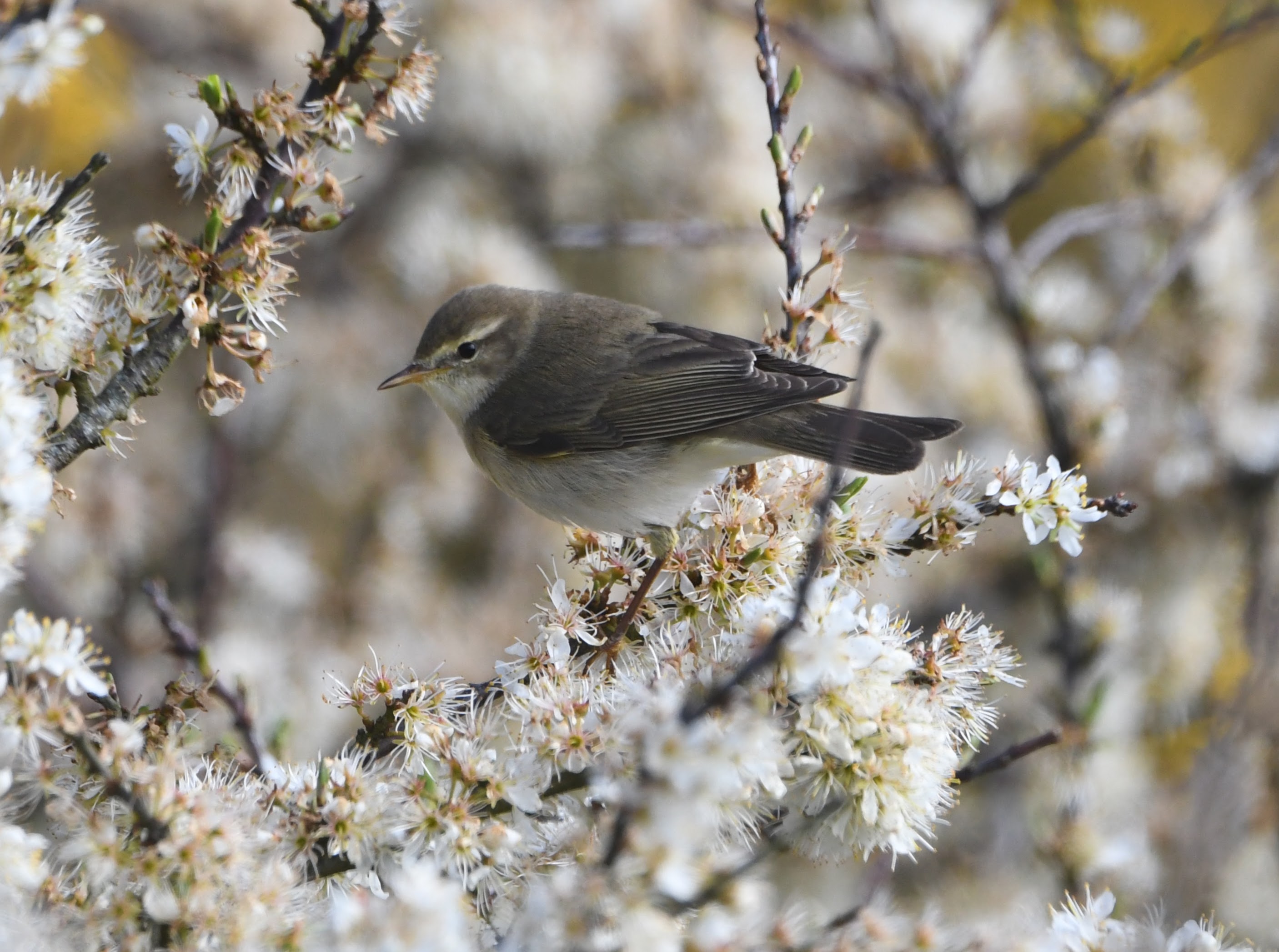 Willow Warbler Millcombe © Greg Lee
After census, I decided to briefly check on Millcombe again as the sun had risen considerably and there may have been a mid-morning arrival, which is a feature of island bird migration. Although there wasn’t a great deal more in terms of birds, at least two Peacock Butterflies were feeding up on the blossom whilst overhead two Peregrines were wheeling high over the valley amongst some Herring Gulls. I also took two students from the Imperial College London to the Manx Shearwater colonies on the West Coast. Over the next two weeks, they are hoping to collect the calls of up to 50 different individuals, as a part of a wider study into variation in bioacoustics between different Manx Shearwater populations. Whilst enjoying the sun on the slopes of the West Coast, more Sand Martins and Swallows were passing through, Puffins and Razorbills were sat on the sea and there was plenty of Wheatear action amongst the rocks. The slew of Common Dolphin records also continued with another 20+ feeding distantly offshore.