


Bird Sightings
June 9th Sightings - Blue-headed Wagtail remains
 Yellow Wagtails Flava (female) and Flavissima (male) in Bartons Field. ©ThomasWeston
The female Blue-headed Wagtail and the male Yellow Wagtail were seen again in Barton’s Field and showing very well.
On census, 3 Mallard were in Barton’s Field, a Feral Pigeon, 23 House Sparrows and 70 Starlings was in the Village, and a single Swift flew North. Millcombe was sheltered quite a bit from the breeze and held a single Woodpigeon, a flyover Sand Martin, 7 Swallows, 2 House Martins, single Willow Warbler, single Chiffchaff, 8 Wrens, 5 Blackbirds, single Song Thrush, 5 Robins, 3 Dunnocks, single Blackcap, 2 Whitethroats, 6 Chaffinches, 21 Linnets, 11 Goldfinches. From the Ugly, 4 Oystercatchers were seen. Moving around to Benjamin’s Chair saw 134 Guillemots, 41 Razorbills, a single Shag, a single Fulmar, and a single Rock Pipit. In the fields, 7 Wheatear, single Stonechat, 6 Great-Black Backed Gulls, 97 Herring Gulls and 6 Lesser-Black Backed Gulls were spotted, as well as 3 Carrion Crows, 3 Ravens, 7 Skylarks. In the Village, 4 Collared Doves, 70 Starlings, 23 House Sparrows, single Pied Wagtail, 8 Meadow Pipits.
June 8th Sightings - Census Counts
A breezy Northernly wind braced the island again today.
 A male Stonechat from the Ugly. ©ThomasWeston
On census, 5 Mallard were in Barton’s Field and a single Feral Pigeon remained in the vicinity of the Lambing Shed. Walking through Millcombe, this was by far the busiest place on the route with a single Woodpigeon, 6 Collared Doves, 4 Swallows, 4 House Martins, 2 Chiffchaff, a single Blackcap, 4 Whitethroat, 13 Wrens, 9 Blackbirds, single Song Thrush, 2 Robins, 5 Dunnocks, single Chaffinch, 35 Linnets and 6 Goldfinches.From the Ugly, a single Oystercatcher was in the Landing Bay, as were 2 Manx Shearwater, 2 Gannets, and a single Shag. Benjamin’s Chair saw a single Kittiwake, a single Rock Pipit, 54 Guillemots, 21 Razorbills, 29 Puffins. Gulls were seen at the latter two sites but were spread across the census with 15 Great-Black Backed Gulls, 165 Herring Gulls and 7 Lesser-Black Backed Gulls spotted, with the majority in the fields. Other counts from the fields included a single Peregrine, 6 Carrion Crows, 6 Ravens, 5 Pied Wagtails, 7 Skylarks, a Wheatear, 4 Stonechats (2 from the Ugly), 34 Starlings, and 16 Meadow Pipits. A Grey Heron was the best on Ackland’s Moor Pond, an unusual site for this species to be found. A flock of 20 House Sparrows were noteworthy in the Village.
June 7th Sightings - A Blue-Headed Wagtail
Even though we are stuck in NW winds, a female Blue-headed wagtail was found in Barton’s Field today. Meanwhile, House Sparrows and Starlings are currently undertaking their second broods, with both species currently being impacted by the cold, sometimes wet weather we are experiencing. We caught a good number of Manx Shearwater last night with a range of new and retrap birds from previous years recorded.
June 6th Sightings - Jenny's Cove Seabird Surveys Day 2
The second of a two-day seabird census in Jenny’s Cove was undertaken today with the help from RSPB staff. The census considers every cliff face and aims to count as many of the seabirds in the Jenny’s Cove area. To confirm our findings, results will be posted in a subsequent update on our Latest news tab. However, for you keen readers, totals just for Jenny’s look really positive so far, so let’s hope tomorrow will be similar.
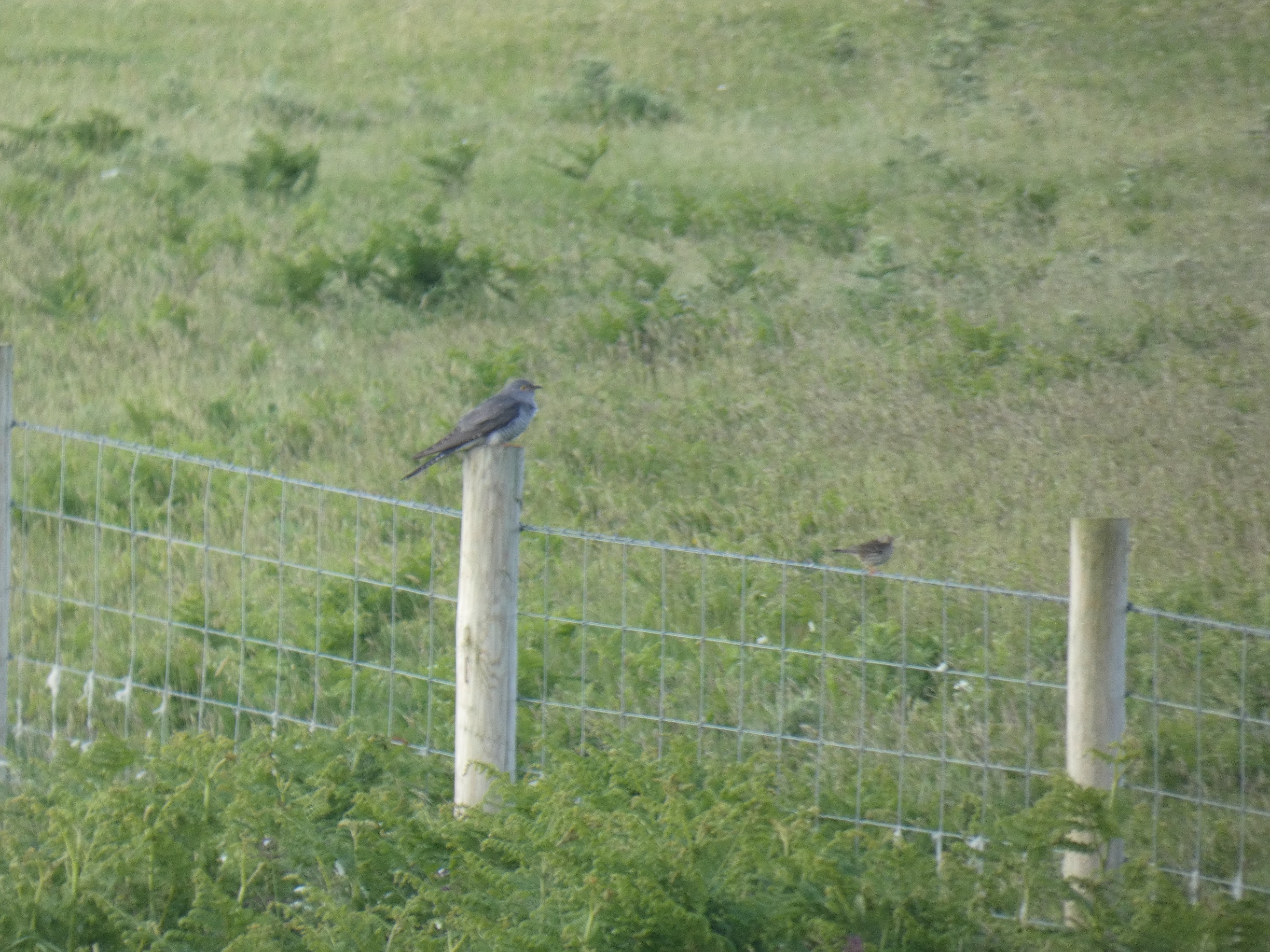
Cuckoo with Meadow Pipit at QuarterWall. ©ThomasWeston
In other news, census highlights included a Cuckoo being mobbed by Meadow Pipits at Halfway Way/Old Quarry Cottages, a Swift flew over North, 4 Collared Doves, 97 Guillemots, 22 Razorbills, 31 Puffins, 2 Gannets, Grey Heron, a slight passage of Hirundines.
Our Seabird surveys are in full swing so we are graced by thousands of seabirds whilst we monitor the productivity plots across the island.