


By Jessie Dermody
My morning began with a short walk over to the Castle to join a seawatch organised by some volunteers from the mainland! The Sea Watch organisation has a large network of volunteers who regularly survey for cetaceans from land, and these two volunteers in particular visit Lundy every year to run a series of watches. Unfortunately, there were no cetaceans around this morning for us to record. We did, however, spot four Gannets, a Peregrine and a Kestrel.
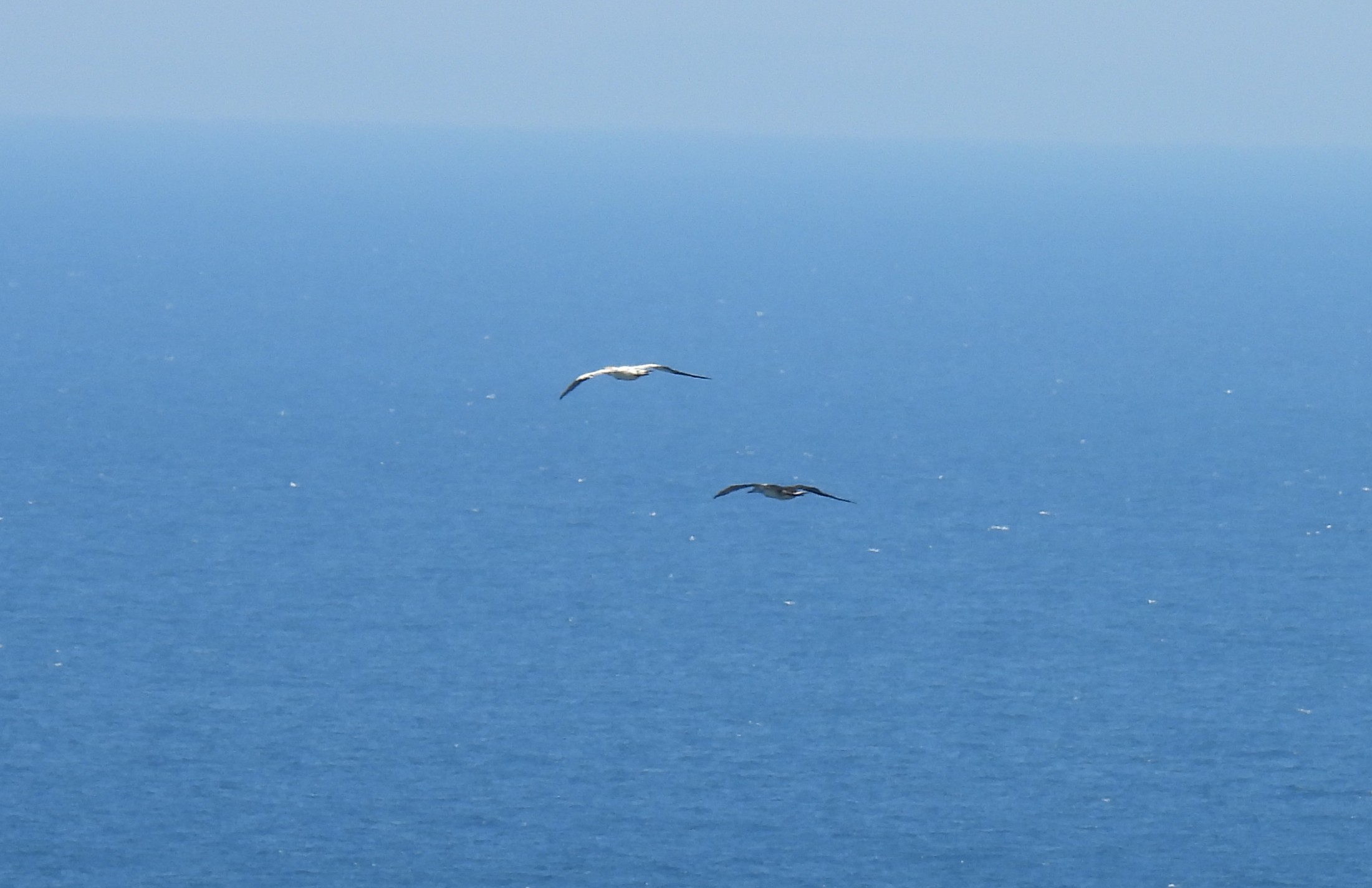 Adult and juvinile gannets on the wing. Photo by Jessie Dermody
After some lunch and admin in the tavern, Chloë and I headed to the landing bay for a BRUV deployment. We dropped the BRUV on the north side of Rat Island, right on the edge of a rocky reef with lots of kelp. During this hour-long deployment, we recorded five fish species, three cnidarian species and a lobster! I was able to identify some seaweed species in the footage: Mermaid's Tresses, Forest Kelp and Wireweed.
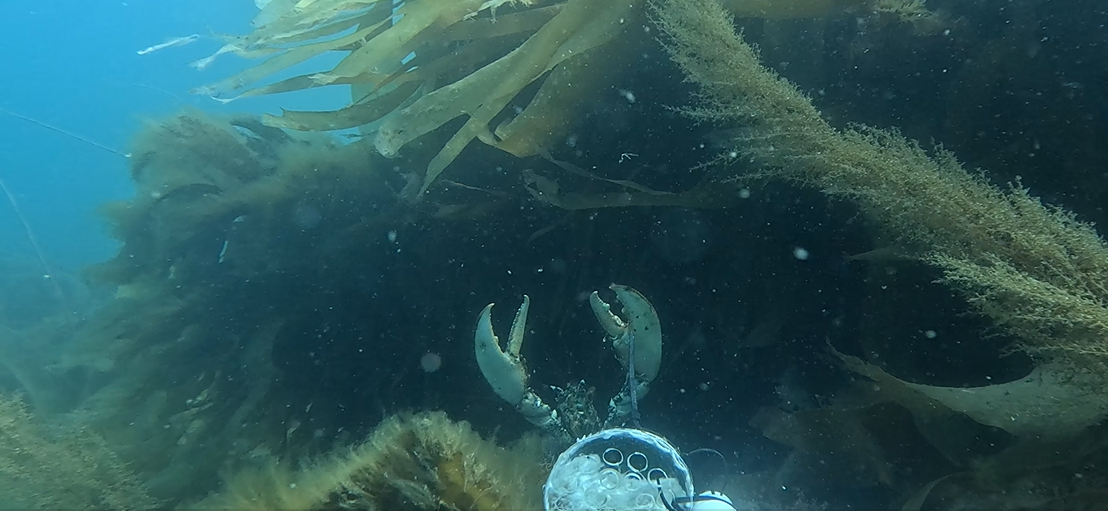 A screengrab of the lobster approaching our bait!
The data we collect from the recreational fishing area in the landing bay will eventually be compared to data collected in the landing bay. From this we should be able to determine whether the No Take Zone is higher in species richness than the fished zones around the island. Today we recorded two Corkwing Wrasse, one of which was an adult male. There is a good chance that these two corkwings could have a nest in the rocks near our deployment site. We also had 2 Ballan Wrasse, 6 juvenile Pollack, 2 Sea Bass and 13 Two-Spotted Gobies.
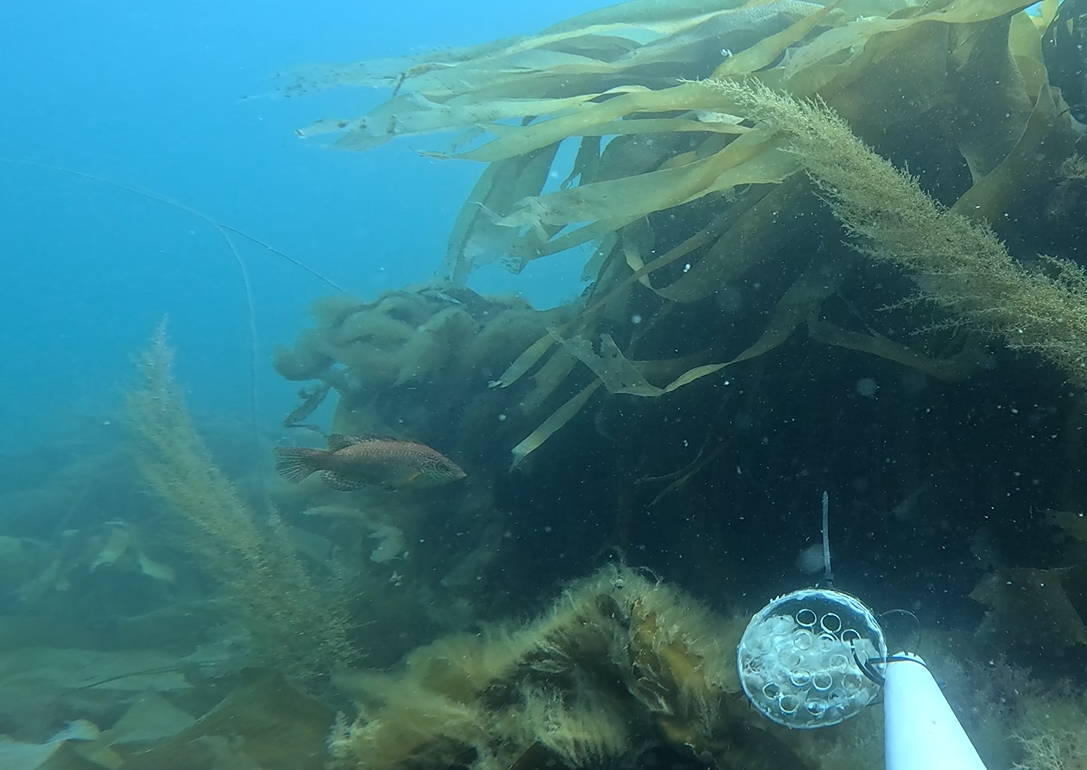 A male Corkwing Wrasse approaching the kelp forest.
Once we had retrieved the BRUV, I enjoyed a little free diving, during which I spotted a large Candy-Striped Flatworm, the two Sea Bass we caught on camera earlier, and many more jellyfish – including a beautiful Blue Jelly which I managed to swim into. Luckily their stings are only as painful as nettles. I ventured back down to the Landing Bay much later that evening, with some other brave swimmers on the island. We hoped to swim with the bioluminescent phytoplankton in the water after sundown. It was a perfect night for it, as the moon was waning and rising very late. The bioluminescence was visible from the surface of the water in the shallows, but swimming off the jetty was truly magical. We all sparkled beneath the water, it felt like swimming through the night sky! The columns of the jetty also glowed, as barnacles feasted on the shining plankton. After a lot of excited squealing and splashing, we all headed up the hill to bed, dodging the Manx Shearwaters as they came in to land near the road.
 The best photo I could get of the bioluminescent algae in the waves. Doesn't really do it justice, but proof that it was there!