


By Thomas Weston
Today was a travel day on a Tuesday. The jet stream position has caused us to receive some pretty strong west winds and today was no different, though the good news was that the boat was still coming. MS Oldenburg was predicted to arrive around lunch time, and it was the day a college group were coming over to the island to learn about conservation, predator-prey relationships, mark and recapture, and of course to see some seabirds. As a result, Simon asked me to come and join him as we showed them some of the best bits of the island in relation to their study aims.
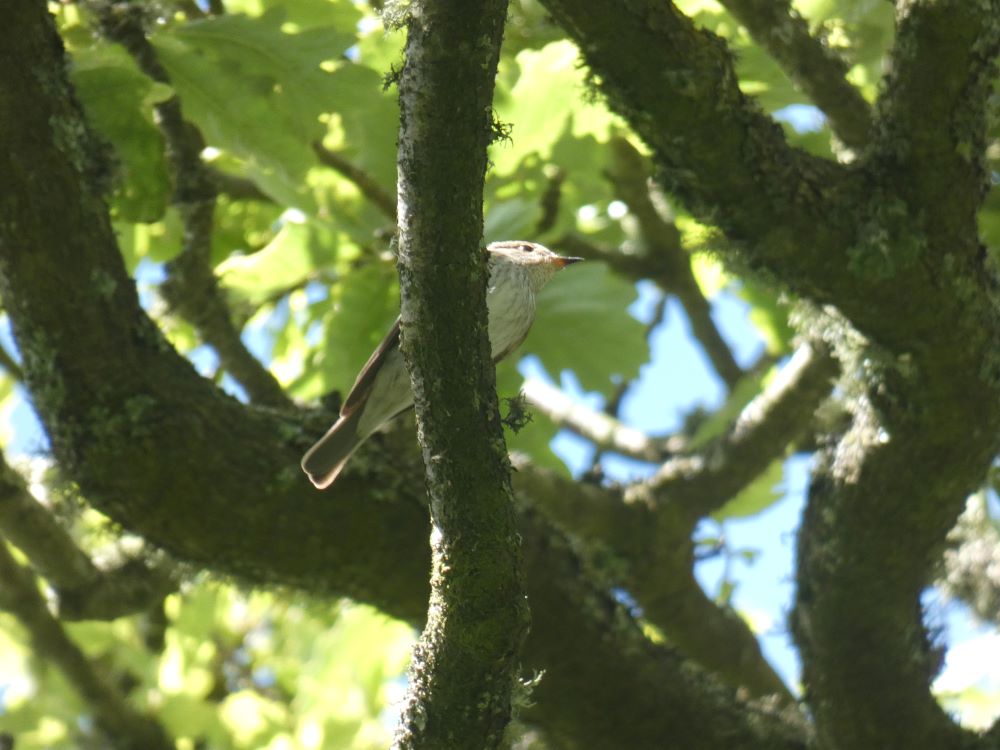 Spotted Flycatcher Millcombe by Thomas Weston
However, I started the day by undertaking census. Census is not compulsory in June or July, though the route ensures we gain an understanding of the local breeding birds – to add to our Terrestrial Breeding Bird Survey, to gain totals to add to our Logbook at the daily log, to enthuse new visitors to record species and totals whilst out and about, and to attract more birders to the island to experience some of our special species. The census went well with a very good 38 species noted across the area. Notable highlights included a good passage of Manx Shearwater and Gannets too, and a nice range and number of juvenile birds, more on that below. The Channel Wagtail pair continue to feed young, we have yet to find this nest due to the drab conditions and disturbance risk, though we are not sure how successful they will be as they are formed of a pair of related individuals! Not great. Breeding birds were noted across the area. Singing Spotted Flycatcher, Song Thrush, Wrens, Willow Warblers, and Chiffchaff were recorded, birds were seen carrying food to nest sites, and a presence of many fledged juveniles filled the area with a range of begging calls. Juveniles noted included Stonechat x2, Starling x23+, Blackbird x3, Carrion Crow x2, Mallard x10 (6,4,1), Raven x1, Meadow Pipit x2, House Sparrow x5, Goldfinches x4, Linnets x5, and Chaffinch x4.
I then checked one of the Manx Shearwater boxes with Eleanor, Jayden, and Emma. We were expecting to see a very small 1-day old chick, however on arrival it seems this is not your ‘average date’ Manx Shearwater and the incubation for this bird was a little longer than the average. We will have to check in a few days’ time, at the max incubation date for this individual.
Back in time for tea, before heading on down to the Jetty with the Cargo Team and Simon. Having not seen a boat in this year, I was asked to throw the ropes for the front of the boat. Something that I have not done for a couple of years, but as with all these things, having done it as a volunteer a few times it was easy to remember. College group and the boat was successfully docked and there were no wet ropes or laughs from the crowd, success!
The group were happy to be on dry land, having been a rough crossing with some very green faces coming off the boat. We took them up Millcombe and showed/talked to them about Lundy Cabbage, our mist netting set up and even found a Slow Worm too! Lunch called before a trip to Jenny’s Cove and the seabird bonanza that is currently being observed here, whereby lots of seabirds were present. We saw Puffins with Sand Eels, so we have some Pufflings, and we saw some Razorbills with food too, so we know there are a few chicks of them too. However, Guillemot and Kittiwake are late with no chicks seen yet! Before we knew it, it was time to head back to the boat. A few Wheatears and Linnet pointed out on the way back, as well as our Highland Cows and Lundy Ponies finished this exciting trip with a few minutes to spare to go around the shop too.
My day finished with Wildlife Log and a collation of sightings from the day. Busy, but worth it!