


By Emma Abel
This morning started cool as Greg and I headed out to carry out some Puffin, Guillemot and Kittiwake monitoring before the heat of the day began. Jenny's Cove was busy with the usual calls of adult Auks accompanied by the high pitched peeps of their growing chicks echoing up from the shelves down below. As a couple of weeks passed since the first chicks were seen, some of the Guillemots and Razorbills are almost big enough to pick a nice evening and jump off their cliff down into the water. Puffins take longer to develop from hatchlings to fledgelings so I continued my observations of adults bringing Sandeels back to their burrows. Quite an entertaining sight as their speed of entry into smalls is quite impressive, such velocity employed in order to avoid other birds robbing them of their hard earned fish. Especially relevant for those that have their front doors right next to hungry Herring Gull and Lesser Black-Backed Gull nests.
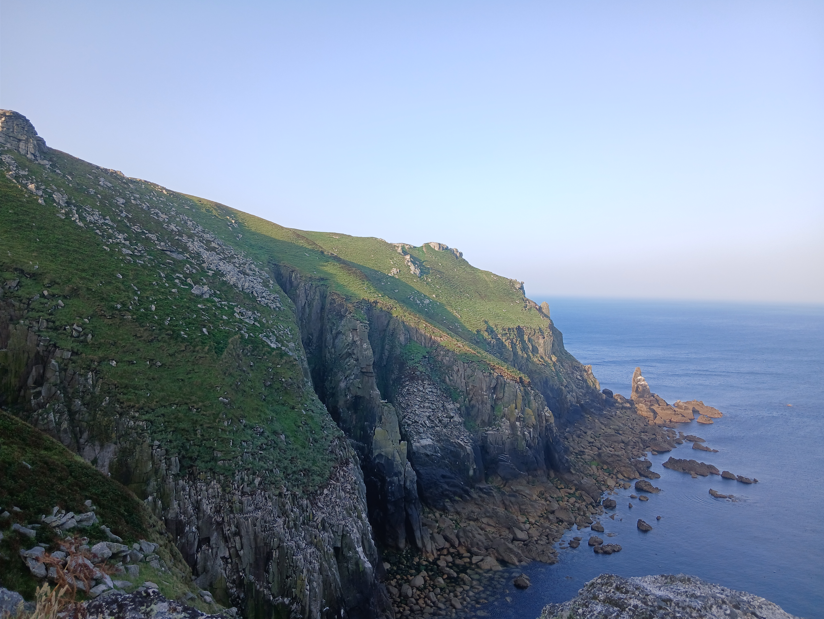 Jenny's Cove in the morning sun by Emma Abel
Most Puffin chicks, affectionately known as Pufflings, stay deep in the safety of their burrows waiting for their parents to ferry in a fresh load of fish. However, occasionally when they are big enough they will wander to the entrance of their burrow and look out at the world, which was a special sight that I got to witness today! As I was scanning the cliffs, I noticed a small dark bird sitting next to a Puffin and was delighted to realise that it was a young Puffling with its smoky features opposing the bright colours of its guardian that quickly ushered it back into the burrow.
Another interesting sight from the cliffs was a Razorbill perching on a rock, showing off its legs which were a yellow colour unlike the usual dark black legs of its species. Presumably a genetic mutation leading to an unusual colouring, that had not affected its plumage in any way.
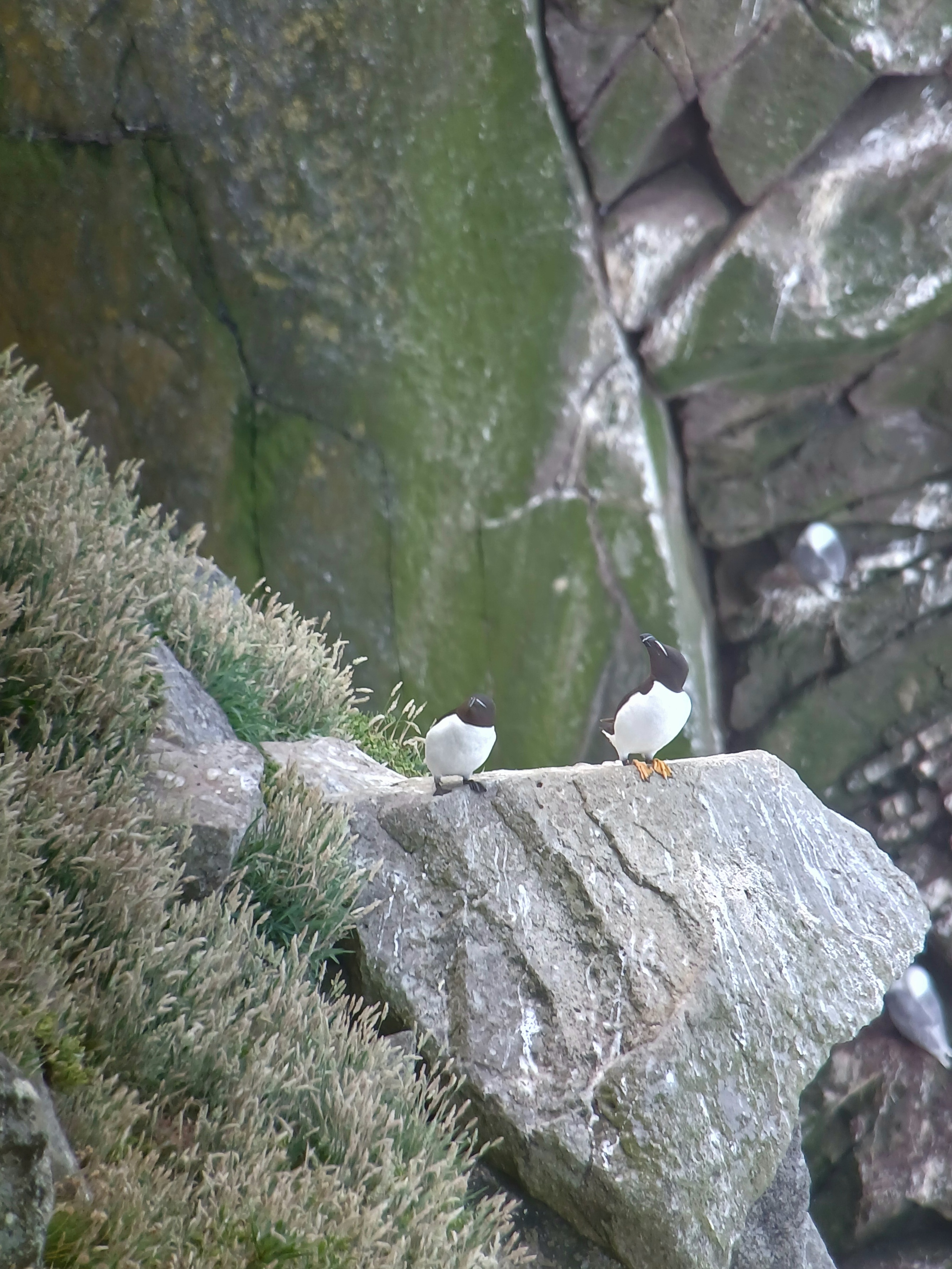 Razorbill with yellow legs by Emma Abel
After finishing my Puffin monitoring, I headed to Aztec cove to join Greg as I have not seen my Aztec plots and wanted to get a glimpse of some chunky Kittiwake chicks. As we were heading back up the cliff, Greg noticed a gull being bothered by a large raptor, excitedly pointing it out to me while trying to find it as it dipped down behind the hill. Binoculars trained on the mysterious bird we saw that it was in fact a Buzzard! A bird that seems so common elsewhere in the UK, yet on Lundy is an uncommon sight to see, with this individual being the first since August last year. We saw the Buzzard lazily flying away inland, losing sight of it until 30 minutes later, when setting up for Seabird Station we once again heard the gulls alarm calling and had a lovely view of the bird soaring overhead, heading inland once again.
We ended the afternoon with a very pleasant Seabird Station, chatting to visitors in the sun. No more pufflings were seen but people were very pleased with their colourful Puffin sightings and a large Herring Gull chick was providing the baby charm.