


Bird Sightings
27/04/2026 – Seabirds and sunshine
By Emma Abel
Today was a glorious day on Lundy.
Last night we set out the moth trap as the night was due to be warm and cloudy – ideal conditions for trapping. We had 21 moths of 6 species, the most abundant species being Brown Silver-line, of which we trapped 9. There were also 4 Bright-Line Brown-Eye, 3 Marbled Coronet, 3 Common Quaker and 1 Garden Carpet. Finally, our largest moth of the day was the Brindled Ochre, a chunky moth suited to coastal habitat, with an amicable face.
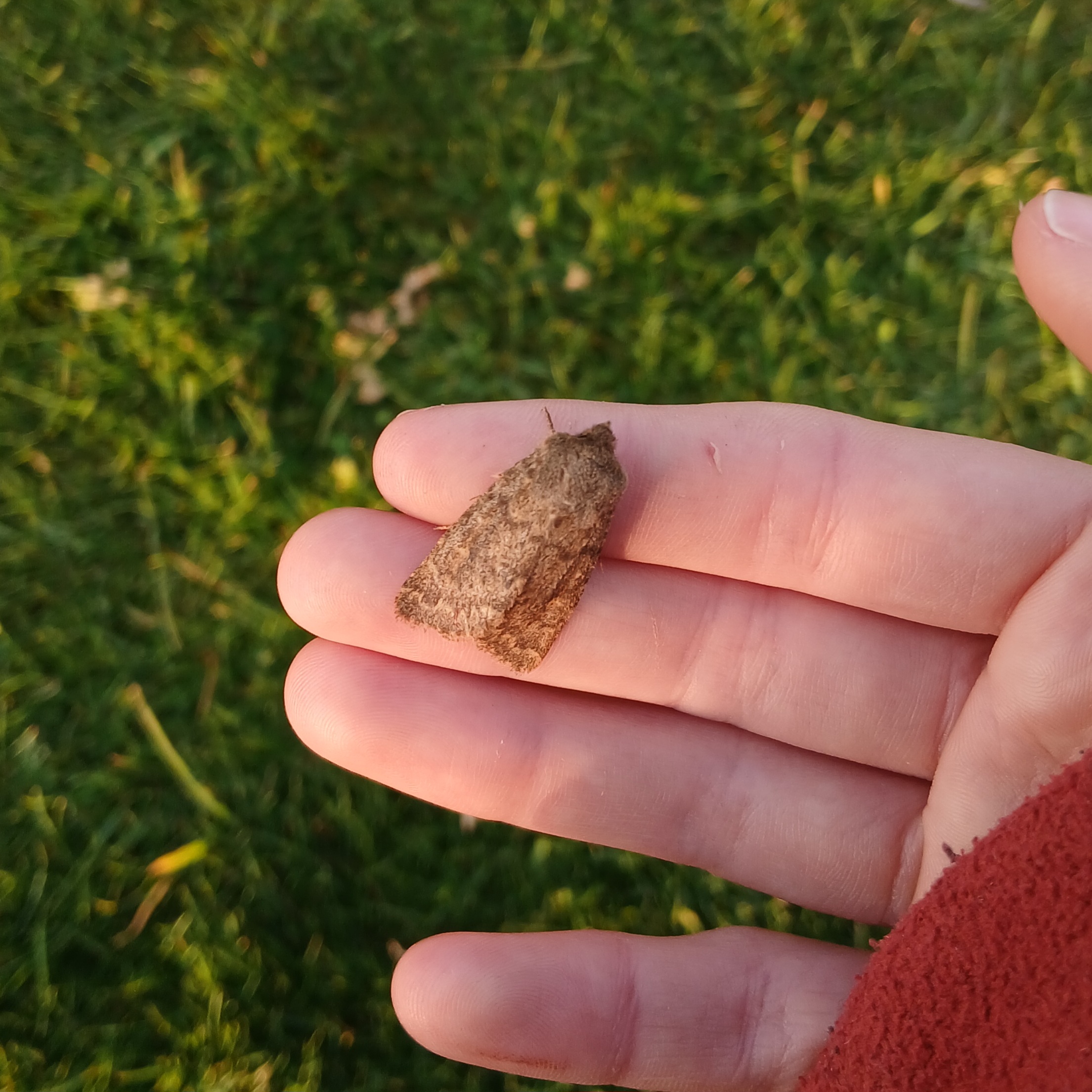 Brindled Ochre by Emma Abel
As it was such beautiful morning, the mist nets were also set up for a bird ringing session, where a good mixture of species were recorded and ringed. One bird stood out the most, which was a Nightingale caught in the laundry garden by PHD students working on the Sparrow project. It was aged as an adult and based on several plumage features, it was confirmed to be a different individual to the one seen yesterday at Quarter Wall. Additionally 5 Sedge Warblers, 2 Blackcaps, 1 Whitethroat, 1 Linnet, 1 Goldfinch, 1 Chiffchaff and 3 Willow Warblers were ringed and 1 Dunnock re-trap.
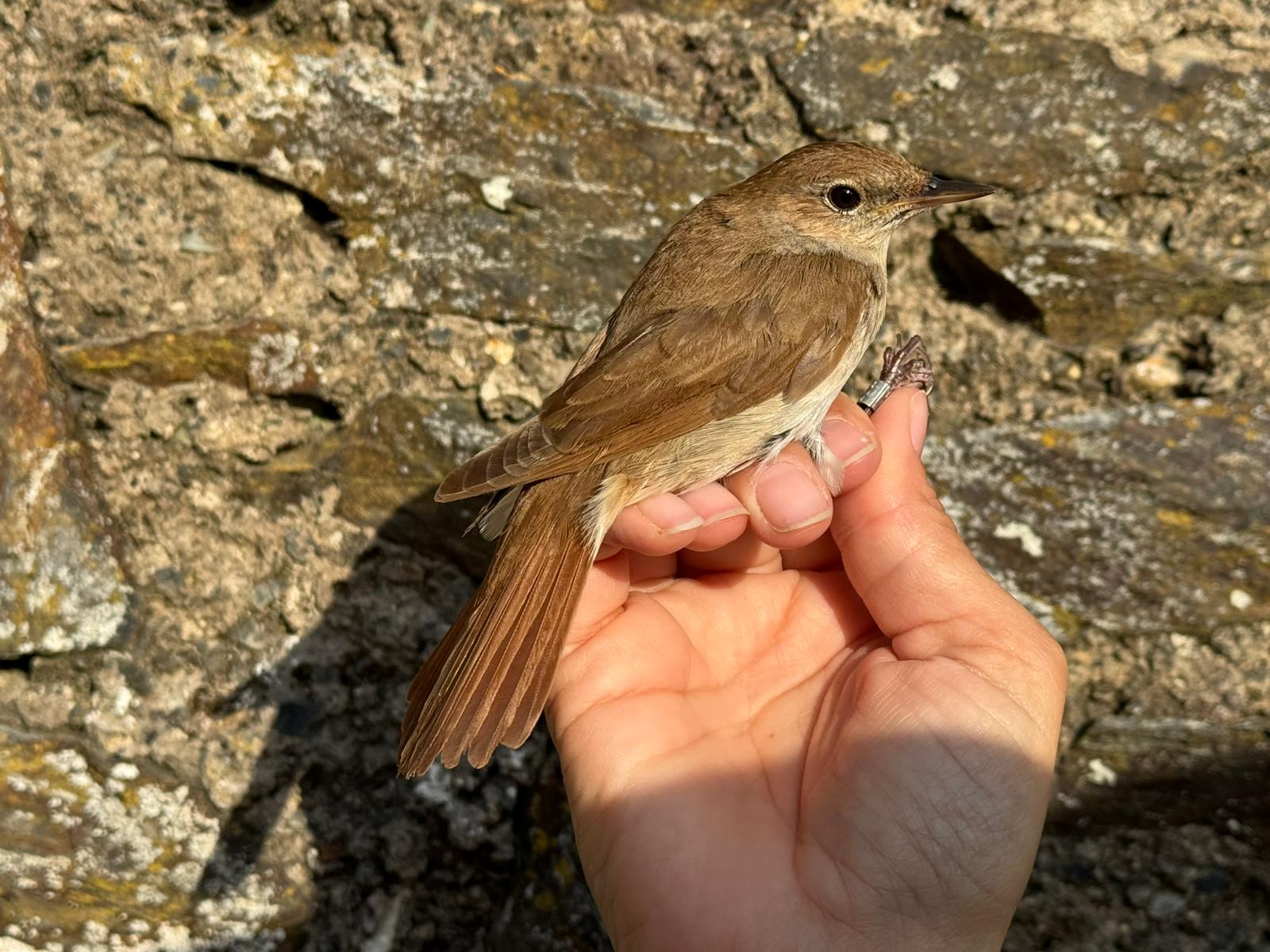 Nightingale
I left the ringers to go to Jenny’s Cove to carry out my Puffin monitoring. The cliffs were much fuller today, which is a relieving sight after last week’s empty shelves during the strong easterly winds. There were 83 puffins on the slopes going in and out of burrows, billing with their partners or just sunning themselves in the morning rays. These are still low numbers for the Jenny’s Cove Colony, and we do hope to see the population increase. The light brown Leucistic Puffin was back on the colony today, prospecting various burrows, most of which seemed to be occupied by existing pairs that did not want company. As for Guillemots, the shelves were very full with an estimated 2000 birds packed in around the cove.
Additionally, this afternoon a female Dotterel was seen at the North End, along with a Lesser Whitethroat and a Spotted Flycatcher at the Terrace.
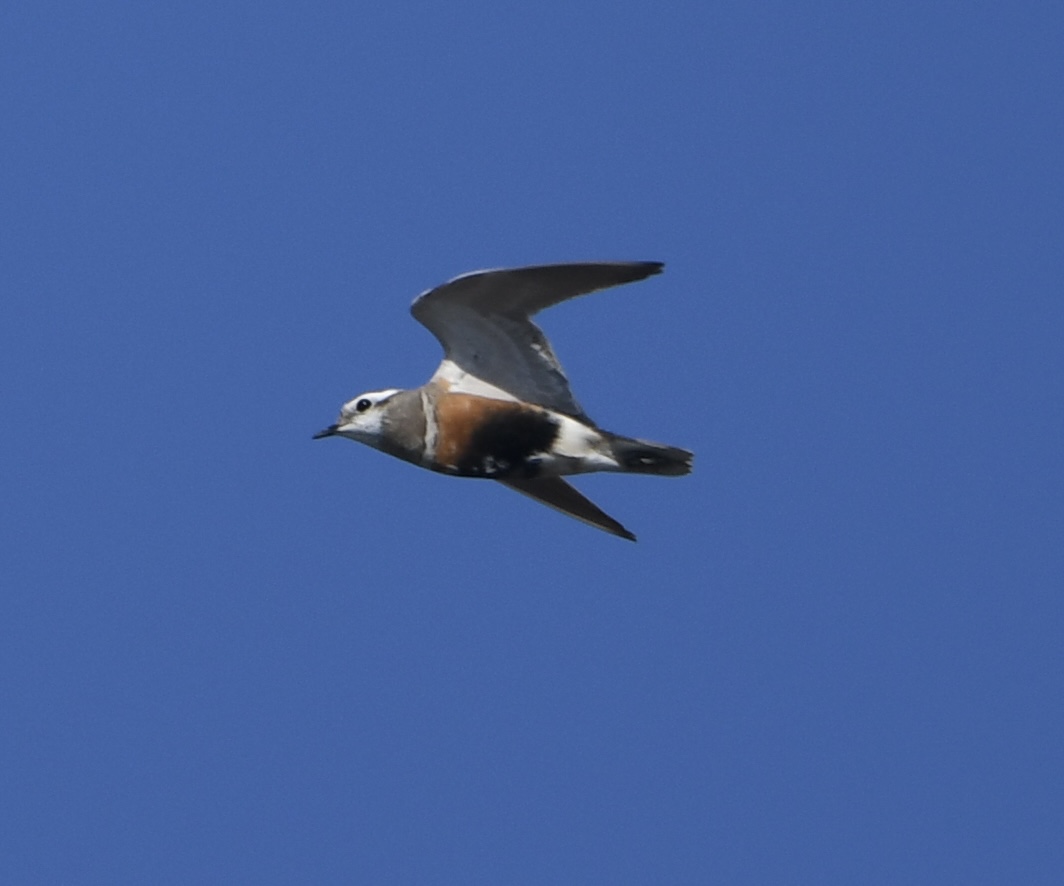 Dotterel by Greg Lee
26/04/2026 – What The Fog Brings...
By Thomas Weston.
After a very quiet session yesterday in Millcombe with just a single Linnet caught in 1hr and 15mins, I awoke to a nice red sunrise and high cloud. Cloud is something we have not seen on the island the last few days so it was maybe a sign of things to come. Or a warning to those who listen to shepherds.
Anyway, getting ready, clothed and fed (in the morning light as it has got to the stage where the ringing o'clock is before generator turn on), I looked out again to see that a thick sea fog had rolled in. Undeterred, I walked down to Millcombe. The fog was not damp, in fact it was incredibly dry plus still! Also something that until yesterday evening was not something we have seen on Lundy at all.
Nets open and we started catching some new migrants. The fog lifted a bit and a Whitethroat came into the net. The two Collared Doves were displaying in Millcombe, having only arrived the other day, and there was a sense of movement with Chiffchaff, Willow Warbler, and Blackcap bouncing around. A female Pied Flycatcher was near the Battlements and we [Eleanor, Greg, Ben and Emma] continued ringing. The next net round was slightly quieter, the fog came down again and we caught a new Sedge Warbler. Slope net had been checked but had nothing in, but then as me and Ben walked down I saw a bird fly in. I asked Ben to go and extract it and he toddled on up and extracted, not saying too much to begin until he came down. Topics of conversation had included overshoots and potential rarities. Ben then asks "How easy would it be to tell a Western and Eastern Subalpine Warbler at this time of year?" Not knowing what was in the bag, he then followed by saying "because I have one in here!"
 Eastern Subalpine Warbler caught and ringed in Millcombe © Tim Jones
 Eastern Subalpine Warbler male in Millcombe © Tim Jones
 Eastern Subalpine Warbler in Millcombe © Tim Jones
 Eastern Subalpine Warbler in Millcombe © Tim Jones
A slight surprise came over me so I quickly had a look at the bird in the bag and very quickly confirmed it to be a Eastern Subalpine Warbler the first of the year, and looking at records within the South West and Ireland, seemingly the first Eastern recorded this year!? Much excitement and many phonecalls to the local (within a few mins walk) birdwatchers, plus those in Millcombe already led to about 10 birders seeing the bird. Amazing! The session continued well with a great diversity of species. A A Reed Warbler was a Lundy scarcity, whilst other captures included a few new Chiffchaff, Willow Warbler, Blackcap, Whitethroat, Linnet, Goldfinches plus retrap Blackbirds and Robins.
We packed up at 12:00 and helped set nets with the Sparrow Team in the Village. A few warblers later and we managed to complete some house tasks. Being our day off, it was nice to be able to do some indoor bits we have been meaning to do for a while! Not in the highest number of hours as the Tims found the 10th Nightingale for the island this century and we were sooo close to going to see it but decided to head back down the Millcombe for some more migrant ringing. We passed a couple of Pied Flycatchers, a Spotted Flycatcher, a few Chiffchaff, Willow Warblers and Blackcap before opening the nets for a short while. More migrants trickled through until dinner and log were called.
What a day and one to remember!!!
Until tomorrow.....
25/04/2026 – A Sparrow Special: guest blog by the Sparrow Team
Sparrow Team are currently busy trying to catch House Sparrows but will update as soon as possible.....
 Sparrow drawing © Heleen
Hello I’m Heleen. I’m a student at ‘Wageningen University and Research’ in the Netherlands. Currently I’m in my master program, studying Forest- and Nature conservation. My main passion are bats, which is also the field of research in which I specialize. However I have also done some smaller projects regarding sparrows and swifts in urban areas.
I have always thought the sparrow is a really interesting bird to study. As it is a species that thrives in a lot of places around the world. So when I saw a possibility for my internship to go to Lundy and help as a field assistant at a sparrow research, I was more than thrilled.
For the coming weeks I will be helping Bea with her research. It is my first time capturing and analysing sparrows (or birds in general) and I have already learned so much from Bea. Whether it is setting up mistnets to capture the sparrows or analysing the individual birds based on their colour rings. I hope to learn even more when I’m here.
I will also be doing my own research, which will be based on sparrow behaviour. I will be using video data to analyse parental behaviour connected to the partner choices female sparrows make.
Next to my research, I am also enjoying the beautiful nature here. Trying to draw as much of its wildlife as I can see. And of course one sparrow each day.
It’s my first time being on Lundy and I have an amazing experience so far.
 House Sparrows in the Village © Beatriz Taboada
Hi! My name is Bea, and I’m a second-year PhD student at the Netherlands Institute of Ecology, studying the house sparrow population on Lundy Island. You might wonder why a Dutch PhD (I’m actually Portuguese!) is studying sparrows on Lundy when they are (or used to be) so common everywhere. The reason is that the Lundy population is quite special. The island is far enough from the mainland to prevent most sparrows from migrating. This isolation allows us to monitor the entire population very closely, including the breeding season—a dataset that has been collected for over 25 years. In fact, if you’ve seen the sparrows around, you probably noticed they are all colour ringed. That makes individual identification much easier (feel free to let me know the colour rings of sparrows you may have seen during the day)!
My project focuses on the microbiomes of these birds. A microbiome is a community of microorganisms—such as bacteria, fungi, and viruses—that live in an organism. They can be either helpful, if you think about the gut microbiome and its essential role in digestion, or harmful. Microbiomes can be found in the gut, but also the mouth, skin, feathers and even the reproductive system. While we know quite a bit about how microbiomes affect human health, much less is known about their role in wild animal populations. So, my aim is to understand how the microbiome can influence the ability of birds to reproduce and survive. Ultimately, I hope this research will contribute to the conservation and long-term health of wild populations.
24/04/2026 – Wagtails and Whitethroats
By Thomas Weston
When I awoke, the calmer winds made our accommodation seem a bit more stable and still. A positive sign for the day ahead! Whilst getting ready a message came through saying there was a Wood Warbler in Millcombe. The first of the year and a rather stunning warbler, in my opinion.
 Greenfinch in Millcombe by Thomas Weston
We attended travel day meeting, and I set off to begin census. A Yellow Wagtail was heard flying over Barton’s Field and a Greenfinch heard singing before being spotted in the trees were the first two birds noted. An amazing start. Walking through the top of Millcombe and it seemed active; a few Willow Warblers and Chiffchaffs bounced along the bushes and a Pied Flycatcher was seen flycatching from the bottom of the pines. We have suspected our Goldcrest have been busy nesting, and it was nice to see the female hopping around the pines and feeding up, maybe collecting food, or perhaps failed. It is hard to tell.
 Blink and you miss it, Wood Warbler in Millcombe by Thomas Weston
The Landing Bay has been a bit of a blow out recently. We dream of passing terns, small gulls and skuas, but these seem to arrive on the south coast of the UK, cut across inland, and pop out on the River Severn/further up the Bristol Channel. Demarking the channel/Atlantic means the best I could muster were a couple of Shag and Kittiwakes plus the usual large gulls. Back in Millcombe and the sounds of Dunnocks, Goldfinches, Linnets, Blackbirds, Wrens and even our Song Thrush were active today. I bumped into the Tims’ and spotted a Blackcap and saw the Wood Warbler too before it became more active and headed off up the valley
 Dunlin Barton's Field Thomas Weston
A member of public reported a Common Redstart male, though sightings throughout the day noted at least two around the island. Another staff member turned up and showed a photo of three Yellow Wagtails in Lower Lighthouse, all of the ‘British’ Flamissma.
 Blue-headed Wagtail female in Bartons Field. ThomasWeston
However, they relocated to Barton’s Field and were joined by a female Blue-headed Wagtail and a male Channel Wagtail too, plus a White Wagtail and one of our breeding Pied Wagtails. And to add to the wagtail craziness, a Dunlin remained showy all day and was even seen on census too.
Out of Millcombe and our Razorbills were back in force, over 300 were noted this morning. More excitingly, a pair of Rock Pipits appeared on Benjamin’s Chair. After noting their scarcity recently, it was nice to have them back. Walking through South West Field and all three hirundine species came through. Then a Tree Pipit was flushed by a Meadow Pipit before heading off towards the Chair direction. Walking to Old Light and the Whimbrel was still present, looking less tired but still feeding well. Upon reaching the lighthouse and another Tree Pipit dropped out of the sky and hid in the long grass. It was nice to see and presumably was the bird I saw heading north over me when crossing the Airfield. Quarter Wall held a nice Wheatear pair, whilst a singing Whitethroat was a nice spot. The rest of census was good with Starlings, House Sparrows, and a Peregrine to name a few of the species overhead.
An afternoon wander to help with the feral game stock drone surveys and species of note included Redstart, Pied Flycatcher, a few new Whitethroat, and the wagtail fest.