


Bird Sightings
31/05/2026 – The last (official) spring census and a Quail!
by Greg Lee
Census today and technically the final patrol of the spring season, as we are expected to only do coverage until the end of May. However, since early June can provide some interesting records some years, we will be continuing to do a bit more until the middle of the next month. Census itself was pretty quiet, with little of major note and the general quietening down that can be expected of migrants at this time of year with a solitary Spotted Flycatcher at Millcombe being most obvious. The Golden Oriole remained in the same trees above the Casbah continuing my hot streak of familiarity with this particular bird.
A Spotted Flycatcher at Old Light was a nice record in the always attractive garden at Stoneycroft. Over the spring I’ve had various Warblers, Redstart etc. in this small area, I’m interested to see what may turn up in autumn in the bushes.
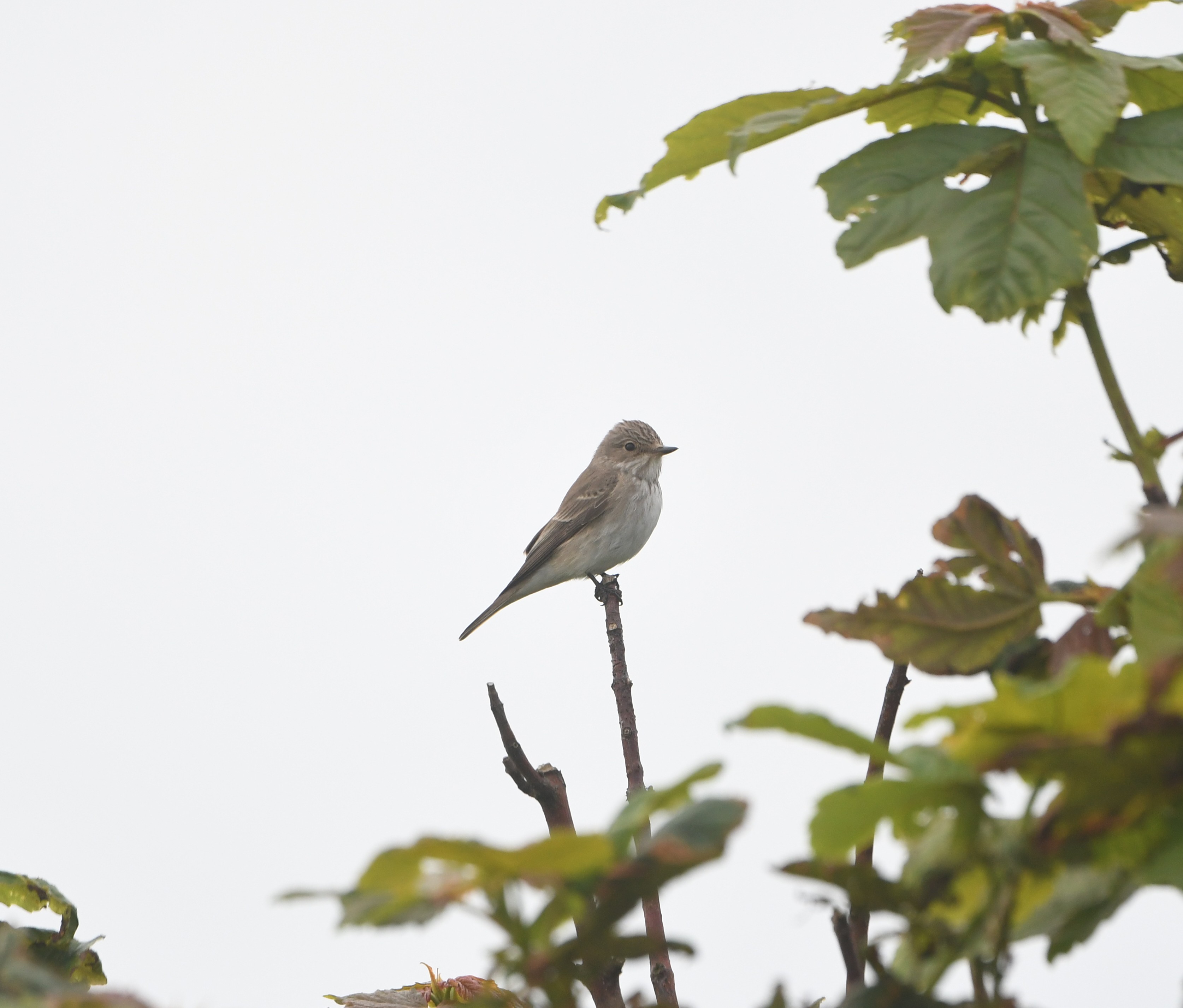 Spotted Flycatcher by G.Lee
This week, my parents are visiting the island so later on, I connected with them for a walk up northward to North Light. Naturally, birding wasn’t the aim of the trip, but it would’ve been most remiss of me to not bring my camera and binoculars. Passing Quarter Wall, an Emperor Dragonfly cruised by, whilst Small Heath butterflies dance and skipped over the short turf. As we passed Quarter Wall Pond on the main path, I saw something small and brown run into the grass on my left-hand side. Perplexed, I walked towards the clump of where I flushed a small, compact and streaked bird up from the ground, giving a short, sharp “meep” call as it flew. It was a Quail! The first I’d ever flushed and actually seen in the UK (having come across a few singing from deep cover in various locations), the bird didn’t fly very far but it did go quick and low over the ground with whirring wings before diving into the rushes near Quarter Wall. Not a bad start. An impressive Orchid in flower opposite Pondsbury also caught my eye though I wasn’t entirely sure on the species. The rest of the walk north was less high-octane but the Thrift display at North Light was excellent, with Puffins also performing nicely on the waters off the Lighthouse and the Guillemots piling together on the cliffs.
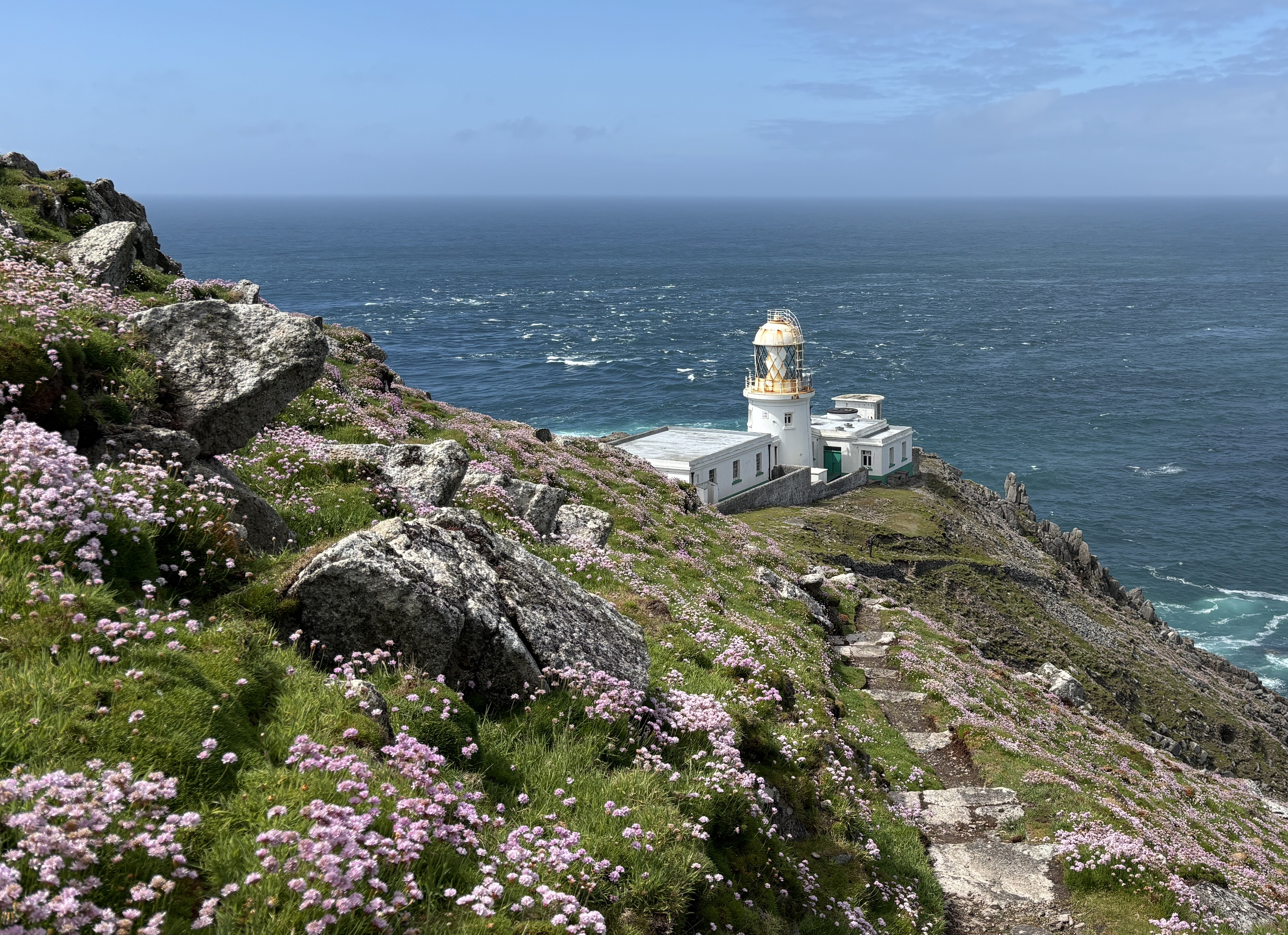
The final act of the day was a cutthroat game of Snakes and Ladders with my parents in the Tavern before doing battle with a game of Wingspan against my fellow Lodge mates. Having taught them how to play, it was only right that I came out on top with a respectable haul of 86 points. The others have much to learn...
30/05/2026 – Ringing Day
By Thomas Weston
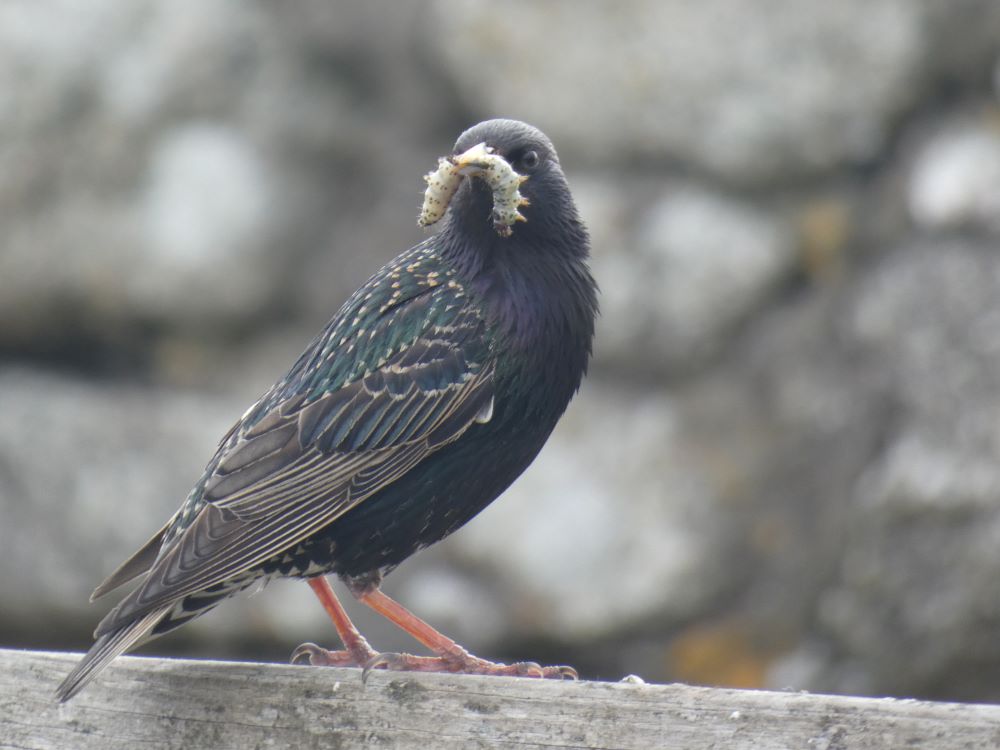 Starling with food in the Village. Thomas Weston
Today started with me awaking just before 5am. I got up and ready and headed on down to Millcombe to open some nets and start some ringing. The first couple of birds seen from the house to the ringing site included one of our Channel Wagtail pair and a Siskin along with the local House Sparrows and Starlings. The weather was sunny and extremely calm, not a breeze or a gust at all and it was looking like another glorious day on the island.
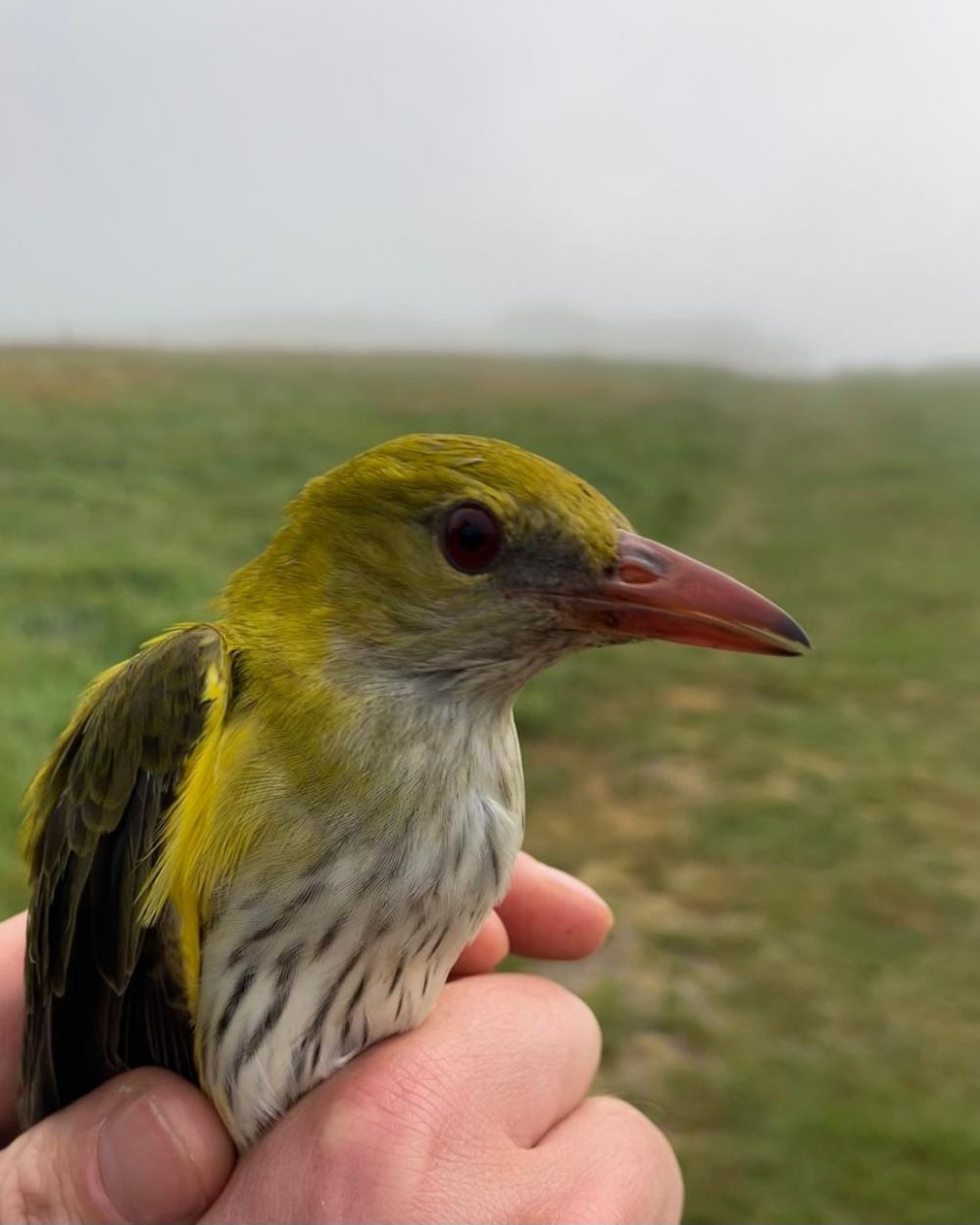 Golden Oriole ringed Millcombe by Thomas Weston
Opening the lower Millcombe nets was the plan as I was on my own. The session was extremely slow to begin. A single new Chiffchaff made up the 1 bird per hour (05:30-06:30), followed by a new(!) female Blackbird keeping up the 1 bird per hour (06:30-07:30). There were flocks of passing Auks, 100+ Manx Shearwaters and a 6 Gannets too. Our male Golden Oriole was singing in the trees but remained stubbornly elusive as they do. There was passing fog too, but nothing on the island yet! This all changed when Maddie came down to the site. We opened a net near the Casbah and went back down to the bottom to extract any birds. Success came in the form of 2 new Chiffchaffs showing breeding evidence, almost certainly a pair, and a retrap Linnet. The fog started to close in now and it was feeling rather eerie and cool. Greg made an arrival, and we checked again. Nothing on this round but we were not going to call it quits yet. Two juvenile Blackbirds were a welcome sign of fledged juveniles, and we could see parents of a lot of the locals collecting food for their young too.
The next net round was very special and memorable, we approached the Casbah net, and we had caught a retrap Blackbird from two years ago, a new Goldfinch and the Golden Oriole! A very big surprise given that none of us had seen it this morning, just heard it. There were a pair of retrap Linnets in the lower Millcombe nets, and we proceeded to process all birds bar the Oriole in the Valley. Only a couple of minutes later we went to ring the bird at the top of the valley so those who were around could see. A small gathering formed, and the Golden Oriole was ringed. A smart 2nd calendar year type male. On release he flew back into Millcombe, where he was seen and heard again up to the time of our departure, 10am. A successful, and good morning, especially for all those retraps we caught today!
Making my way into the Village I undertook some washing of Bird Obs bags, met with a new researcher on the island, Jayden, who is looking into the temperatures of the cliffs where our colony/cliff nesting species are currently holding territory, and helped Lucile with a brood of House Sparrows that needed some assistance. There was one fledged Starling today, though crashing into the Vestry was never the best idea and so we popped it in the closest nest of similar size young, an adopted family.
An evening of chill and relaxing is the plan tonight.
29/05/2026 – Clearwings and a Corncrake
By Greg Lee
Moths again to start the morning and I was joined by Chloe and Emma to take a gander at the goodies. With the colder breeze, it wasn’t as busy as the previous night but there were still some new moths for the year such as Yellow Belle, Shoulder-striped Wainscot and Ruby Tiger. Migrant totals were lower than expected but the westerly breeze may have pushed them further towards the mainland.
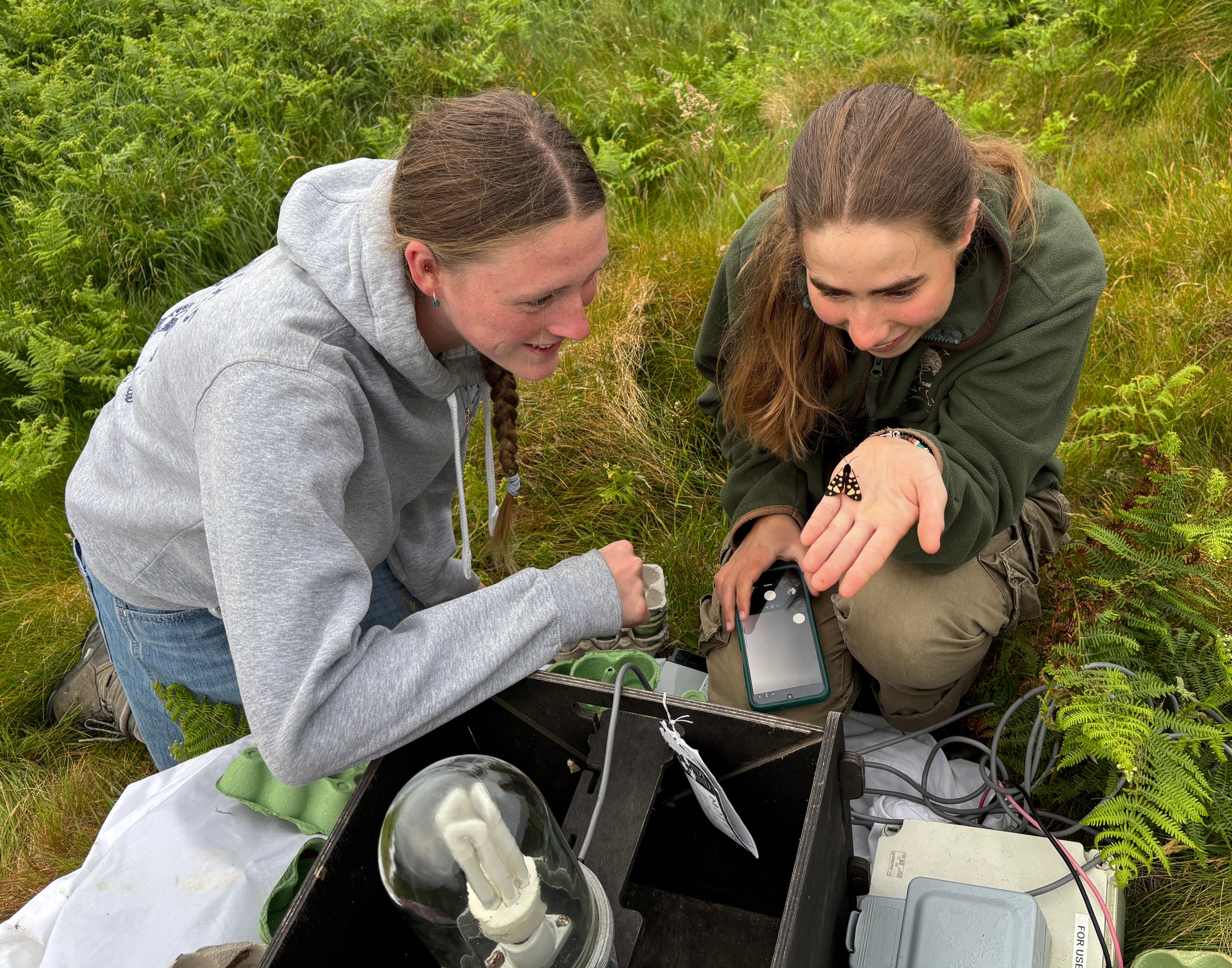 Chloe, Emma and a Cream-spot Tiger
Next, after some needed coffee, it was census, where I reported a low number of arrivals, although two Spotted Flycatchers and a Reed Warbler were in Millcombe. Of course, the Golden Oriole made an appearance, though this time, perched up quite nicely in the big trees allowing for my best photos, despite the number of times I’ve seen these birds this month. Near the Quarries, a pair of Blue-tailed Damselflies were my first for the year. Once finished, it was time to make use of the sun and grabbed our new pheromone lure to head to Pilot’s Quay, where I was joined by Emma. Sitting at the platform of Thrift at Pilot’s Quay, we put the lure down and were immediately set upon by Thrift Clearwings with 10+ surrounding us. Being the smallest UK clearwing species, it was quite amazing to see so many around the place.
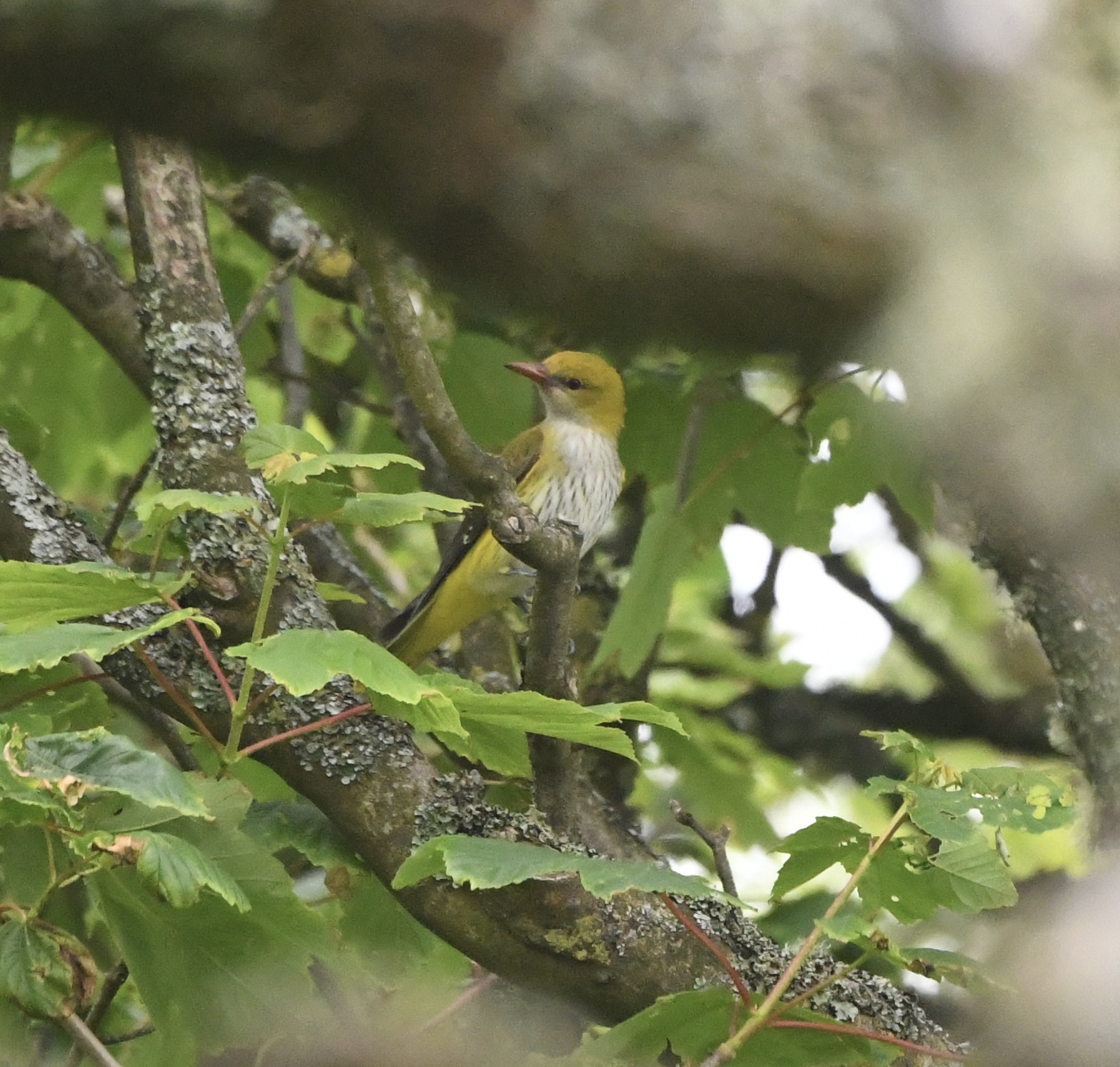 Golden Oriole by Greg Lee
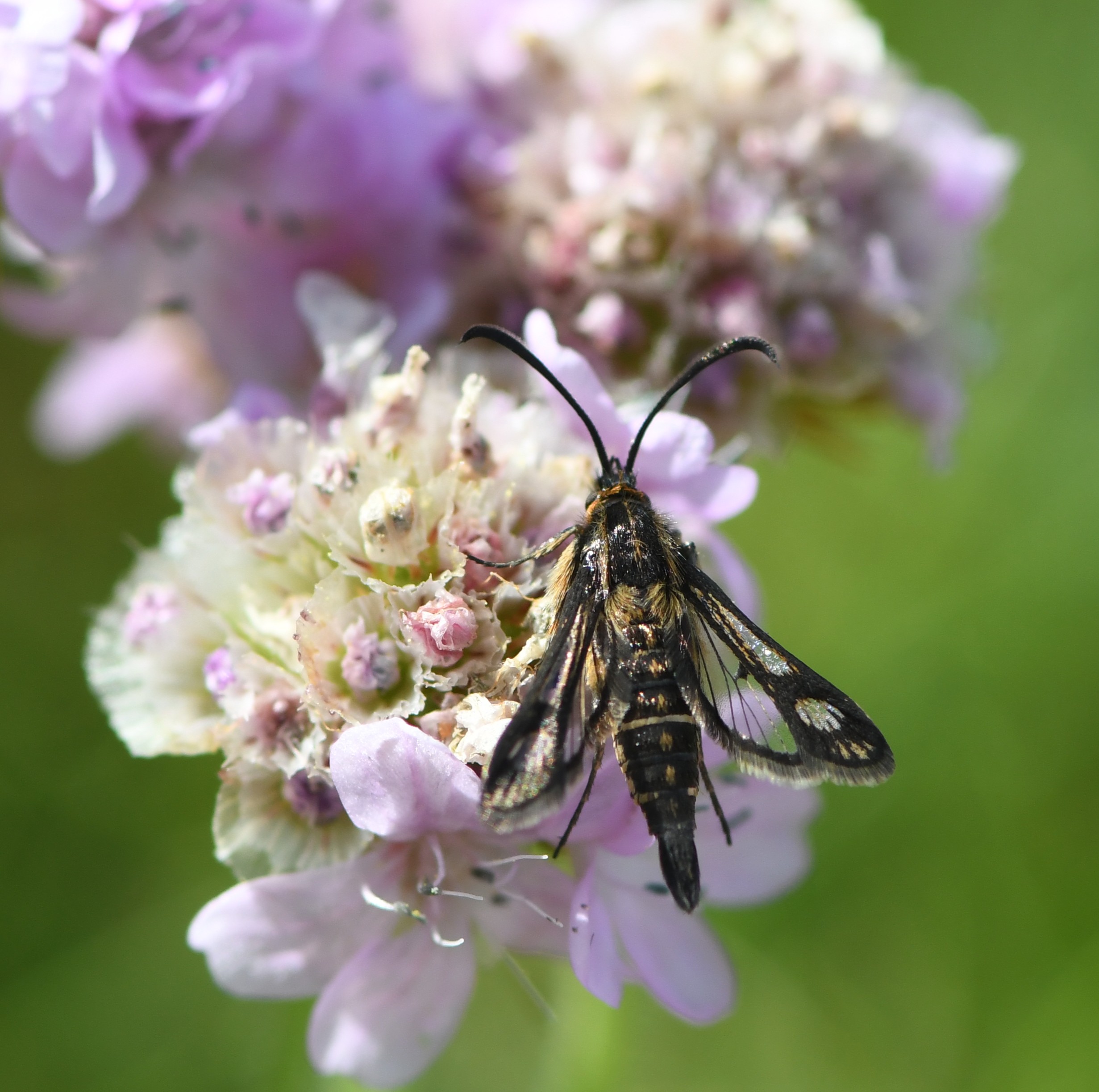 Thrift Clearwing by Greg Lee
Later on, I joined Thomas to check the last brood of Starlings near the Vehicle shed, unfortunately, the cavity was quite deep but mercifully two birds jumped into the hands of Thomas, allowing for them both to be ringed.
The main excitement was to come later in the night though. Early last week, on a late-night walk over Ackland’s Moor, I heard a strange, repetitive noise coming from Quarter Wall direction, but on the wind, I couldn’t tell what distance it was and I didn’t investigate further. However, the LFS also heard this noise too on a different night and took a recording. Initially, we thought it may be a Water Rail or even a Moorhen, but something didn’t quite add up. So, last night, Thomas had a listen and expressed his belief that it was certainly not a Water Rail. Then, the penny dropped, the sound appeared to match the call of a female Corncrake! So, I went out to listen with my shotgun microphone in hand. Within just walking up the track on the still night, I could hear the sound blasting way further ahead, a consistent and distinctive noise. It immediately was obvious, it was very crake-like, with the sound continuous for the whole duration of the stakeout. Taking some recordings, I then headed closer to Quarter Wall, with Brick Field having a fantastic area of juncus and lush vegetation, the perfect amount for a Crake. Fortunately, I brought my thermal imager too, which would prove to be useful. Once activated, I had a look at the field, eventually walking the wall. I then picked out a small thermal spike in the vegetation which obviously was the head of the Crake, where it was stood calling proudly from its spot and rotating its head to project its call. Once having collected sufficient recordings, I headed back to the Village. This is the first live record of a Corncrake on Lundy since 2004, with remains of two dead birds being found in the autumns of 2006 and 2011.
28/05/2026 – Bird and MPs Day
By Thomas Weston
Today was my first of two designated ‘bird’ days for the week. A time when I can undertake bird related activities to enhance and promote the Bird Observatory and keep it going for more to enjoy!
I started the morning getting ready for a ringing session in Millcombe. The cool breeze flooded the house, and it felt a little cold to start, a shock to the system some may say after the last few days of sweltering heat! The first bird of the day was one of our Channel Wagtails heard flying over the house heading off to feed first thing. A nice start before I made a gradual wander down to a slightly breezy Millcombe and opened a couple of nets. I passed a nest-building Chiffchaff and heard its partner singing very close by. Getting closer to the nets and a brood of Dunnocks could be heard in the bushes. Whilst opening Slope Net, a bird flushed from the bushes and landed on a small tree nearby. To my surprise it was a Siskin! A bird I was certainly not expecting for the end of May. This was then followed by a sighting of a Redpoll heading overhead with a small flock of Goldfinches and both nets for the morning were opened. The session was quality not quantity but good birds were around. I caught a retrap 2025 juvenile Willow Warbler with a brood patch, a retrap male Dunnock from 2021, a retrap female Linnet showing breeding evidence, a retrap 2yr old Blackbird who must almost have fledged young by now, and extraordinarily a new Robin. There was a lot of activity on the Red Valerian with Painted Ladies and Red Admirals filling the flowers plus a Hummingbird Hawkmoth and a Silver Y, a sign of new arrivals for sure. Overhead a new-in Cuckoo flew North low over the valley and a pair of Spotted Flycatcher were seen singing and displaying above the Gas Store. I was joined by Maddie, but her luck did not transpire into any more birds unfortunately! But there were lots of Bees around for her and Chloe’s Bee Transect which was positive.
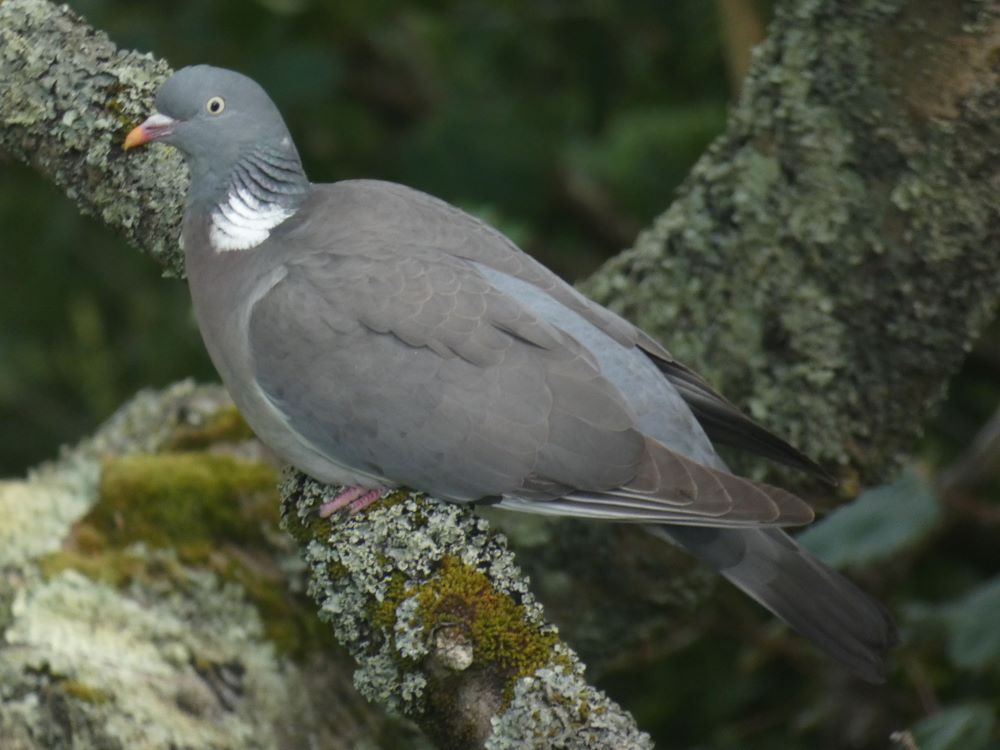 Woodpigeon in Millcombe - one of the locals showing breeding evidence. ThomasWeston
Ringing ceased around 8am so I could begin census. Going to the top of Millcombe, being joined by Eleanor, and beginning census to come back down again yielded a few nice species. Manx Shearwaters were heading south along the east coast and a couple were seen from the Ugly. We spotted a lot of breeding evidence of the ‘locals’, amazingly missed some of the highlights from the morning, but we did see three Blackcap throughout the Valley. Along St John’s there was a Stonechat and a Meadow Pipit singing. Benjamin’s Chair saw Guillemots and Razorbills with the local male Wheatear showing incredibly well. As we wandered over to Rocket Pole a few Linnets were seen. The highlight of census then flew around the gorse bushes and out towards SW Point before being lost to view. It was a Golden Oriole but odd not seeing this 2nd calendar year bird in Millcombe! A new bird? The Lighthouse Fields yielded a few Mallards before Old Light saw another migrant Spotted Flycatcher. For late May the Skylarks were in full voice, and more Linnets were over the Airfield. Pointless Wall Gorse held a singing male Reed Warbler who was another surprise! Quarter Wall Copse was relatively quiet though a singing Willow Warbler was the highlight. Walking back into the Village and the clouds were bubbling and swirling, a front was coming but unfortunately it did not form much rain apart from a few drops. Back in time for tea and to meet the MPs who were joining Simon, Tara and I today.
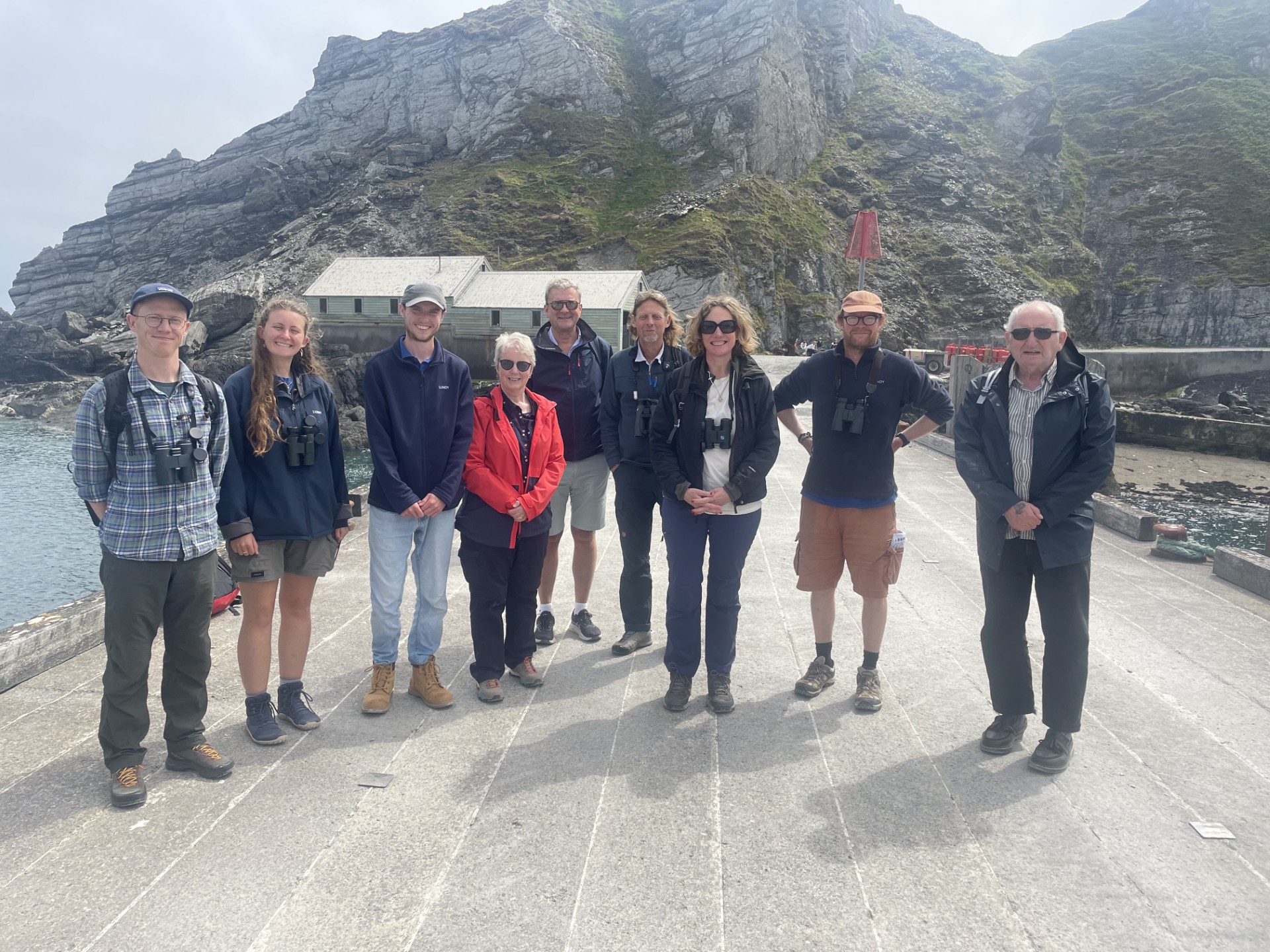 Lundy Conservation Team, RSPB, MPS, and Lords. Photographed unknown
 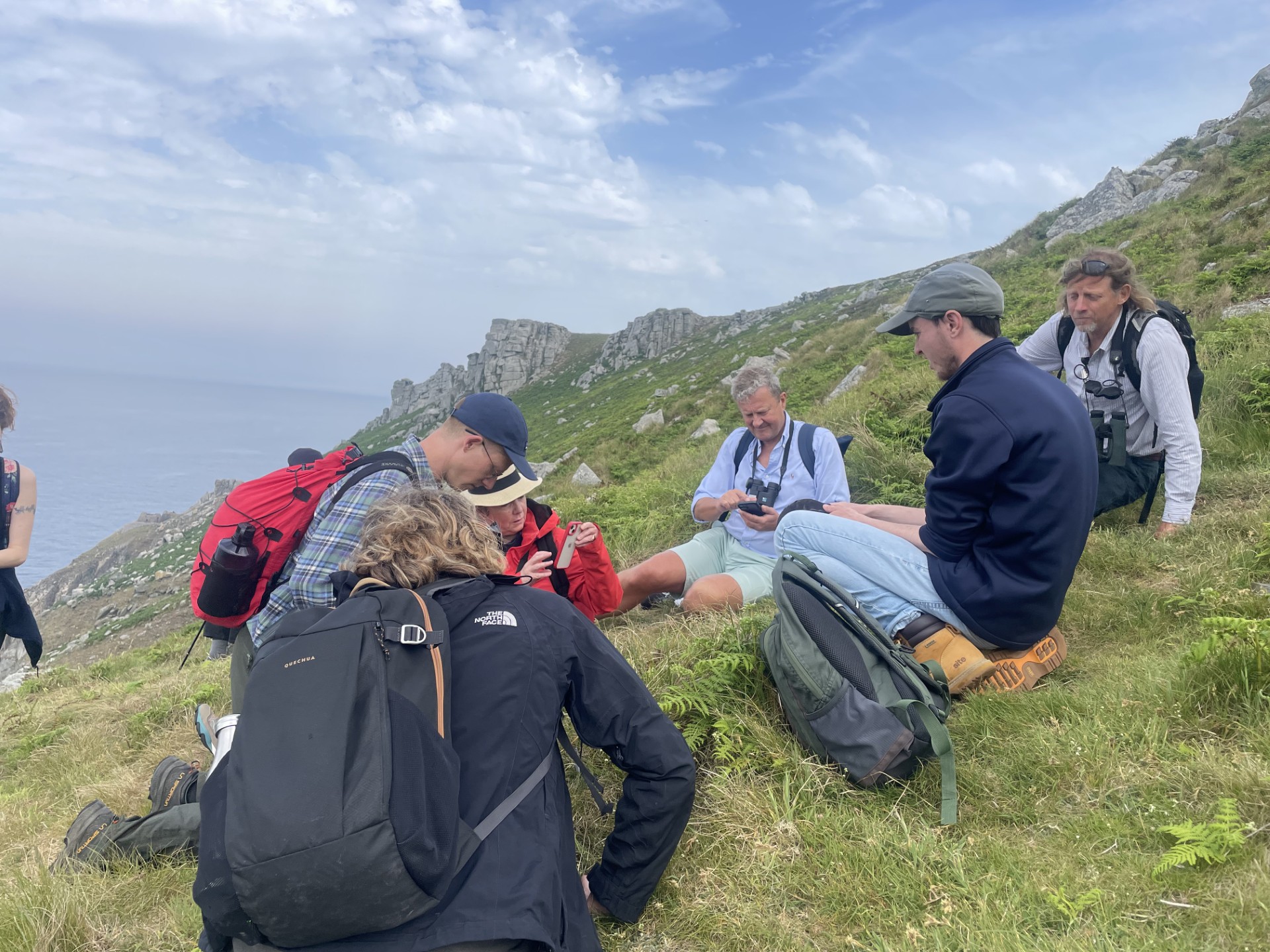 A chat about seabirds. Photo by Tara
The team showed the MPs and Lords the west coast, hoping we could persuade the government officials why a Special Protection Area (SPA) would be amazing for the island. We showed the group Manx Shearwaters, Storm Petrel habitat, 120+ Puffins, 40+ Kittiwakes, 2500+ Guillemots, 500+ Razorbills, passing Gannets, and a few Fulmars too. The trip was successful and hopefully something can be said in parliament regarding further designations to help protect our seabirds on Lundy. We can only hope.
The afternoon quickly turned to the evening; a Turtle Dove was photographed by Matt whilst driving to the boat hinting at either a new bird or a new location of the previous? I think new as it was seen in the morning when the Oriole was seen in an odd spot too! We met up with the other volunteers and I helped with the ringing of a brood of House Sparrows who are being monitored by the Sparrow Team, before meeting up at the daily log where sightings of birds, butterflies, other wildlife was recorded. Everyone had a successful day, and it will be great to see what tomorrow brings…